
4/19/2024

Julia Rocchi writes prose, poetry, prayers, and a lot of thank-you notes. She is the author of AMEN? QUESTIONS FOR A GOD I HOPE EXISTS (Lake Drive Books, 2022). With an MA in Writing from Johns Hopkins University, she has garnered multiple story publications and honors, including First Place in the Saturday Evening Post’s Great American Fiction Contest. Julia also works in nonprofit marketing, facilitates gatherings, and performs improv comedy. As an ENFJ, Enneagram 2, and Cancer sign, she’s never met a personality indicator she disagreed with. Julia lives with her family in Arlington, Virginia. Visit juliarocchi.com to follow her on her blog or on social media.
Sydney Houston is a senior Literature major concentrating in Literary Studies at American University. She also has two minors, in both Dance and African American & African Diaspora Studies. She is a multidisciplinary artist, a writer, a dancer, and an avid fangirl at heart. She is a native of Prince George’s County, Maryland, in which she has immense pride. Sydney also is a published writer in The BlackPrint, American University’s magazine for student writers of color.
Introduction to “Egg White”
By Sydney Houston
The Supreme Court decided on Friday, June 24th, 2022, that a woman does not have a choice in whether or not she carries a fetus to a full-term pregnancy. This decision to overturn the 1973 case Roe v. Wade took away 50 years of protection for reproductive rights across the country. Precise language to articulate your position on a woman’s right to choose to become a mother is key. What does choice look like in family planning? How are we listening to women who want to have children versus women who don’t? Julia Rocchi places her reader in the mind of a hopeful soon-to-be mother in her story “Egg White.” This flash fiction story confronts directly how we talk about the act of reproducing, and the introspection of thought on what it means to create life.
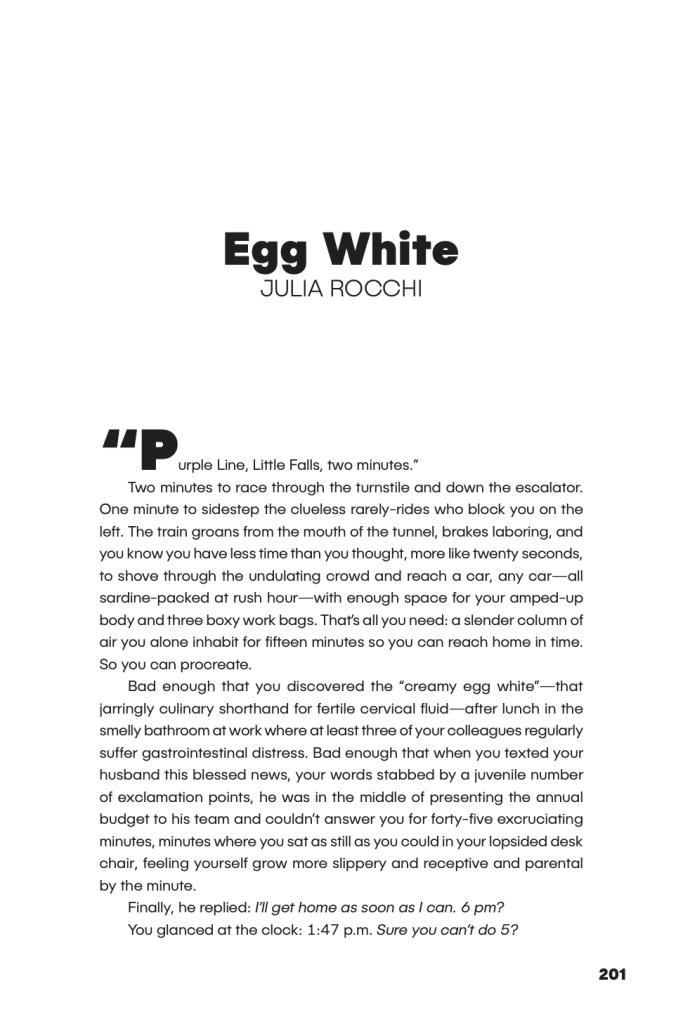
“Egg White” confronts the way that in order to be able to talk about reproduction, medical professionals reduce the terminology to make it palatable for people’s understanding. Rocchi immerses the reader into a perspective that rejects this idea, that we should use culinary terms to describe a positive sign of fertility. Rocchi moves you through the discovery of the creamy egg white, to contacting your husband that he should prioritize getting home on time, to the contemplation of the disdain for the train platform being crowded and the use of an omelet ingredient as a term for a biological process.
Rocchi’s other writing, very similar to “Egg White,” provides insight into how she observes the world and provides commentary on it. Her debut book Amen? Questions for a God I Hope Exists, a collection of essays and prayers, took more than two decades for her to write and publish. Her website also functions as a blog, where she regularly writes reflections inspired by her life. As in her book, she couples her updates with different prayers; I think seeing this evident in her writing practice outside of her published work relates to the way she infuses her belief in hope in her writing. Her own personal statement about her writing is that she writes “poetry, prose, and prayers.”
What is poignant about “Egg White” is not only Rocchi’s use of the second person point-of-view to cement the reader’s position but also how she constructs the tone of the internal monologue. The sense of frustration begins with the knowledge that you are going to miss the train that just arrived and evolves into aggravation at the reduction of your circumstance to a catchy hashtag. Rocchi places the reader in multiple scenarios in just two pages. The brevity of the piece does not detract from the gravity of her words. The choice to also make this story not a full-length short story, but only using two pages means that every word and sentence was carefully crafted to keep the reader in the experience.
Using the second-person point-of-view is a formal choice that invokes a sense of connection to the subject. As a college student, at the age of 22, I have not once thought about what it would mean to be actively trying to conceive a child. My own decision to have children in the future is very murky. Whether you are capable of carrying a child or not, Rocchi connects you to the experience of being someone who can and is actively seeking out motherhood. The usage of you and your pronouns also makes this an interesting gender experience. Rocchi is adept when she chooses this form to submerse the reader into the emotion of the piece.
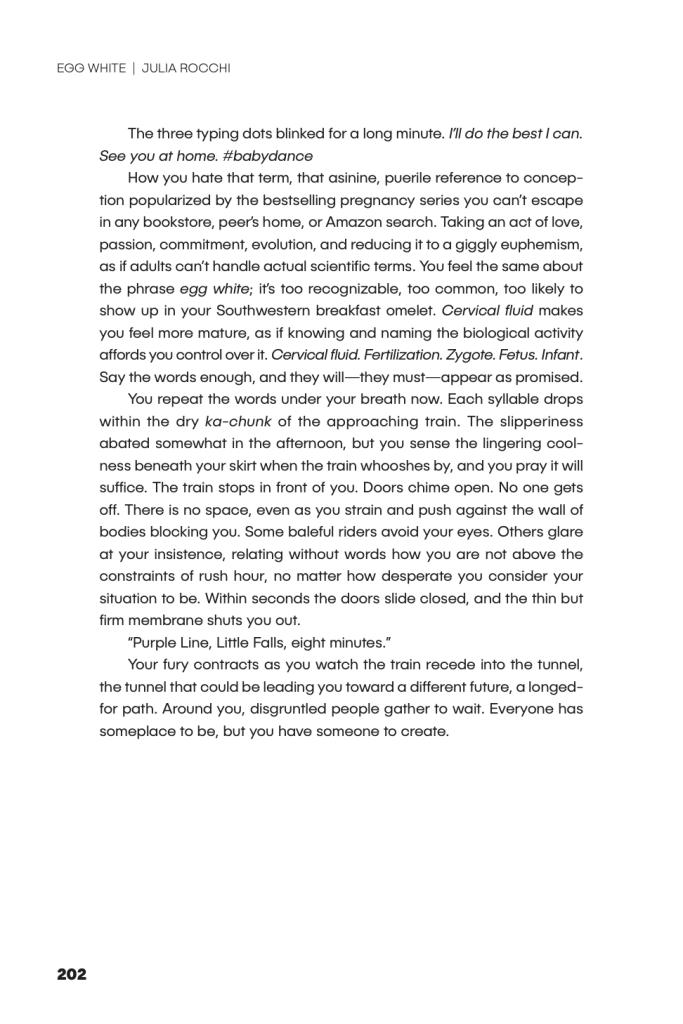
Rocchi’s tone is acidic with the way she writes the reader’s feelings about the term #babydance: “How you hate that term, that asinine, puerile reference.” Puerile is a synonym for childish but its effect is much more potent. So often we see women’s health and especially reproductive health boiled down into simpler, more digestible terms. When asked, the average man can’t even correctly label a woman’s reproductive system with a chart. In a political climate where women’s bodies are being legislated, it’s imperative we actually can name and understand what is being said and done to women’s bodies. For the story, to center on a woman who desperately is attempting to conceive a child being able to correctly separate a term like egg white from cervical fluid would change her own perception, “as if knowing and naming the biological activity affords you control over it. Cervical fluid. Fertilization. Zygote. Fetus. Infant. Say the words enough, and they will—they must—appear as promised.” Our bodies are semi-autonomous; they function on their own, with necessary help from us choosing to eat and exercise to aid the day-to-day processes. Rocchi suffuses a hope within the reader at this moment; the hope that there can be a way to efficiently control a process that happens all on its own.
Rocchi oscillates between mature adult rationality and a juvenile, naive hope for the future. While the tone of the piece is overarchingly aggrieved, the ending offers hope. The reason you are rushing home even if you have to wait another 8 minutes for the next train is more important than your frustration because “everyone has someplace to be, but you have someone to create.” To have this understanding that children don’t just appear in the world or are given to mommy and daddy by the stork—that they are created and nurtured by mothers who take on that responsibility—shouldn’t be revolutionary.
 GRACE AND GRAVITY