
4/12/2023

Jessica Rapisarda is a poet and Pushcart Prize-nominated essayist. She has been published in River Teeth, phoebe, jubilat, The Potomac Review, HuffPost, The Good Men Project, and more. She teaches writing and literature at Northern Virginia Community College. Before succumbing to the siren song of the classroom, Jessica worked as a strategic communications analyst for the Intelligence Community, a freelance parenting writer, and as an editor for the National Academy of Sciences. A native of Baltimore, Maryland, Jessica now resides with her husband and son in Alexandria, Virginia. Follow her at jessicarapisarda.com.
Melanie Hrbek is a fiction writer and current MFA candidate at American University. She grew up in Cleveland, Ohio but has since relocated to the East Coast in pursuit of becoming a full-time whimsical creative type. She likes to write about dysfunction, decay, womanhood, and emotion (riveting stuff, really). When she’s not writing, she likes to spend her time baking cookies, going on long pensive walks, and keeping a basil plant alive at all costs.
Introduction to “Grief for Girls”
By Melanie Hrbek
Jessica Rapisarda’s frank and beautifully constructed essay “Grief for Girls” offers quiet comfort to its reader. It tells us: Pain is allowed to be felt. Suppression only delays what is inevitable. You are not wrong for feeling what you feel. In exploring various manifestations of pain and grieving over several stages of life, Rapisarda implicitly speaks on the gendered meanings of these experiences, as well as unpacking the specific sort of endurance demanded of women and girls in times of woe. Originally published in Furious Gravity, “Grief for Girls” remains apt reading for anyone in need of affirming insights in a world that continues to overlook the realities of women’s suffering — within the personal, the public, and the medical spheres.
Rapisarda is a poet and essayist who has been active in the DC writing scene for over a decade. Across her body of nonfiction work, Rapisarda has written prominently about parenting, disability, and loss — three themes which coalesce in “Grief for Girls.” Rapisarda’s 2021 Pushcart-nominated work “Another Word for Gone” is similarly interested in unpacking these themes — although in that essay, chronic pain takes center stage while motherhood and loss linger in the air: still present, but more as context than subject matter. “Grief for Girls” carefully unpacks each of these experiences in detail, with grief itself acting as a frame. Also in conversation with these themes are Rapisarda’s essays “How the Open Road Heals Me” (Elephant Journal) and “Depending on Painkillers” (originally in The Establishment, now on Medium), as well as her poem “The Point About My Mother” (Northern Virginia Review). There is a rich intertextuality in Rapisarda’s work, with individual pieces offering specialized elaborations on the experiences of grieving, mothering, dealing with pain, or simply existing.
“Grief for Girls” begins with a meditation on losing one’s mother at a young age, then goes on to discuss a long-term struggle with chronic migraines, and concludes on a short, compelling snapshot concerning the experience of raising a young boy. Rapisarda lays out carefully-chosen details, interspersed with sharp moments of reflection, to deliver subtly-worded yet profound insights. She captures the quiet particularities of girlhood, of womanhood, and of all the vexing expectations in between. The essay immediately pulls its reader in with lucid specificity, opening on a scene of little girls in July 1984, playing pretend with “pink plastic teacups” under an “antiseptic blue sky” . Off the bat, we know where and when we are, in a vivid landscape of childhood innocence. And yet, there lies a sense of complexity under the neon surface. The theme of grief is first introduced to us in the middle of the opening paragraph, where Rapisarda writes: “We imagine we’re orphans and that we’ve been adopted by Daddy Warbucks.” In this Annie allusion, orphanhood is merely a fictional context, an archetypal device in the intricate business of childhood whimsy. But just a few sentences later, grief becomes an unavoidable reality when the speaker learns that her mother has died. This moment of emotional juxtaposition subtly underscores the sharp impact of this loss on a young girl, and begins to convey the difficult negotiation of emotional reality that will take place throughout the essay, as the girl grows into a woman and deals with grief and suffering in their various forms.
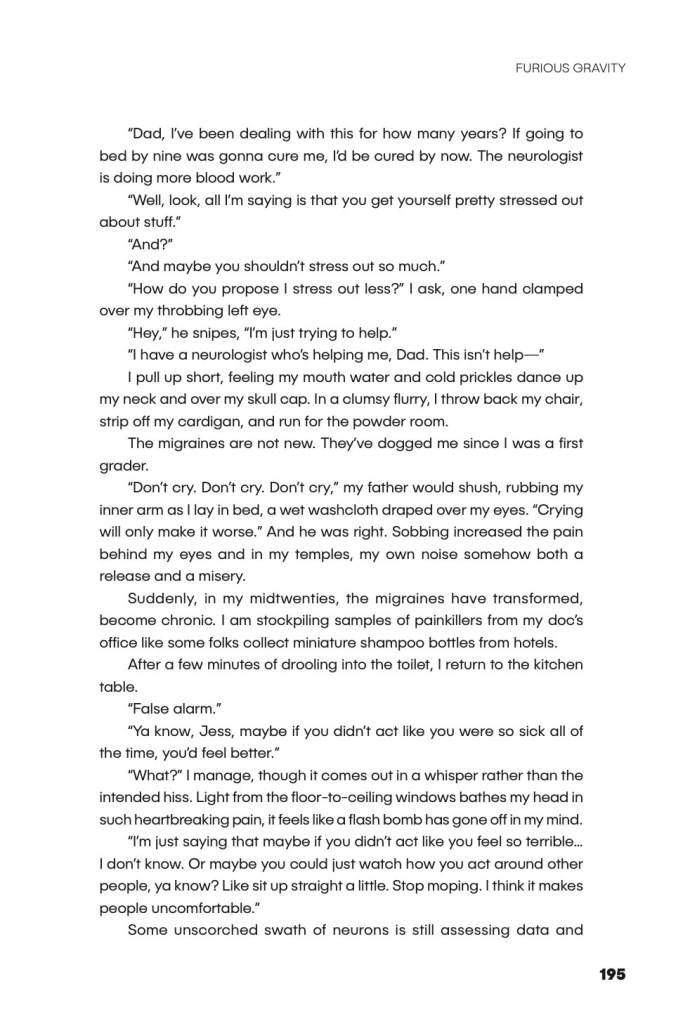
Migraines appear throughout the essay as another manifestation of pain, supplementing grief and figurative growing pains. In one scene, the speaker argues with her father about the source of her chronic migraines. To her indignation, he advises in dialogue: “Maybe you shouldn’t stress out so much” and “Stop moping. I think it makes people uncomfortable.” Immediately after this scene, the narrative voice shifts into reflection on an ex-fiancé, who, as a medical student, decided that her migraines were psychosomatic — that is, by definition, “caused by mental or emotional disturbance” (https://www.merriam-webster.com/dictionary/psychosomatic). Here, another theme arises, one of women’s pain being dismissed and chalked up to a mismanagement of emotions. The underlying suggestion seems to be: Maybe if you weren’t so crazy, your pain would go away.
Rapisarda challenges these assumptions with an aggrieved yet persistent voice of reflection. She remarks: “It was not enough. It was not enough. It was not enough: The tears I did not cry. The questions I did not ask.” It is a maddening thing to know that you have been disguising the worst of your pain from the world, and still, you are perceived as overreacting. Our best efforts at suppression often earn us no respect in the process. As a sufferer of at-times debilitating chronic pain myself, I know all too well how difficult it is to navigate these dynamics. We are challenged to remain functional and personable at all times, while simultaneously maintaining a burden of proof for our struggles. I’ve been told versions of “Just stop being stressed, and it will go away” and “If you’re in pain, it’s your own fault for failing to do x, y, and z preventative measures, which may or may not be marginally effective.” Living with chronic pain, you almost inevitably receive the message (whether implicitly or explicitly) that your condition is an inconvenience to others, and that this is somehow your fault. Rapisarda captures this experience viscerally, while affirming the ultimately unavoidable and cyclical nature of pain itself, both physical and otherwise.
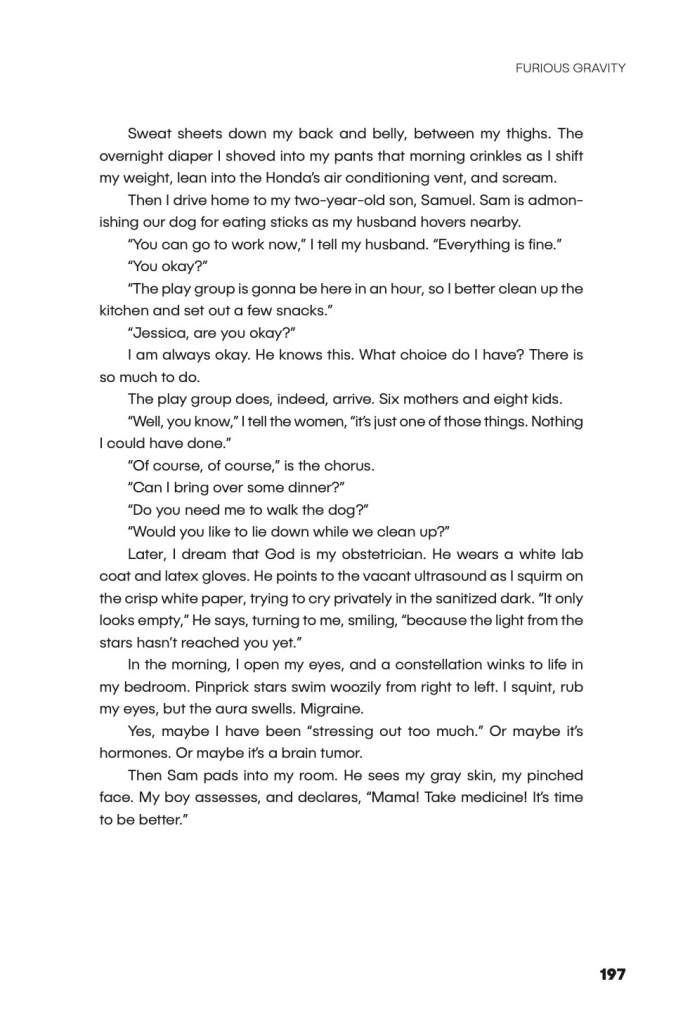
The bridge between physical and emotional pain is another focus of “Grief for Girls.” On the final page, Rapisarda writes: “I am always okay. He knows this. What choice do I have? There is so much to do,” reflecting on the aftermath of a pregnancy loss. The sense that “there is so much to do” supersedes any emotion the speaker might feel. Tending to emotions becomes a chore, a chore which falls near the bottom of the to-do list. And as several insights throughout the essay suggest, this self-imposed obligation to power on through suffering in the interest of attending to others’ needs or preventing some kind of unbecoming outpour has a decidedly gendered component. An aunt buys funeral dresses for the daughters of the deceased, and “the gears of the family machine turn” (192). An eight-year-old girl turns down the opportunity to discuss her mother’s death, fearing that the conversation will overwhelm, and her father sighs with relief. Life goes on and the emotion lingers, still untended.
Nonetheless, “Grief for Girls” does not convey a message of hopelessness. Quite the opposite — it is a story of persisting. And it’s not the aimless, rose-colored sort of persistence story where everything ends up perfectly fine in the end, but rather a commentary on the kind of conscious persistence it takes to get through real suffering without caving under its weight. This essay brims with the knowledge that grief and pain do not prevent or cancel out experiences of joy. The truth is, many people will misunderstand and dismiss your pain, but not all. There are those who will offer to bring over dinner, to walk the dog, to clean up the house while you lie down and attend to yourself. There is still love to be given and had after something once-loved is lost.



 GRACE AND GRAVITY