
4/13/2023
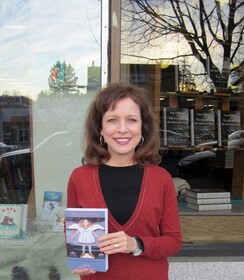
Teresa Burns Murphy is the author of a novel, The Secret to Flying (TigerEye Publications). Her writing has been published in several literary journals, including Chicago Quarterly Review, Evening Street Review, Gargoyle Magazine, Literary Mama, The Literary Nest, The Opiate, The Penmen Review, Rkvry Quarterly Literary Journal, Slippery Elm Literary Journal, and Stirring: A Literary Collection. She holds a doctorate in education from the University of Memphis and a Master of Fine Arts degree from George Mason University. She has worked as a high school English teacher, the director of an Upward Bound Program, and a college professor. Originally from Arkansas, she currently lives in Virginia. To learn more about Teresa Burns Murphy’s work, visit her website.
Alex Greenhill is a writer who attends American University. He has completed National Novel Writing Month for 2016 and aspires to have his work published one day. His favorite genres to write and read are science fiction, fantasy, and horror. The majority of his fiction work has a dry and somewhat dark sense of humor. @Typingoctopus on Twitter
Introduction to “Halloween Gift”
By Alex Greenhill
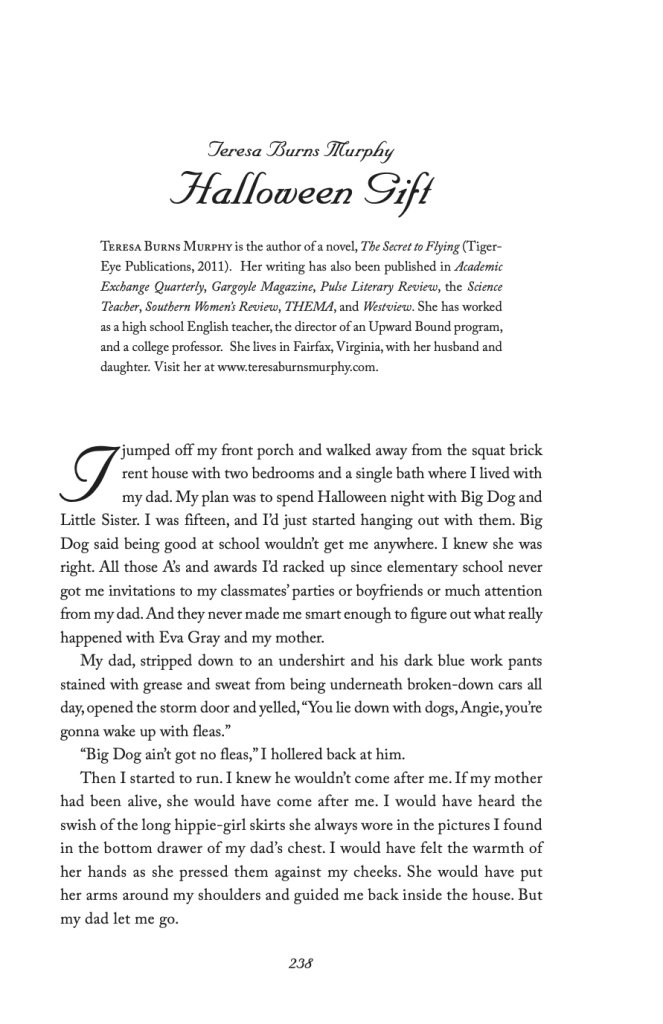
America has a long history when it comes to tales told on Halloween night. Urban legends are set in Anytown, USA and told by the light of a campfire. “Halloween Gift” begins like such a story. It is the story of a girl who witnesses an accidental murder on Halloween night. With the aid of an unlikely ally, the murder is covered up. We are first introduced to Angie, the fifteen-year-old protagonist growing up in a town in Arkansas, the author’s home state. The tale also recalls the tradition of old campfire stories. This quality of storytelling is one of the reasons I enjoyed reading “Halloween Gift.” While not strictly a scary story, “Halloween Gift” does not shy away from the macabre, as the reader will see.
The story begins as Angie sets out to meet up with her two friends, Big Dog and Little Sister, on Halloween night. As Angie passes a particular house in the neighborhood, the central mystery comes into play when she first encounters the elusive Eva Gray, a neighborhood woman subject to many rumors that may or may not have something to do with Angie’s dead mother’s past. She almost has a sort of Boo-Radleyesque reputation. The situation is subject to much speculation but was never made entirely clear, which makes Eva Gray’s actions in the story all the more fascinating. It makes the reader question why Eva Gray would help Angie. Does it have something to do with her involvement with Angie’s mother? The story asks more questions than it answers, to be sure.
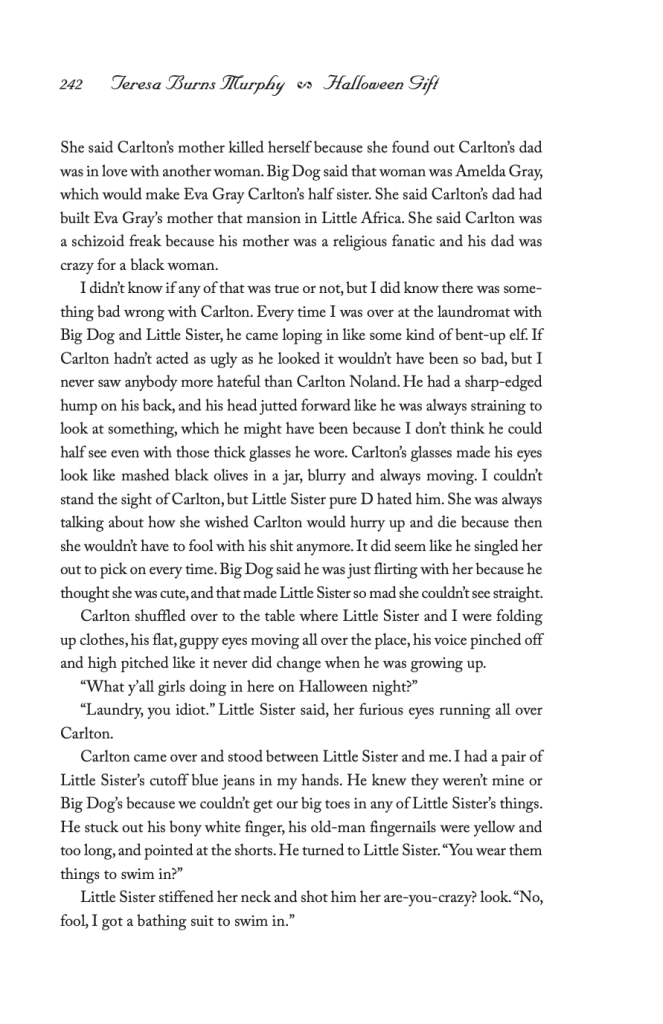
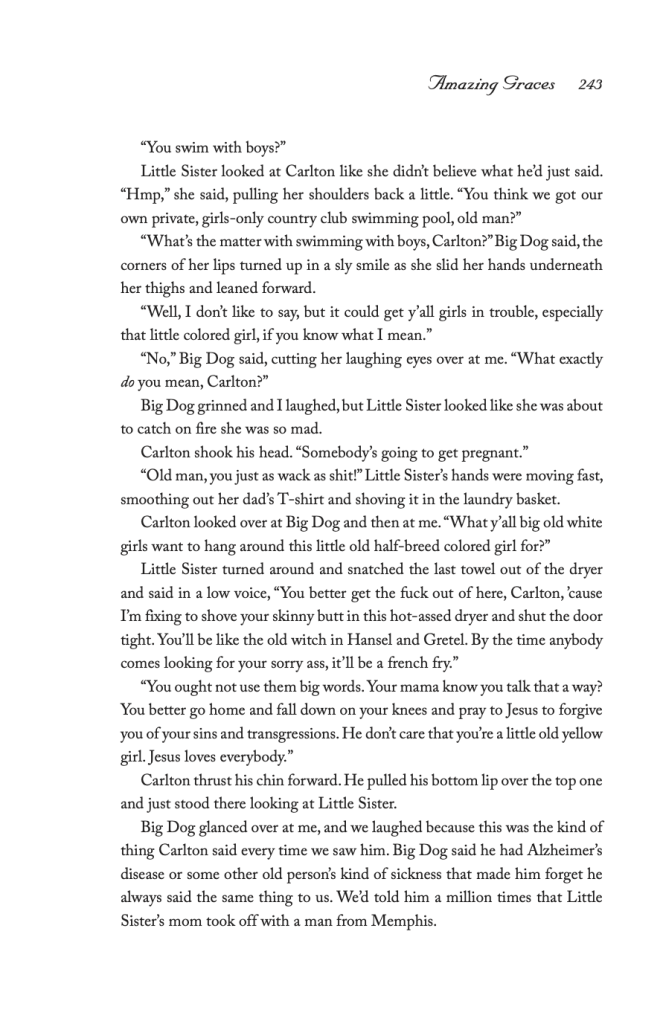
The story is written in the Southern Gothic tradition, a genre defined as dark stories set in the American South with Gothic elements. The intentionality of this stylistic pull is confirmed by the author’s interview with Pamme Boutselis, and she states that Flannery O’Connor and William Faulkner, two authors famous for their Southern Gothic writing, are among the authors who have inspired her most. I’m familiar with both Faulkner and O’Connor’s stories and could recognize their tropes. One prominent element taken from the Southern Gothic tradition is its grounded setting. Aside from the atmosphere and characters like Carlton Noland, an old, hunchbacked religious zealot who serves as the story’s antagonist, there is nothing supernatural about the setting. Little Sister, one of Angie’s friends, kills Carlton Noland in self-defense when he attacks her. Without even thinking, Angie runs to ask Eva Gray for help. The story had me asking many aforementioned questions; Burns Murphy was careful which to answer and which to leave ambiguous. The ambiguity she fomented helped immerse me in the story and kept me invested. The reader never finds out what happened to Angie’s mother, and neither does Angie. There are hints and clues throughout for readers to draw their conclusions.
What is best noted about the story is Burns Murphy’s use of language. The story’s prose is equal parts natural and poetic with lines like: “As I crossed the street, the setting sun exploded into waves of purple, orange, and pink.” She uses brief but vivid descriptions like this to pace the story and keep it moving. In the story’s third act, she even uses prose to briefly illustrate Angela’s guilt after witnessing Carlton’s death: “A little boy with a humped back was hobbling alongside her.” It’s implied, but not stated, that for a brief moment, she thinks it’s Carlton going by the description of the child having a humped back like Carlton. The child turns out to be just trick-or-treater. A narrative speed bump like this keeps the story’s tension going before the final twist. The story explores the idea of innocence in a way that shows that Angie feels like she’s in over her head. Even though she was not responsible for the crime herself, Angie feels like an accessory to the murder. The event of this accidental murder has shaken Angie to her very core. This is probably the main reason she turned to Eva Gray for her help.
Eva Gray’s handiwork is only revealed in the story’s last line. It is a powerful and somewhat gruesome, if fitting, ending. It feels evocatively nostalgic like an urban legend told around a campfire. I can’t imagine a better ending to this story. I enjoyed “Halloween Gift” for its story, style, and spooky atmosphere. Curious about her writing process, I reached out to Teresa concerning the writing of this particular story. She shared: “I wanted to write a story about adolescent girls who have been marginalized.” All the main characters in the short story, including the main antagonists, are outcasts. Big Dog is just as mysterious as Eva Gray because there doesn’t seem to be anyone else like her; she is a true nonconformist. On the other hand, the reader knows from Carlton’s ramblings that Little Sister is shunned because of her race. Apart from Carlton, the marginalization of these characters in this small town is mostly based on the false assumptions of them being “different” from anyone else in town. One wonders why Angie, who is white and not particularly different, apart from her backstory, chooses to be friends with these two outcasts. In fact, Angie is discouraged by her father at the start of the tale not to hang out with her friend Big Dog in the first place that night. It’s never made clear exactly what made Big Dog an outcast. She appears to be ostracized for her cigarette smoking and tom-boy persona. It is implied that Carlton frequently harassed Little Sister. He is by all accounts a despicable character.
The best thing about this story is the mystery. That is what hooks the reader to begin with. There is something tantalizing about the fact that the story is left open-ended. I still wanted to know more about Angie and the mystery of her mother. However, “Halloween Gift” illustrates that there remain some questions that are better left to the imagination.





 GRACE AND GRAVITY