
11/1/2022

Michelle Brafman is the author of Bertrand Court: Stories and the novels Washing the Dead and Swimming with Ghosts (forthcoming in June 2023). Michelle has won numerous awards for her short fiction, including a Special Mention in the Pushcart Prize anthology. Her work has appeared in the Los Angeles Review of Books, Slate, LitHub, The Forward, Tablet, The Nervous Breakdown, and elsewhere. She teaches fiction writing in the Johns Hopkins University MA in Writing Program.
Melanie McCarty is an emerging writer, public media fundraiser and donor communications expert. She is currently pursuing her MFA in fiction at American University. She resides in Riverdale, Maryland with her husband and two cats.
Introduction to “Her Antonia”
By Melanie McCarty
A woman who steals the family silver. A washed-up politico who turns to triathlon training to relive the rush of power. A middle-aged yogi who prepares for the funeral of her first love. These are Michelle Brafman’s characters: grieving, hungry and trying to recover lost pieces of themselves. Her stories ask us to consider: what do we give up by trying to protect ourselves from harm? How do we reclaim parts of ourselves we’ve sacrificed in that process?
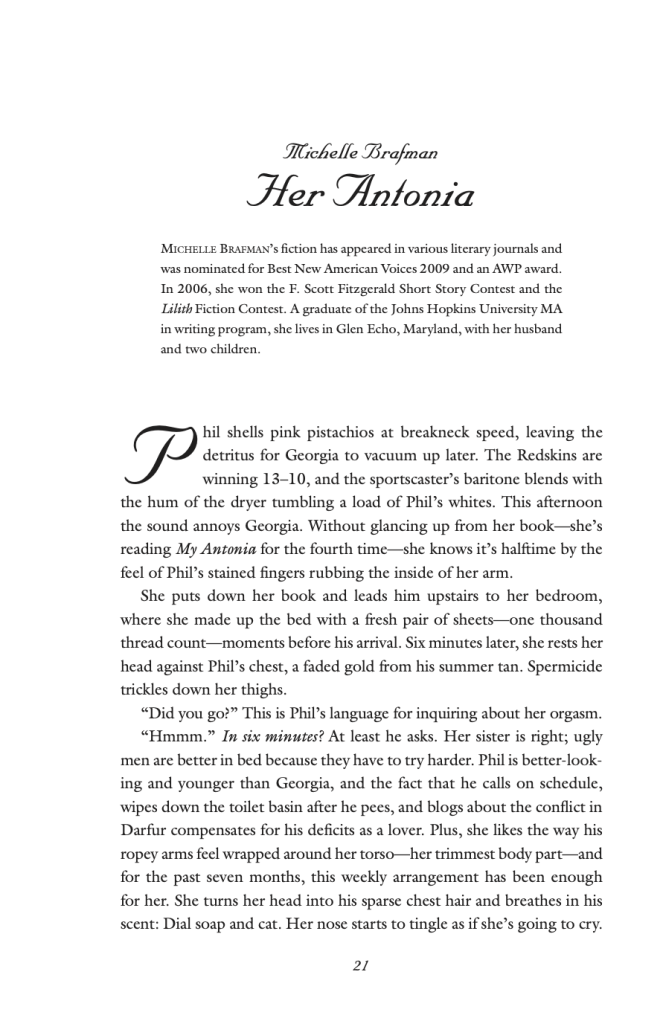
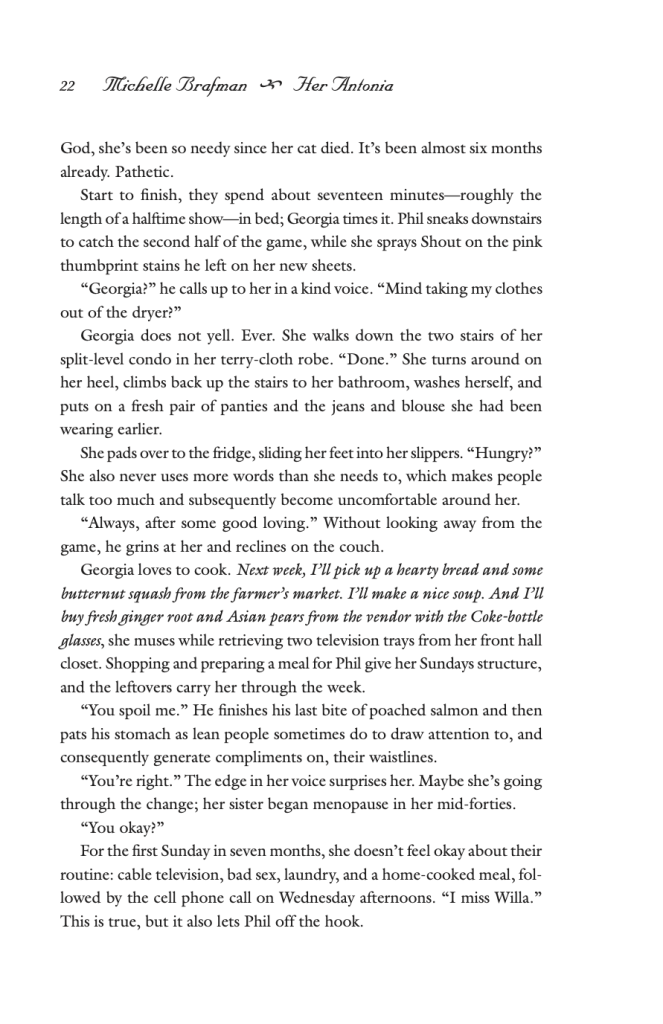
We see these themes in Brafman’s story “Her Antonia.” The story centers upon Georgia Dumfries, a woman who becomes unmoored after giving up her career as a documentary filmmaker for better paying work producing reality television. When the story opens, her life is a joyless routine. We see her rereading the same book for a fourth time. Engaging in pleasureless sex. Working at a job she finds demeaning. She protects herself from further loss by cutting herself off from desire. The story follows Georgia on a journey that leads her to regain a sense of agency and begin to heal.
Once a television producer herself, Michelle Brafman began writing fiction as an outlet to tell stories she was gathering. Since “Her Antonia” appeared in the Electric Grace anthology in 2007, she’s published an array of stories and essays, and completed three book-length works, Washing the Dead, Bertrand Court, and Swimming With Ghosts (forthcoming in June 2023).
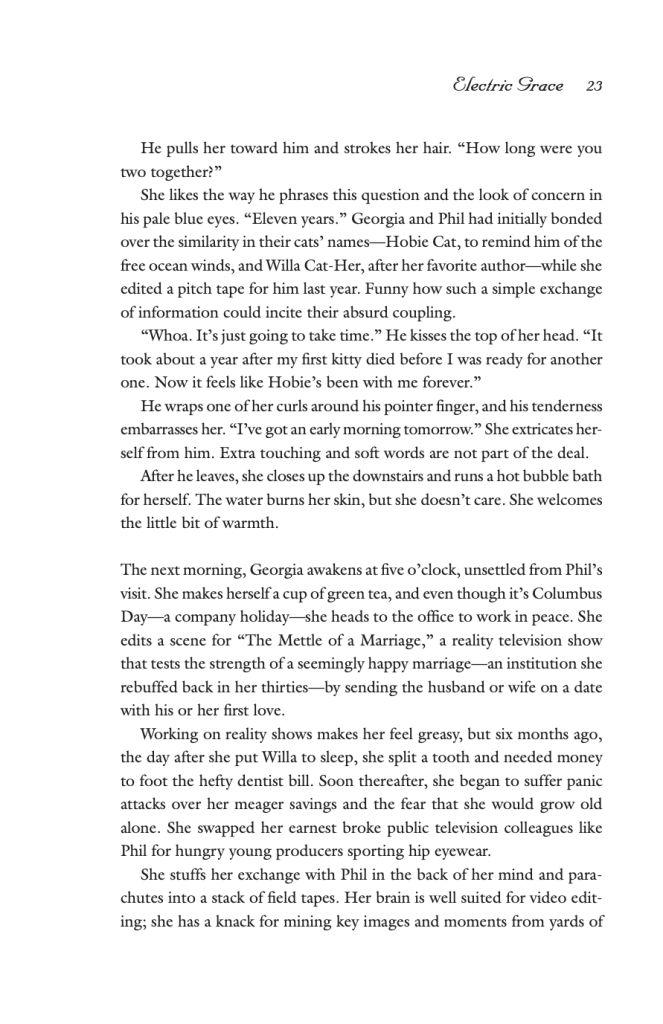
Although it’s been 12 years since “Her Antonia” appeared in Electric Grace, it addresses a topic at the center of our current cultural conversation: burnout. Following the pandemic and the “Great Resignation,” Americans are reexamining their relationship to work. Countless articles and studies speak to the widespread phenomenon, with as many as 3 in 4 Americans saying they are burned out according to Gallup. Notably, Georgia exhibits all three of the condition’s tell-tale symptoms cited by the World Health Organization: exhaustion, cynicism and a lack of efficacy. Through the story, we see her questioning the value of her own work, clocking long hours on the job, and distancing herself from the people around her (“what would be the point” of owning a cell phone Georgia wonders at one point, as she’s lost touch with most people in her life).
We also see evidence of her exhaustion. In the story’s final scene, when faced with a crushing realization about the nature of her relationship with the man she has been seeing, she responds by going to sleep. “God she is tired,” Brafman writes before Georgia closes her eyes for what she thinks will be seconds and awakens forty-five minutes later with a cat licking her face. When viewed in this context, “Her Antonia” can be read as an exploration of the inner life of a person experiencing severe burnout. Georgia’s detachment, weariness and lack of care for herself demonstrate a person who has exhausted her inner resources, going through the motions in a life out of her control.
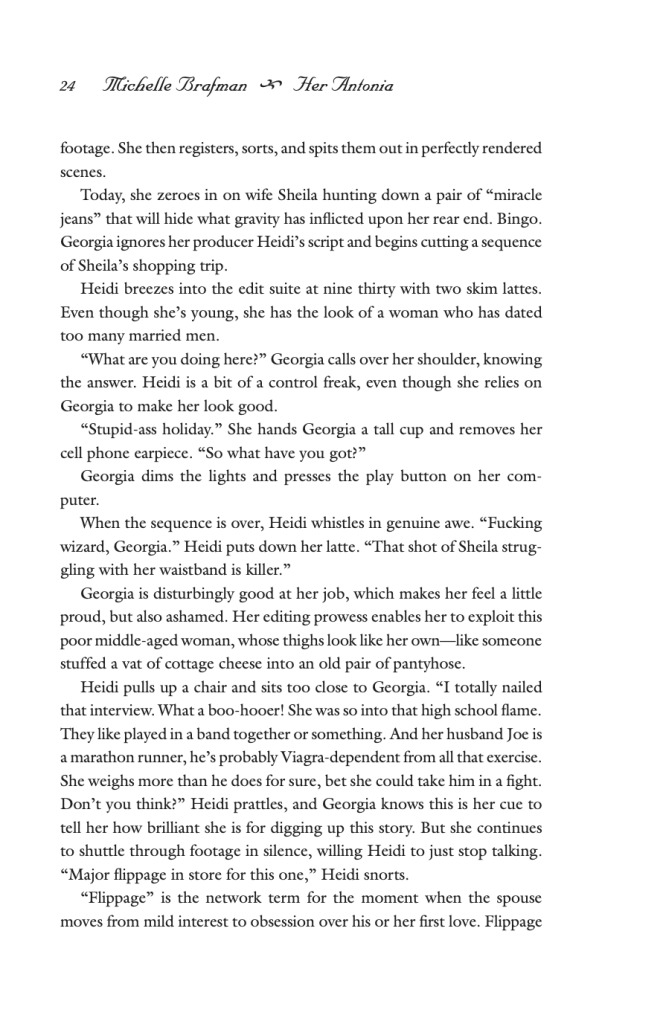
Like many of Brafman’s stories, “My Antonia” is set in the Washington Metro Area. Yet, unlike the heiresses and politicos that populate Brafman’s other stories, Georgia is emblematic of a different type of Washingtonian, the idealistic, low-paid workers who fill in the ranks of the city’s newsrooms and non-profits. Many of these workers initially come to the city as interns, flocking to our country’s center of power for a chance to make a difference. Except this story doesn’t show Georgia as a starry-eyed young person. Rather, it shows Georgia in her forties, coming to terms with the years she spent hustling to make a living as a storyteller, and the sacrifices she made for a career that was deeply meaningful but which left her broke. It’s debt brought on by a dental procedure and the death of a pet forces her to make the difficult decision to leave her position at PBS. In providing this view of Georgia as a filmmaker forced to abandon her calling, the reader is asked to consider the true cost of choosing a life of creativity and public service. Why is this work so undervalued by our society? And how much is too much to give?
We receive added insight into these questions when considering the story in the context of Brafman’s other work. In 2016, Brafman republished “Her Antonia” under the title “Georgia and Phil” in the linked story collection Bertrand Court. Georgia appears in a handful of the book’s other stories, including “Would You Rather,” which is set about a year before the events of “Her Antonia,” while Georgia is still working in documentary film. In the story, we see Georgia’s pattern of placing work ahead of all else, twice leaving her college roommate, Nikki, waiting for her in a bar while she works late. While waiting in one scene, Nikki reflects upon Georgia’s professional success, noting that Georgia is a “big deal” in the documentary world, and that one of her recent films was nominated for an Emmy Award. This scene provides validation of Georgia’s skill as a filmmaker, adding gravity to her decision to leave her field.
However, as the scene continues, Nikki undercuts Georgia’s achievement, reminding herself that the films are “Georgia’s children.” This notion is reinforced in the story “Harvard Man,” when Nikki and her husband Tad discuss Georgia, noting that she “deserves to find a good man, because beneath her reserve she’s warm and kind.” Despite Georgia’s professional success, the fact that she’s a woman means that she’s viewed as lacking because she does not have children or a husband. The question of whether Georgia ever wanted those things does not seem to factor in.
At low moments in “Her Antonia,” Georgia too questions her decision to forgo family life, reflecting upon the prospect that she will “rot alone.” These stories beg the perennial question of whether women can “have it all,” both family and a career. It also asks us to consider that sacrifice for a career does not guarantee its success. What are you left with when you sacrifice for a career that ultimately doesn’t work out? These added pressures almost certainly contribute to Georgia’s burnout.
Another factor in Georgia’s decision-making are her mother and sister. We are told that they are “reckless” about love, centering their lives around the whims of men. This is another reason why the loss of her career has been so destabilizing for Georgia. It was a key marker of her identity, giving her independence and freedom that the other women lack. Losing her career, then, calls into question her decision to live a different life than the one that was expected of her. In this way, “Her Antonia” touches upon a mainstay of Brafman’s work, the complicated relationships between mothers and daughters. Brafman’s first novel, Washing the Dead, tells the story of a woman whose mother abandoned her family, and her long journey back to her religious community, her mother’s love, and the piece of herself she’s unwittingly withheld from her teenage daughter. Brafman’s women have a profound influence upon one another. The complexities of these relationships are fertile ground across Brafman’s body of work.
As “Her Antonia” concludes, a chance encounter leads Georgia to understand the one-sideness of her relationship with a man named Phil. Recognizing this truth, she begins to engage in behaviors that previously seemed impossible. She adopts a cat, which grief had held her back from (notably, the cat she brings home is Phil’s). She leaves pink fingerprints on Phil’s bed, one of several ways she soils his apartment in the ways he soiled hers. For Georgia, and many of Brafman’s characters, recognizing the truth is the first step on a path forward. These small steps show us that Georgia is reclaiming her autonomy and acknowledging that she is deserving of more.
Despite these steps, “Her Antonia” does not have a neat conclusion. Though we see Georgia begin to assert some agency, the story’s closing image is one of her pushing through pain. Brafman writes, “The hard leather of her shoe zests a layer of skin from her heel, but she ignores the warm blood trickling toward the arch of her foot. She just keeps moving.” This conclusion leads the reader to wonder how much easier Georgia’s life is going to become, whether she will continue a life characterized by burnout, pushing herself past the point of exhaustion. Maybe in the story, as in life, there are no easy answers. The best you can hope for is to keep putting one foot in front of the other, reclaiming what you can of the things you’ve lost along the way.
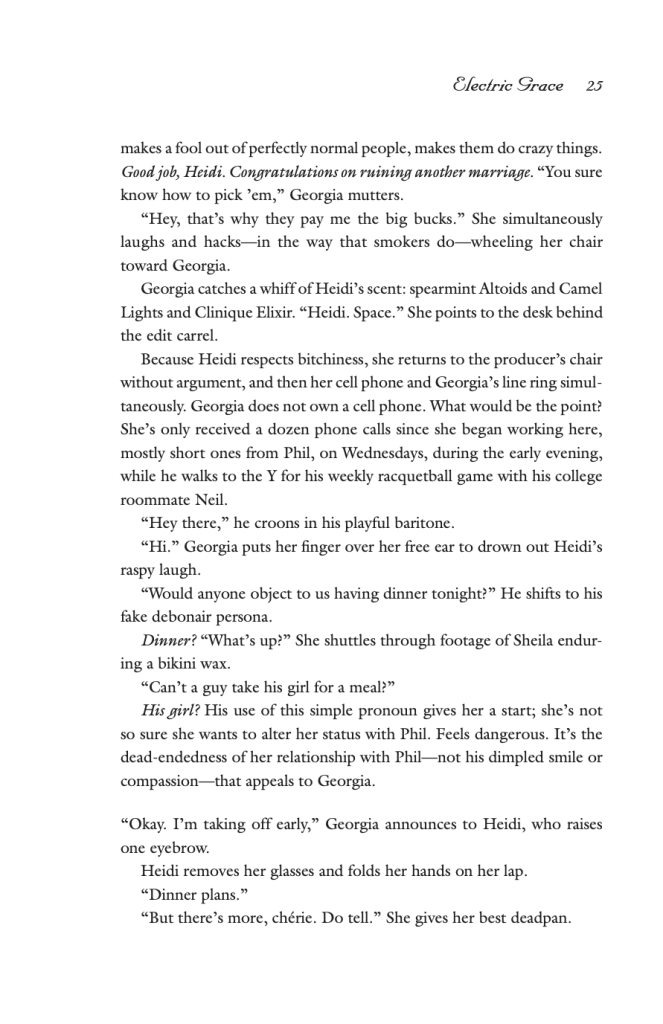
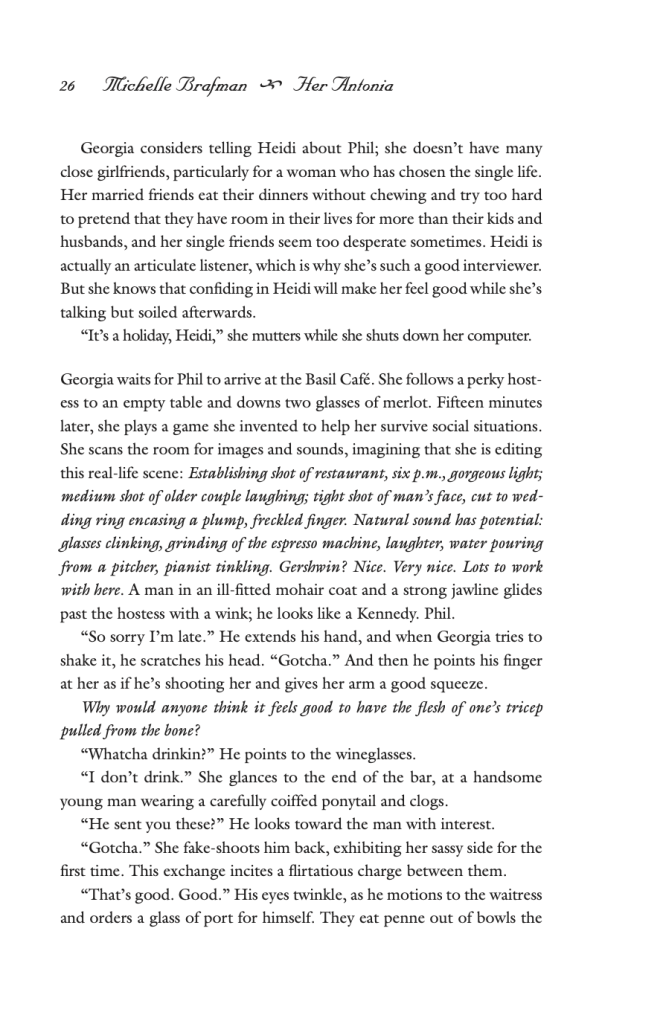
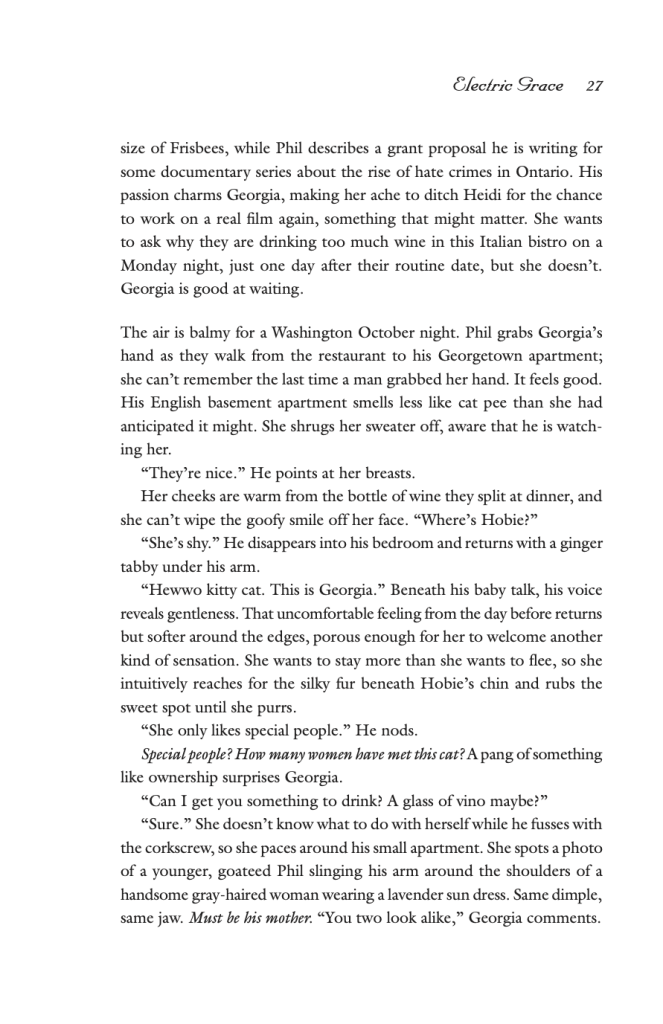
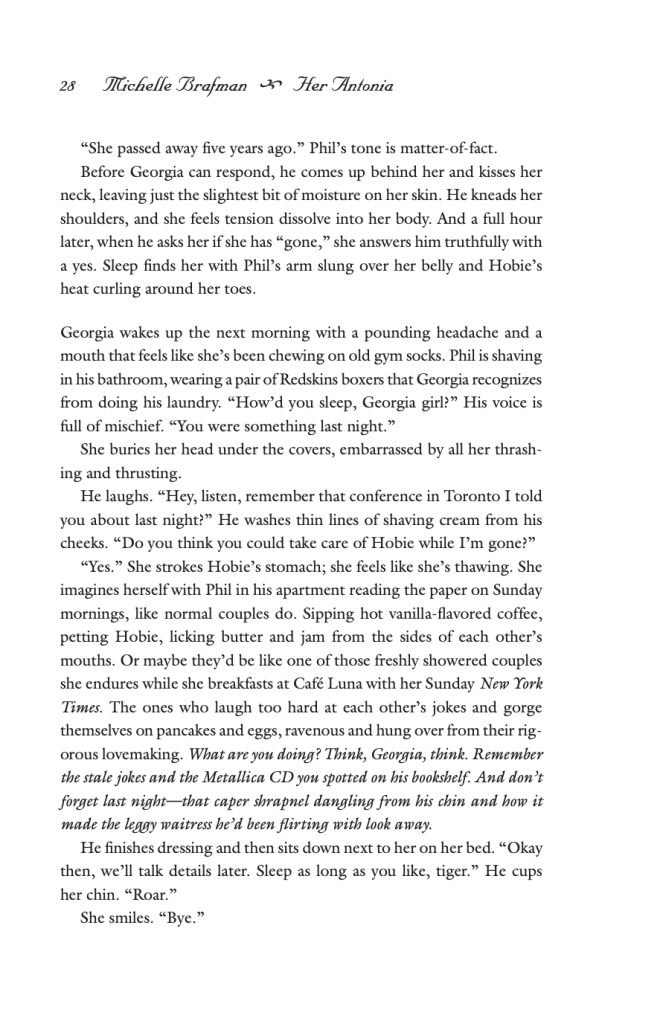
The following is a selection from Electric Grace, pages 21-32.
To learn more about Michelle Brafman’s work, including her upcoming novel, Swimming with Ghosts, visit her website.

 GRACE AND GRAVITY