
11/25/2022

Doreen Baingana is a Ugandan writer based in Entebbe whose short story collection, Tropical Fish, won the Grace Paley Prize for Short Fiction and a Commonwealth Prize. Her stories have been shortlisted for the Caine Prize three times, and her other awards include a Miles Morland Scholarship; a Rockefeller Bellagio Residency; a Sustainable Arts Foundation grant; a Tebere Arts Foundation Playwright’s Residency, and a Gretchen J. Bryant Freedom to Write Distinguished Fellowship.
She has also published two children’s books as well as stories and essays in many journals including Agni, Callaloo, Chelsea, Glimmer Train, The Guardian, UK, Caravan: A Journal of Politics and Culture (India), Chimurenga, Kwani?, Ibua, Evergreen Review, Transition and The Georgia Review. Ms. Baingana has adapted her stories for the stage, which have been performed in Uganda and Germany. Previously a managing editor at Storymoja Africa and chairperson of FEMRITE, she has taught creative writing for two decades.
Oread Frias (they/them) is a genderqueer writer studying literature at American University. Their poetry has appeared in AmLit, as well as the literary journal Just A Phase, published by The Muse Writers Center in Norfolk, VA in collaboration with the Norfolk Academy. Their writing covers contemporary social issues and topics of queer identity. They enjoy drinking tea and taking long walks in the rain, and hope to finish writing their book before they graduate. If you would like to read more of their work, you can reach them through email at df2364a@american.edu.
Introduction to “Holy Shit! or Afterwards”
By Oread Frias
In reading Doreen Baingana’s “Holy Shit! Or Afterwards,” I am left warm, weary, and filled with a kind of satisfaction that I so rarely find outside of the bedroom. I was not raised in Uganda, and I was not born with the gift of a female body, but the questions asked here nonetheless pierce me. Those questions—what role sex plays in comprehending the self, and whether or not sex is really so far from the other natural things in life—are familiar to me. They mirror thoughts I have alone in the dark, when the shape of my being comes into focus, and I can find silence enough for introspection in the space between ragged breaths. This piece is a consideration of vulgarity. It examines how the nature of this world and our place within it is crass, and how the denial of this fact detaches us from reality.
Baingana’s writing so often focuses on physicality. She takes great care in examining the corporeal, even when she isn’t specifically discussing themes of sexuality. Baingana published a short story earlier this year called “Her Gorgeous Body,” in which the main character’s comfort in her body is a vital piece of her sense of physical and emotional belonging. That piece is more recent than “Holy Shit! Or Afterwards” by almost two decades, so I think that this consistent vision of corporeality shows us how important honest portrayals of the physical body are to Baingana. Throughout her work, there is a shared authenticity in her depiction of the body: it is imperfect, ugly, and gorgeous by the very fact of its existence. Her prose is raw. It flows in the most natural of ways, so that as you read about these bodies you become them. This awareness of the physical is a crucial reason why “Holy Shit! Or Afterwards” is such a profound piece of writing; it presents sensuality in a way that connects sex to the most grotesque parts of our human condition, and it emphasizes the lack of true distance between them.
Such a concept would be considered crude to many. In a world obsessed with the appearance of purity and innocence, to draw a line between sex and the other bodily urges is sin. To speak on the influence of sexuality in other parts of our lives, to expand its reach beyond the bedroom, is improper. It’s nasty. It’s bad manners. We present the illusion of proprietary while denying the ways in which our sexual habits are extensions of selfhood. We see sex as a simple indulgence, and turn people into objects so we do not have to think about the ways in which we are violating them. When we abandon sex as a passage to self-discovery, we turn it into an act. An act of power, and punishment, and pain. In choosing to reject vulgarity—and by extension, the honesty inherent in such lustful abandon—we strip away the reality of sex and are left with an ugly kind of innocence. This story shows us that sex can be beautiful not in spite of its grossest aspects, but because of them. Sex can be messy and disgusting and at times foul, but this grotesqueness represents a physical and emotional sincerity that is often absent elsewhere in our lives.
Baingana’s writing style mirrors this idea. She shows us life as it is, presenting a vision of reality where the imperfections that form us reflect the imperfections that form our world. Her prose is a cradle of conception. In it, we are laid to rest, and shown a vision of sexuality beyond propriety. This is nowhere more apparent than in the central image of this piece, in which the speaker is enraptured by the profound action of a cow defecating, seeing in this act the same “brazen badness, rudeness, sliminess of sex.” However, her partner does not see the same beauty in the grotesque as she does, and the speaker in turn no longer sees the partner she thought she knew so intimately. They move away from each other, “like memory does from reality.” Baingana pleads with the reader, begging us to see eros through her eyes. Begging us to take what she has given us—a man, a woman, a cow—and see tragedy in the way that sex brings us together behind closed doors, while dividing us everywhere else. She shows us that we must steal from ourselves a version of sex sans decorum, and sans respectability. We must extend the rapturous joy of sex to the rest of our lives, so we may come to a more intimate understanding of our crass existence.
To Baingana, the beauty of sex is not only in its pleasure, but also in the way its vulnerability reveals our deepest truths. I do not consider myself to be a particularly sexual person, but I will confess to being as vulgar as anyone who ever lived. I am never more honest than I am in the bedroom, and to see that mirrored in this story affirms my desperate need to dissect my urges and follow them to their roots. It has helped me to comprehend how sex inspires me, and how it grounds me. How it peels me open, spreads me out to reveal the seeds of my desire. There is room for introspection in every moment, and sex is no different.
The presence of sex in our lives is a complicated one. I won’t pretend to be the authority on how we should treat it, but when it comes defining my own experience with sexuality and determining what worth pleasure holds in the broader scope of my wellbeing, I know that I will cherish the insights that Baingana’s work has given me. If you like sex, or at the very least value its presence in your life as a tool for interpersonal connection, or if even you simply enjoy short, weird, and shocking works of art, then you will like this piece. It shows us how the crudest sights, tastes, and smells can reveal our most painful truth; that so often desires grown from lust are repressed for the sake of etiquette. The fruit of satisfaction is left to rot on the vine, and we are made slaves to false images of intimacy and selfhood.
The following is a selection from TITLE, pages 1-2.
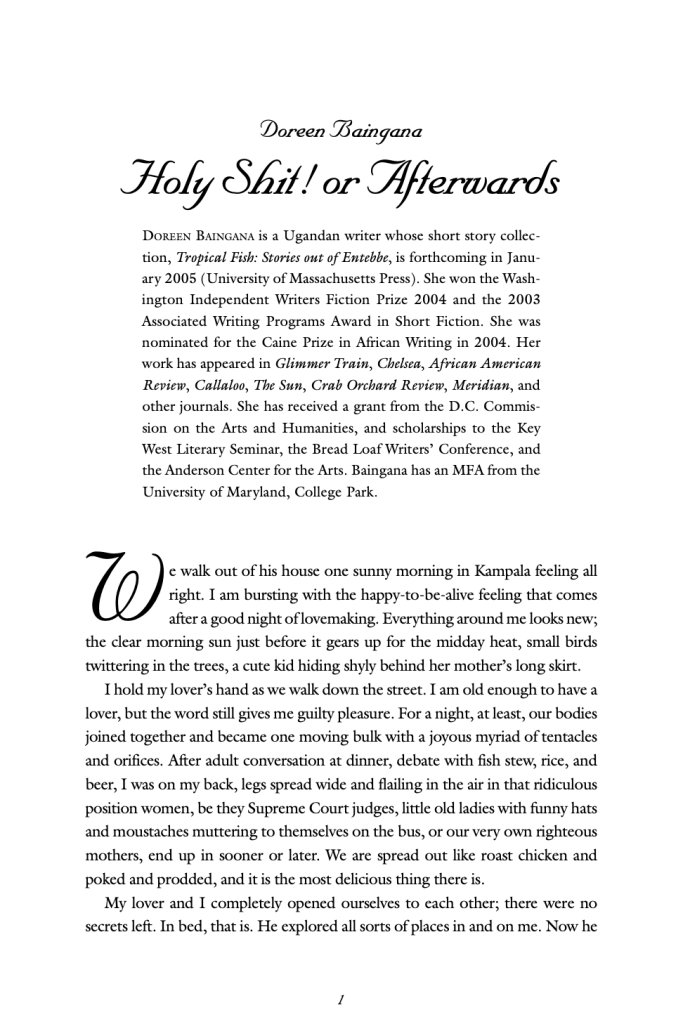
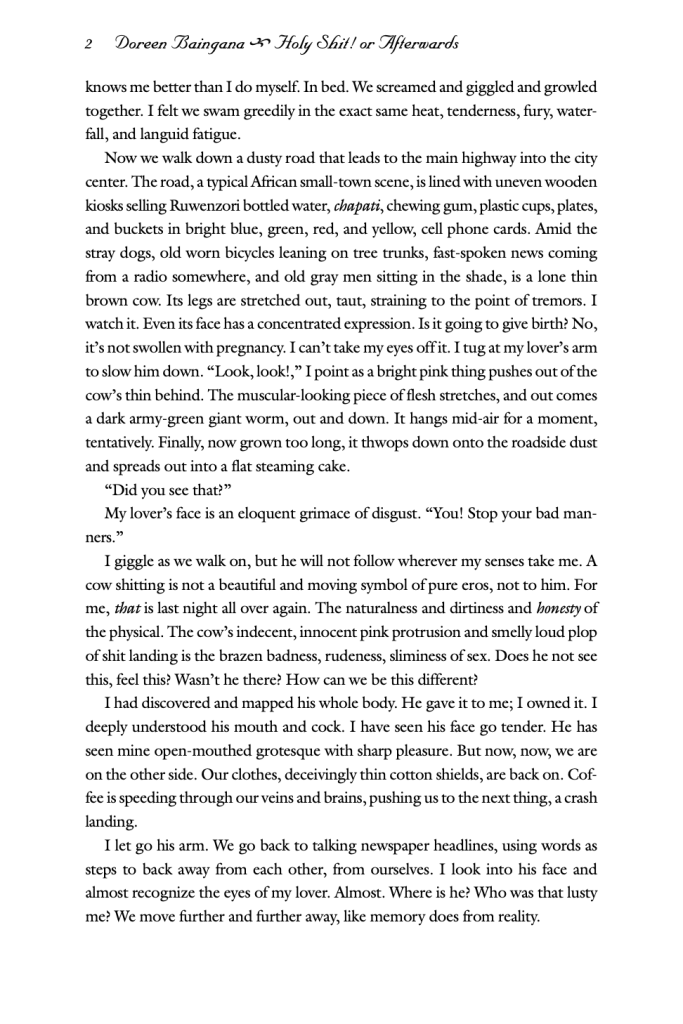
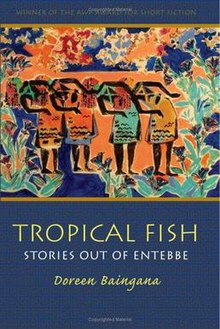
Check out Doreen Baingana’s short fiction collection, Tropical Fish: Stories out of Entebbe here.
 GRACE AND GRAVITY