
11/4/2022

Patricia Fuentes Burns is a writer and editor whose fiction and non-fiction can be found in publications such as TriQuarterly, Quarter After Eight, Another Chicago Magazine, Jellyfish Review, Arlington Magazine, and Quarterly West. Her writing has been anthologized in Grace in Darkness and Shut Down Strangers & Hot Rod Angels, work inspired by the music of Bruce Springsteen. She earned an MFA in Creative Writing from George Mason University. While originally from Spain, she lives in Arlington, Virginia with her husband and three daughters.
Abigail Martinez is a writer who is currently studying and majoring in Literature at American University in Washington, D.C. As a proud Chicana, her work is inspired by social issues of both the past, present, and possible future with a focus on Latiné stories. When she isn’t writing, you may find her with her nose stuck in a book, any kind of concert around D.C., or at home where she enjoys indulging herself in “self-care” (better known as binge watching Grey’s Anatomy on Netflix while enjoying a slice – or four – of pizza).
Introduction to “How Long Before I See You”
By Abigail Martinez
As we age, sometimes we yearn to be kids again – young and carefree with the ability to just be. Hardship strikes and we ask ourselves: Why me? Patricia Fuentes Burns’s short story “How Long Before I See You” contrasts this way of thinking and living. Her story not only illustrates living optimistically in times of hardship, but also highlights a kind of privilege that comes with living optimistically. In other words, not everyone can be a glass half full kind of person. That mindset always depends on personal and external circumstances.
Burns has been published in an array of different journals dedicated to pushing the boundaries of typical writing conventions and with a dedication to unique writing that shares a potent message, such as Jellyfish Review, the Quarter After Eight, Quarterly West, and the Georgia State Review. By highlighting the complexity of the human experience, her stories harbor feelings of hope and sadness that are inevitable when examining the hardships that others are going through; however, it also provides a kind of relatability for readers. We can empathize with them. This is especially true in “How Long Before I See You” which allows the compelling story to permeate our subconscious and call on us to reflect on our own lives.
Because Burns is originally from Spain, she grew up at the beach. She still loves going. Therefore, it makes sense that this is where “How Long Before I See You” is set. The story describes a family’s illuminating summer vacations over the course of three years. It feels like a recounting of memories that a friend might tell you over the phone. In the case of “How Long Before I Met You”, we accompany a family in experiencing the fun-filled warmth of the beach, meeting new friends and people, and even jealousy – all very real experiences and emotions that many of us have had. We see it in another one of her short stories: “Play with Me”. This story describes another family setting that reminded me of my childhood by detailing a “day of doing home things” i.e., watching cartoons, cleaning, playing board games, baking, and playing. Reading this story, I was transported back to my own childhood of doing these same things on Sundays. We would watch The Simpsons on the television, play with Barbies, go outside to play, etc. We just did “home things.” This brought a feeling of comfort to the experience of reading for me. It created a sense of familiarity, and I think her works, for many people, may feel like bouts of déjà vu.
The tone of “How Long Before I See You” can be described as nostalgic with narrative distance. While reading, I appreciated Burns’ stylistic choices. Sentences are short, descriptions are direct, and we do not even get character names, which highlights this feeling of impersonality. However, this pushed me to become the characters, to see what the characters are seeing, and to feel what they are feeling. By becoming the characters, especially the main character, I experienced her individuality. Burns’ writing is powerful in this way because, by the end of the story, we have learned something through this experience – gleaned a message whether it be about privilege, optimism, or facing hardships – that relates to the issues we may be facing in our own lives. We see what the main character sees. We find out the big things when she does. This makes the story all the more poignant, distinctive, and memorable.
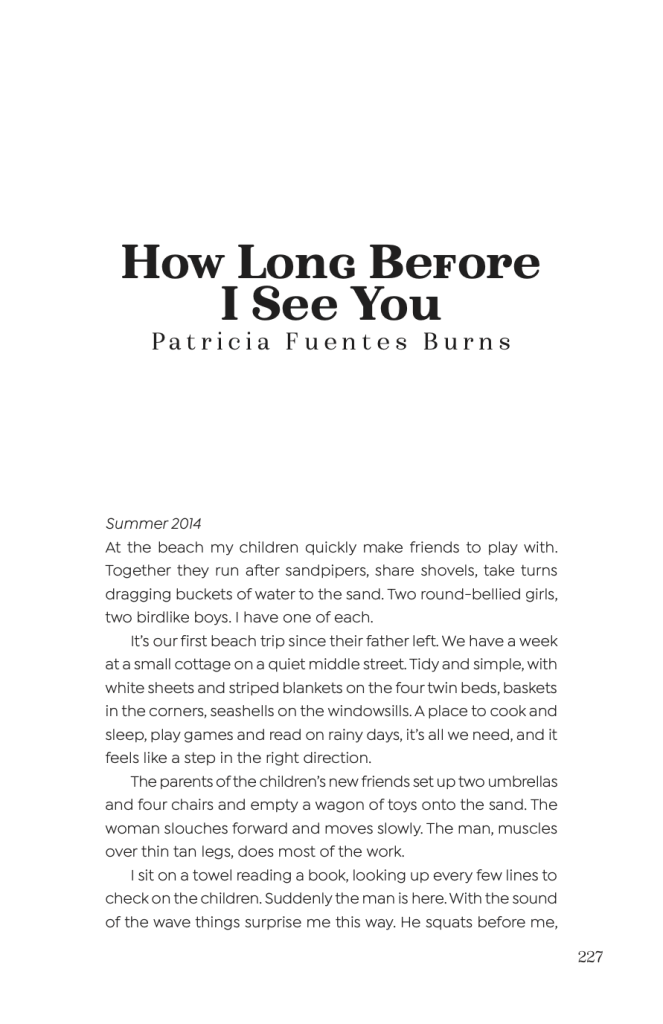
“How Long Before I See You” follows the life of a single mother and her children. Written in the first person, we live the family’s three summer trips – each in a different year – through the eyes of the mother. The story’s structured in fragmented sentences causing pauses in the story that showcase what the mother observes and focuses on. They are important in helping us understand the main character in that we observe the experience along with her. The story centers around the main character and her newfound relationship with people she meets on these beach trips: an older man, his wife, and children. Though Burns’ sentences are short, they are descriptive and tell what strikes the story’s protagonist. She immediately takes notice of the appearances of the man and woman that she meets and notes the stark differences between them. Where the older woman “slouches forward and moves slowly”, the man has “muscles over thin tan legs.” This brings our attention to the difference in the health of the couple. The man introduces himself to our main character and tells his story. He is lively and happy and seemingly proud of the life he is living. By the end of their first encounter, it is obvious that the protagonist envies the life of the couple. It is the last thing she mentions: “I think about this life – your name on a street sign, three beach houses to pick from every summer.” This life is one most people wish to attain. It seems like a life of little hardship and immense happiness. The man is living a life of light while our protagonist is stuck in a moment of darkness.
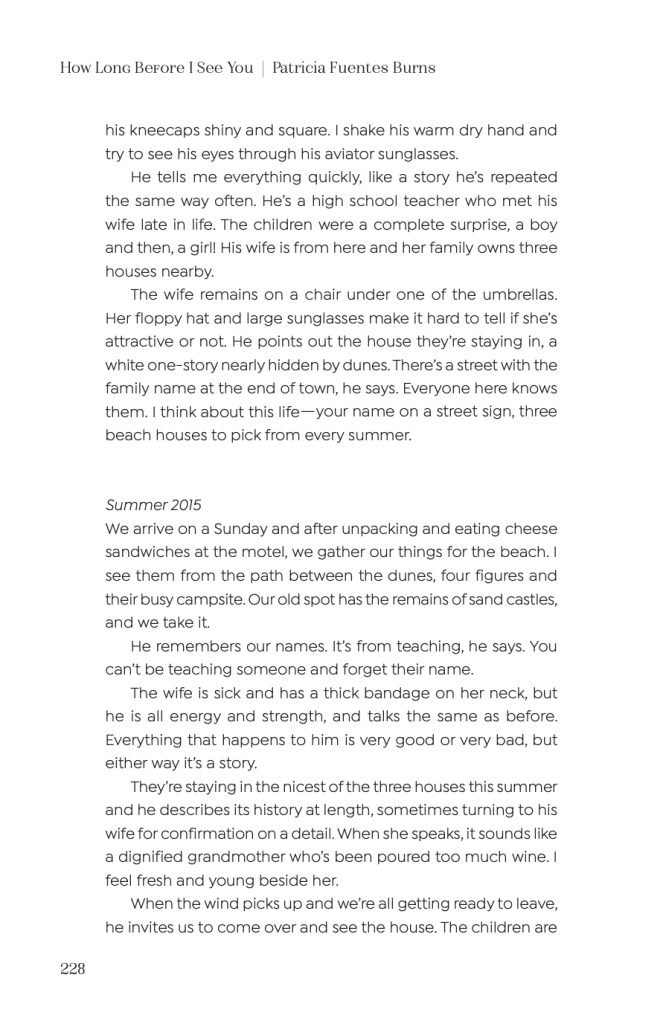
The Summer of 2015 brings the protagonist back to the same beach where she meets the same couple. Though most of the story is set on the beach – a place of light and happiness and warmth – this section takes us into the home of the older couple. It illustrates the intimacy and vulnerability of the section. It centers around the health of the older woman, who this time has a bandage around her neck and is obviously very sick. The home is a mess with gauze and medicine bottles all over the place. This section of the story reminds us that everything is not always what it seems. Even the happiest of people may be dealing with terrible ailments and hardships. The contrast between the outward appearance of the couple and their inward appearance in their home allows the story to take an unexpected, somber turn.
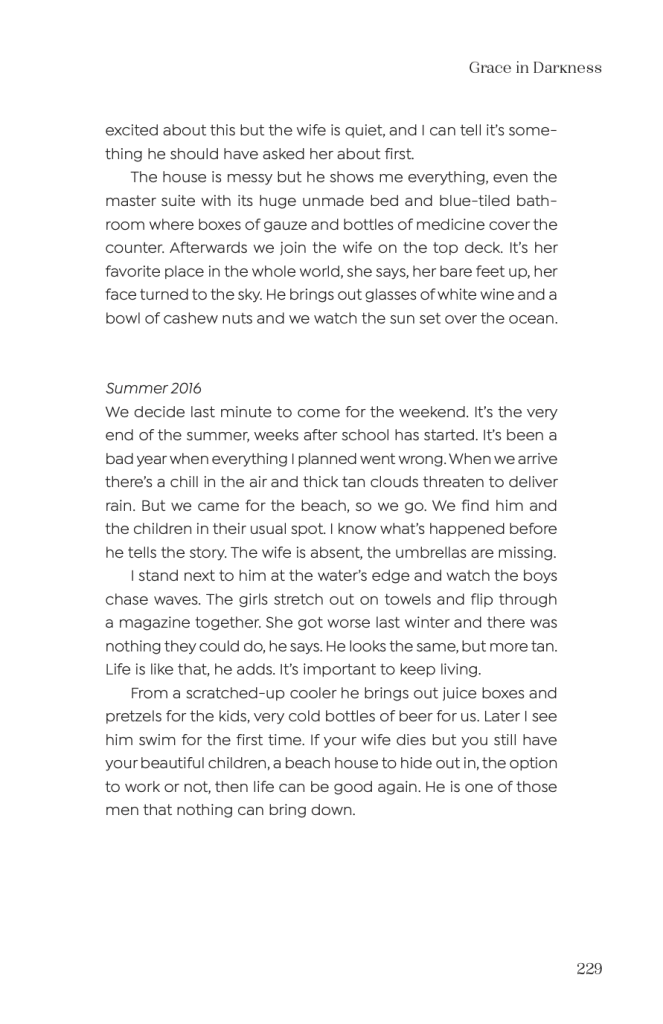
Lastly, the Summer of 2016 ends the story on a sad yet heartwarming note. The section begins with our protagonist describing the turbulence of her year. Their family goes back to the beach a final time only to be met with “a chill in the air” and “thick tan clouds” threatening rain. Already, the setting illustrates an air of somberness – of tragedy. She comes to find out that in the time she has been gone, the older man’s wife has died. Despite this tragedy though, he states, “Life is like that” and that “it’s important to keep living.” The main character notes that the man is more tan. He even goes for a swim later. It is peculiar that though his life has been struck by loss, he is still living a life that anybody would crave to live. This brings our attention to the idea of privilege. The main character notes, “If your wife dies but you still have your beautiful children, a beach house to hide out in, the option to work or not, then life can be good again.” This sentence can be perceived as strikingly envious. We can think back to the loss the main character experiences at the beginning of the story. She loses her husband through divorce and continues to struggle throughout the next three years. Yet, this man loses his wife, and is still tan, happy, and able to continue living without physical struggle. We can observe the obvious message of the story’s ending: that life is worth living through the hardships we experience – that we are strong enough to continue living despite unimaginable pain. But we can also view this message as layered and more complex in that we are strong enough to continue living despite unimaginable pain, but not everybody has the opportunity to live through this pain comfortably. Not only do people have to deal with the emotional turmoil of loss but also external circumstances that people in positions of power or immense privilege will never understand.
Reading this story, I was reminded of the fact that privilege is a determinant of the individual life experience. Where the main character struggles with money and being a single mother, the father she meets at the beach is privileged in ways that she can only wish to be. Although the story touches on the fact that sometimes we need to look on the bright side for the betterment of ourselves, our life trajectory, and the people around us, it emphasizes the idea that not everybody can just do that. The protagonist at the beginning of the story is newly divorced and envious of someone else’s circumstances, but by the end, she and the man are more alike. Though they differ in their privilege, they still may be able to relate and find comfort in each other. All in all, Patricia Fuentes Burns’ writing allows us to feel an array of emotions ranging from sadness to those of happiness. Her writing calls on us to self-reflect and to remember that though no one individual human experience is the same, we can see ourselves in the lives of others.
 GRACE AND GRAVITY