
4/10/2023

Anna Kahoe reads, walks and writes in her hometown of Washington, DC. For 18 years you could find Anna at the corner of 14th and U St., NW, behind the counter at GoodWood, a beloved shop of collected treasures from 19th Century furniture to a fragrance once worn by Marie Antoinette. Now, she’s writing. Anna’s creative non-fiction has been published in the Washington Post, PBS Newshour’s In My Humble Opinion, The Writer Magazine and Furious Gravity.
Maanasi Natarajan (she/her) is a fourth-year student at (and hopefully, soon-to-be graduate of) American University in Washington, D.C. She grew up in South Jersey, which she affectionately calls “Jersadelphia” in an effort to distinguish it from the worse parts of New Jersey typically associated with New York. Writing is a means by which she strives to understand herself and the world around her, and although her level of comprehension is constantly changing, she is glad to use it as a motivator to keep working toward her goal of receiving an MFA in Creative Nonfiction. She has difficulty gaining the confidence to show the world her writing – but is working on doing it more after learning that the pieces she writes about existential dread have elicited a thoughtful response in her generous reader friends. Her life goal is to be as unpretentious and unannoying as possible, and to be lucky enough to have people read her writing and want to have a drink with her because of it. In her free time, you can find her working as a barista, promoting her Spotify playlists like it’s her full-time job, and actively trying to organize a DMV-area Bananagrams tournament (please reach out if interested).
Introduction to “It’s Atmospherics, Baby”
By Maanasi Natarajan
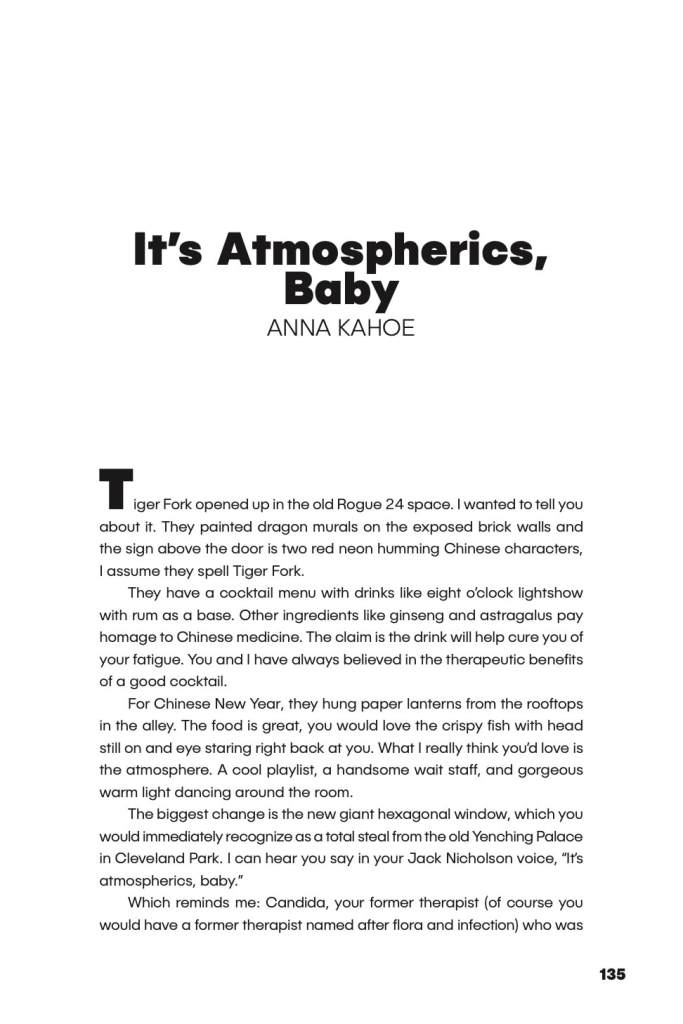
Epistolary stories are among the best in contemporary writing, and I am often confused at why they aren’t more common. The epistolary form has the ability to make you feel both far removed and deeply entrenched at once, and to place yourself in the position of both the writer and the subject; I feel as though I am the indicted and the accuser, the giver and the taker, both emotional and somewhat detached because I know what’s coming. Reading Anna Kahoe’s “It’s Atmospherics, Baby”, I felt all these emotions and more from the moment I began the letter, like I knew everyone involved without really knowing them at all, because the writing was so vast and careful and earnestly chosen that I trusted her completely.
Kahoe’s mastery over this brief but effective form comes from her ability to transport the reader into any place she is by bringing us with her to Tiger Fork, or the “old boxing gym,” or to Daniel’s apartment. The intertwining of narrative exposition and scene makes the story feel ever-moving and never stagnant, even after the piece is over – I was left thinking deeply about everything I had just consumed and hungry to read the work repeatedly to find details I hadn’t initially noticed. By the end of the piece, I don’t just wish to know more about what happened – I wish to know Kahoe herself, to learn about her own emotions, to learn about the inception and conclusion of her relationship with the subject.
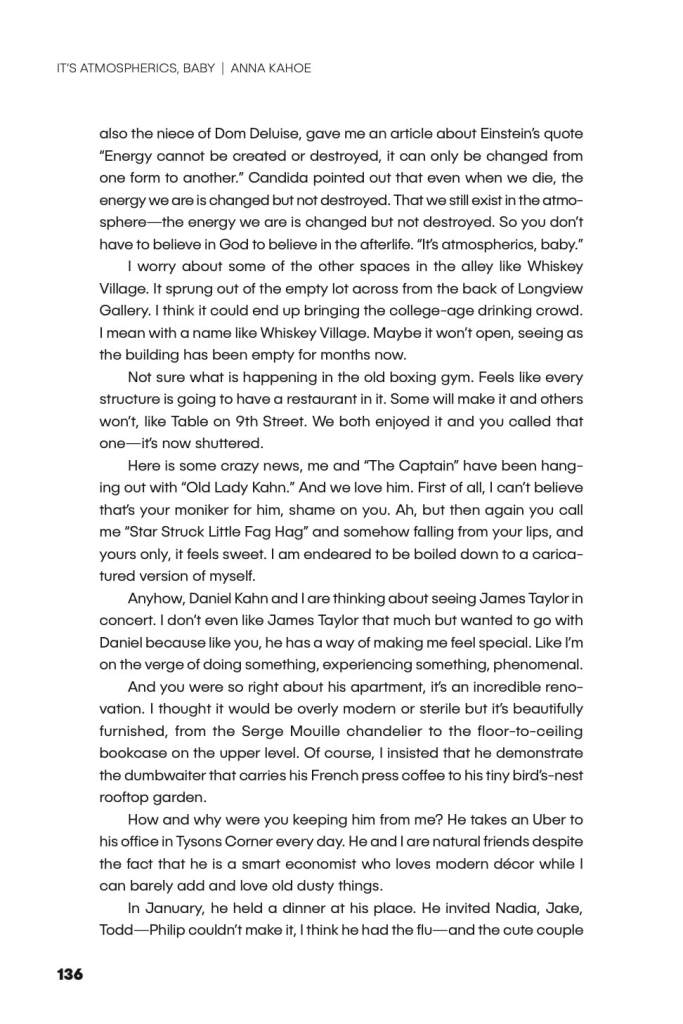
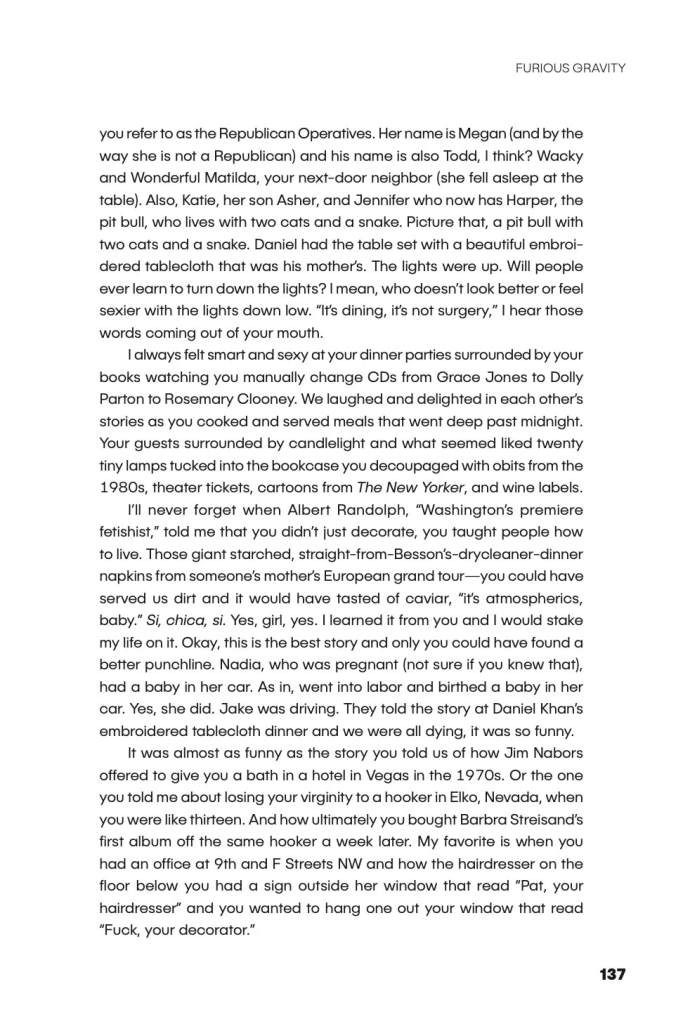
And Kahoe is, in fact, well-known. She is a reader and writer based in the DMV area and owned and operated GoodWood, an antique store located on U Street, for more than 18 years. She and her husband recently sold the business, but they are still deeply connected to the shop and the memories made inside of it. And after reading her work, it is clear that her reputation for unmatched taste and love for eclectic yet perfectly crafted, harmonious spaces is hardly an exaggeration. Her attention to detail when discussing “the Serge Mouille chandelier” and “those giant starched, straight-from-Besson’s-drycleaner-dinner napkins from someone’s mother’s European grand tour” not only convey this element of her, but also show the importance of atmospherics that the piece is centered around. It furthers her sense that it really is the small stuff that makes things what they are, the small stuff that reminds her of Jerry and reminds her to thank him for showing her that dirt can taste like caviar if the atmosphere is just right. It’s the small stuff that reminds her that people and atmosphere are not so different – that he made it what it was.
The work seems to dilate as the letter unfolds, focusing less on the places and faces that the author sees and more on the small details associated with them and the relationship they have to the author: the way that she doesn’t “even like James Taylor that much but wanted to go with Daniel because like you, he has a way of making me feel special” or how the subject “manually change[d] CDs from Grace Jones to Dolly Parton to Rosemary Clooney” at his dinner parties. As the piece enlarges, it seems to become far more vulnerable as we see Kahoe become comfortable with her reader, almost as if we are observing her write in a diary the way that teenagers with big feelings often do. She focuses on all the big stuff that happened but then remembers the seemingly small stuff – and then, realizing that the small stuff was the big stuff all along, discovers that it was what really mattered. Kahoe’s voice accomplishes this in perfect rhythm, her tone guiding the reader through these little, holy moments, reminding us that the memory of someone often appears not only in their being but also in their spirit – the things they told us, the places they went.
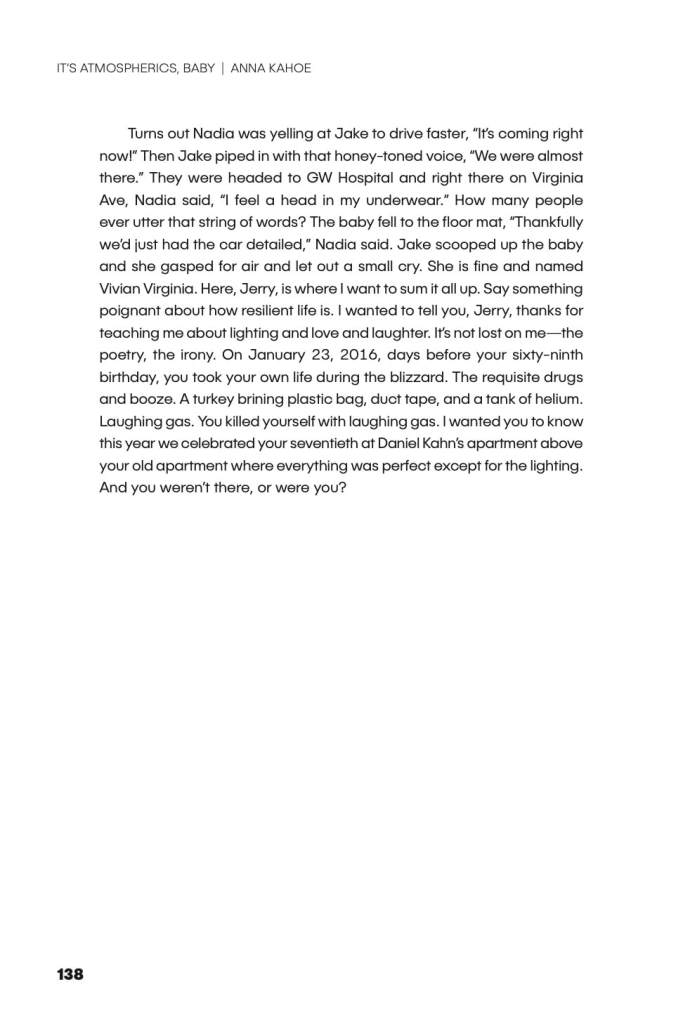
The shape of the piece also reflects this – by vertically descending through each memory, Kahoe provides the reader with the sense that they are understanding both her and her subject more deeply, and that there is far more to show than just the thrilling memories on the surface. The author’s retrospective is much wiser than she initially shows, but we never feel cheated or as if she has left out something important – as readers, we join her through the narrative arc she creates and feel ecstatic when she explains, emphatic when she realizes, and disappointed when she reveals a tragic ending.
And yet, even with all the beautiful narrative choices that Kahoe makes, I find that what drew me to this story was the feeling that she was going to tell me about something that I could already sense, and that I had experienced it before too – that loss is both specific and universal and uncomfortable and unsolvable and unpredictable all at once, and that it makes you wish that you hadn’t let yourself become vulnerable to the devastation that love can breed. Kahoe eerily conveys the feeling of wanting to tell someone about the most miniscule of details: changes to their favorite restaurants, what will happen to their old watering holes, what you remember them saying and how it’s all starting to make sense now. Still, her writing teems with urgency and desire through the repetition of “it’s atmospherics, baby” and quick, short sentence structure – and yet, as a reader, I just feel grateful that I am able to stand as observer.
I am struck by “It’s Atmospherics, Baby” and its ability to place us in the homes and restaurants and shops and celebrations that hold our deepest emotions and serve our souls in ways that we never though imaginable. Mostly, I am filled with light – despite the reality of the bleak ending the Kahoe tells us and that we all know to be true. I am thinking of a Daniel in my own life and his dinner parties, thinking of the stories we tell each other (some to pass the time, some to share the extraordinary with those most deserving of it); thinking of the stories that we tell ourselves in an effort to extract something and grapple with anything, to somehow show our appreciation for the small things that really turn out to be the biggest things in the world; thinking of the atmospherics of it all.
 GRACE AND GRAVITY