
4/6/2023

Marija Stajic is an American Diplomat born in Serbia. Her short stories have been published in dozens of literary journals, nominated for Pushcart Prize, awarded and anthologized. She was the Writers Center’s Undiscovered Voices Fellow. She has a MA in Communication from the American University. She used to work for The New Yorker as a fact-checker, consultant and translator. She’s represented by the Tobias Literary Agency and her first novel is currently on submission.
Bryce Thompson is currently an MFA student at American University, studying Creative Writing. He enjoys reading and writing speculative fiction, absurdism, humor, and all sorts of genre bending.
Introduction to “Just a Boy”
By Bryce Thompson
There are hundreds if not thousands of psychology books, history books, and, yes, stories, that attempt to speak to the reasons and ramifications for war. And yet, Marija Stajic demonstrates a level of complexity, authority, and empathy for the subject in an all too brisk 6 page story that most 600 page textbooks can only hope to achieve. The success of “Just a Boy” comes from the authority Stajic has for her material by herself being an international writer that, like her characters, has also experienced living in a country enveloped by war. But Stajic’s worldliness does far more than supply “Just a Boy” with its subject matter. Stajic’s status as an international writer has given her the opportunity to hone her craft in more places than most writers will visit in their lifetimes, starting from her early life in Serbia all the way to graduating from DC’s American University and working as a Foreign Service Officer for the State Department.
This brief yet poignant story alone is a testament to Marija Stajic’s worldliness, prowess with language, and craft with fiction. The fact that she has an entire resume’s worth of achievements to rattle off on top of this accomplishment is astonishing. In 2014, Stajic won The Writing Center’s Undiscovered Voices Fellowship and has also gone on to win the Neoverse Short Story award while being published in several literary magazines (and three collections of poetry in Serbian). Currently, Stajic second and most recent novel, American Sorceress, is currently represented by Tobias Literary Agency and is on submission.
What Stajic has accomplished so far in her literary career is more than most authors could hope to accomplish in twice the time, but what truly astonishes is her ability to overcome the obstacles she faced and turn them into art. Prior to moving to the United States in 2004, Stajic lived in Serbia and had firsthand experience of NATO’s bombardment of the republic in 1999. Despite this, Stajic’s love for language and storytelling then took her overseas, receiving her Master’s of Arts in International Journalism from American University. Still drawn to the realm of fiction, Stajic also studied fiction at George Washington University as well as playwriting at HB Studios in New York City. The time Stajic has spent to cultivate her skills has rightly bore fruit, “Just a Boy” being a great example of how Marija has used her writing craft and lived experiences to create a fictionalized story about a family during WWII.
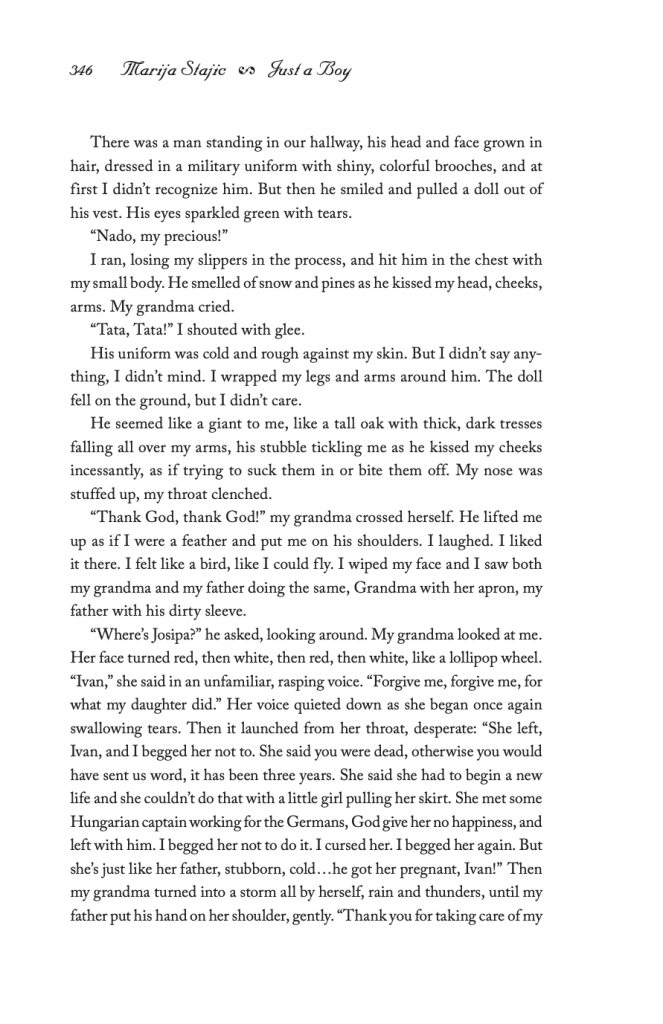
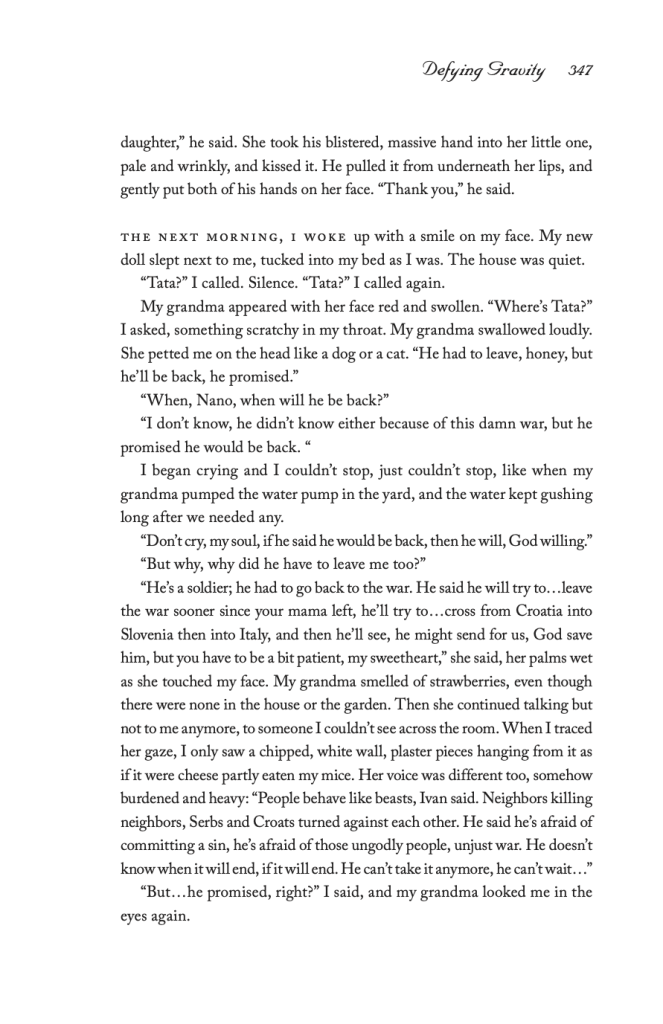
The premise of the story is not unfamiliar given its setting –a child, unaware of the scope and ramifications of the war around her, observes how the adults she would ordinarily look up to are just as vulnerable to the conflict that has hijacked the lives of countless families. In a sense, everyone is reduced to a child’s vulnerability. Yet, the introduction to “Just a Boy’s” setting and characters immediately sets itself apart from other war stories by giving readers specificity through the actions of this scared child. Despite the apocalyptic reality of the conflict outside, our narrator retains their childishness, hiding under the covers from the wind whipping their house, feeling like a spider in their wooden tub that’s gotten too small, and hating how they take lukewarm baths and eat vegetables with hard bread. Yet, the final detail about the food and the baths reminds the reader that while the narrator is a child that processes the world in a childish way, she is still reacting to conditions that are uniquely specific to families that have endured wartime. The family doesn’t have enough water to use for hot baths, and they have little food.
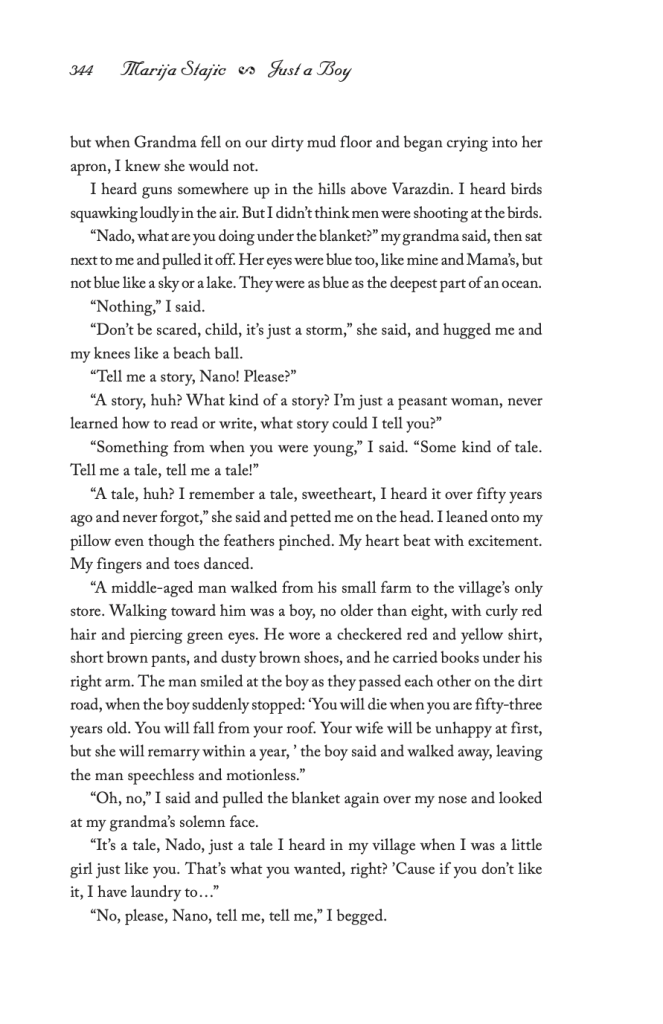
The syntax and diction is appropriately simple for a child narrator but is all the more devastating with how bluntly moments of crisis are described. For instance, the description of the last argument the narrator’s grandmother has with her own daughter ends with the startling revelation that, “when Grandma fell on our dirty mud floor and began crying into her apron I knew that [my mother] would not [return].” While there’s nothing particularly complex about this sentence’s structure, the content the syntax is trying to reveal is all the more impactful for it. The audience quickly learns essential information for the story, moving the plot along while also making no attempt to spare the reader’s heart with any poetic flourishes of language that would distract from the simple tragic nature of what the narrator is witnessing. By the second page of the story, the narrator finds their grandmother at her wits end, hiding underneath her own blanket as the narrator had at the start of the story. In war time, children and adults are equally helpless.
Yet, there is still humanity breathed into these characters in how they continue to live their lives in spite of the war. Seemingly at their lowest point, the narrator asks her grandmother to tell a story, a moment of escapism. Of course, that is how the childish narrator thinks of this moment, and who could blame her? With how much people in more fortunate situations feel the need to escape their own lives through fiction or other art, one can only imagine how a child living through the tumult in her country and her own family must feel. The story the grandmother tells, a highly symbolic one with themes of destiny coupled with luck and happenstance, becomes the focal point of “Just a Boy.” It’s an excellently metafictional take where the audience can analyze the motives the characters have for storytelling while then being able to step back and ask what they value about stories in the real world. For the narrator, it’s a moment of excitement, bonding, and escapism as her grandmother entertains her. For the grandmother, things are far more complicated.
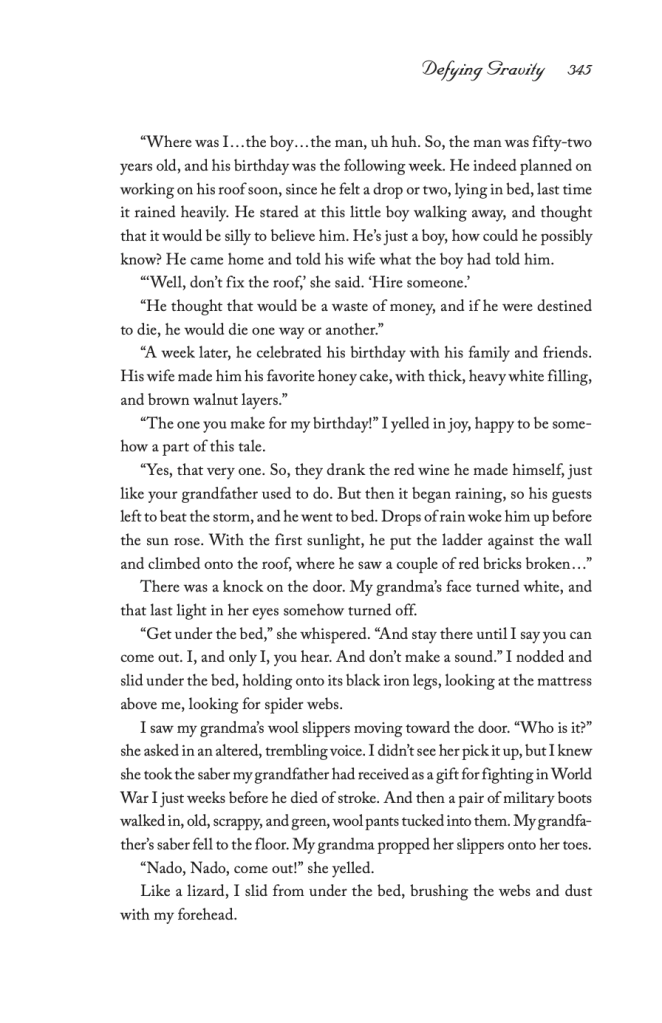
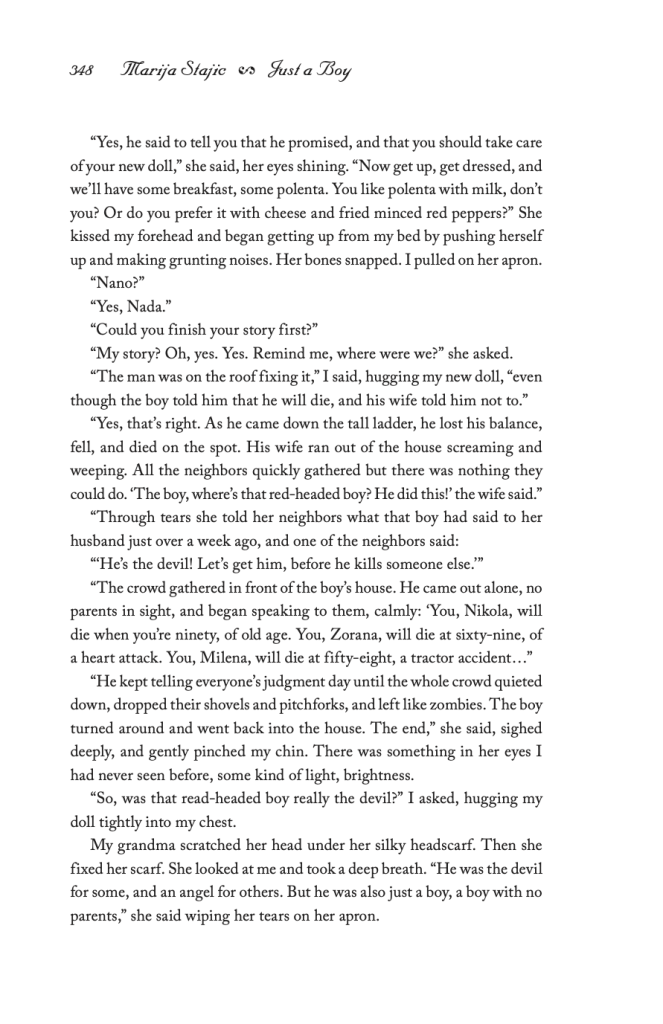
The grandmother’s tale is deceptively simple: a red-haired boy predicts the deaths of a man and his town, and the predictions, though seemingly random, are accepted as truth. A close reading reveals a striking amount of parallels between the two stories in “Just a Boy.” The grandmother reveals, for example, that she originally heard the story from her grandfather, who we learn was a WWI veteran from the description of his saber later in the story. So, since the only context we have for the story’s existence is that it was passed down by a veteran, we can interpret the grandmother’s tale as a war story. The first man predicted to die in the story leaves his wife initially heartbroken, but she’s told she will happily remarry, not unlike how the narrator’s mother left the family for another man earlier in the story after assuming her husband had died in battle. The parallels between the story the grandmother chooses to tell and the world she is telling it in show that she isn’t interested in it for the same reason her granddaughter is. The grandmother’s story, unbeknownst to the child, isn’t about escapism at all; it’s an analysis, the other reason people surround themselves with stories –to make sense of the nonsensical things around her.
Yet, even with this analysis, the grandmother’s strange story feels enigmatic, specifically regarding the strange red-haired boy that predicts the premature and far off deaths of the people in his village. The boy is described as, “angel for some, devil for others,” suggesting that his actions are more ambivalent than our narrator, and the audience, may initially believe. The boy is also said to be an orphan, a sympathetic detail that becomes all the more interesting when we consider how he is, for seemingly no reason at all, described as having green eyes. An inconsequential detail, perhaps, until we also consider that the father’s parents are never mentioned by any of the characters. Perhaps he too is an orphan. There is clearly a subtle connection between the fictional red-haired boy and the narrator’s father. Considering the grandmother’s tale as a war story, the seemingly random nature at which the boy dispatches the townspeople, and the boy’s connections to the narrator’s father –a soldier– we can read the red-haired boy as the embodiment of war itself, something the father is forced to embody as well by leaving for the battlefield once again. “Just a Boy” argues towards the cyclical and random nature of war. The boy himself is a product of war, lacking any parents of his own, simultaneously a product of the tragedies that came before him while continuing to perpetuate the random judgment that had befallen him, just as the narrator’s father is.
There is a delicate balance to strike when telling any story about a type of victimhood, almost a catch 22. Authors want to ensure that they demonstrate the severity of what people experience through tragedy, but at the same time, authors never want to identify any of their characters, representative of actual living beings, solely as victims. Stajic walks this tightrope with such grace, that she makes it seem just that easy to pull off, and she does so through the authority she has over her own experiences and the creativity in which she represents them.
While Stajic obviously never lived through the horrors of WWII, she is able to tell the harrowing events of this fictional family as if she’d been there herself. Like the narrator, Stajic was once unfamiliar with war as a concept, not understanding why it exists yet acutely aware of how it weighs down upon her and those she cares about. Yet, Stajic is also like the grandmother, scared like her younger self but with the experience and craftsmanship to take control of the narrative of her own life experiences while also making it meaningful for others. If people were more like these two characters, frightfully aware of the ugliness of war but wise enough to understand the reality of it, the world would be much better off than it is now with war so easily seen as just a chilling headline in the morning.

 GRACE AND GRAVITY