
4/18/2023

Jessica Claire Haney is a Northern Virginia-based writer, editor, and writing tutor. Jessica’s poetry and fiction have appeared in Washington Writers’ Publishing House, Delmarva Review, Beltway Poetry Review, Written in Arlington, Gargoyle Magazine, Porcupine Literary, Court Green, Earth’s Daughters, and the Abundant Grace and Grace in Darkness DC Women Writers anthologies. Fiction is forthcoming in Jarnal III from Mason Jar Press and the Grace in Love DC Women Writers anthology. Her essays and articles have appeared in The Huffington Post, The Washington Post, Scary Mommy, Mothering, Washington FAMILY, Healthy Woman, and the anthologies Have Milk, Will Travel: Adventures in Breastfeeding and Birth Writes. In previous lives, Jessica was a high school English teacher, a community wellness advocate, and a parenting blogger. Instagram @jessicaclairehaney & Twitter @crunchychewy. JessicaClaireHaney.com.
Moa Short is a queer writer from Georgia currently living in DC with her partner and children. She is an MFA student at American University and writes nonfiction prose and poetry about private violence, gender, race, and family. Her poetry is forthcoming in Pleiades Magazine and Sonora Review. You can find her at moashort.com.
Introduction to “Out of Scale”
By Moa Short
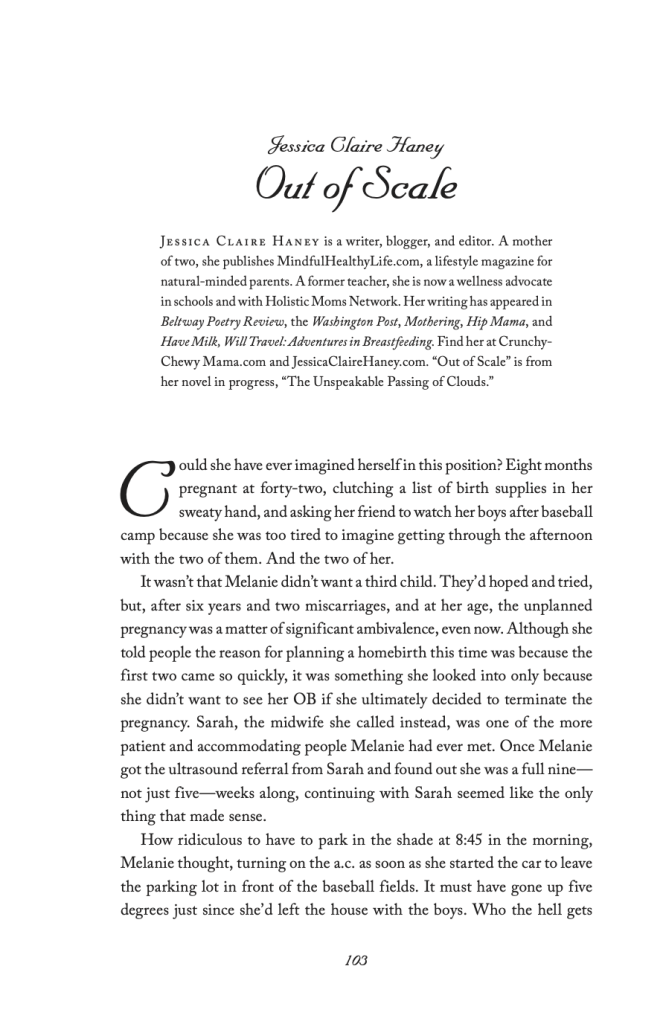
As someone who planned two home births, one of which progressed too quickly for my midwife or doula to arrive in time, I was drawn to Jessica Claire Haney’s story about a woman surprised by a quick labor four weeks before her due date. In “Out of Scale,” Haney’s protagonist chafes against the twin tropes of reproductive labor: childbirth as medicalized and miserable, rendering the birthing person passive, prone, numbed; and mothering as gracefully intuited and practiced with poise, a source of lifelong satisfaction.
We meet Melanie when she is over forty, a mother of two, eight months into an unplanned pregnancy, and doggedly gathering homebirthing supplies in the sweltering, suburban summer. Melanie often finds mothering less than pleasurable. She is wholly ambivalent about a third child. But she longs for childbirth itself, longs for it with an intensity and physicality so subversive that she won’t even admit it to her husband or friends.
Melanie’s desire for childbirth is “like a hunger,” Haney writes. “[Melanie] wanted to know she was minutes away from a life coming heavy through her legs, from where it had knocked against her ribs for months through its dark narrow passage to the open air.” Even in the image of Melanie’s spread legs, Haney resists sexualizing the sensual. As Melanie reads the neighbor’s birthing books, she realizes that “she was not a pervert for feeling like birth was a sensual experience.”
Haney’s attention to physicality provides the texture to Melanie’s interiority. Melanie is sweaty, the parking lot steamy, last Thanksgiving warm and sultry. Her life is “distilled into ounces of fluid coming out of her and into the baby and back out again.” She might have “slunk [emphasis mine] her body back to push Todd out before he came.” She savors the sweetness of chocolate between contractions. Babies are things you catch. Her womb is “a kickball and the vibration of her sound and the tightening of her muscles traveled all the way around the rubber surface.” Haney’s diction focuses us on Melanie’s embodiment – the animalism of sex, pregnancy, labor, childbirth, breastfeeding, mothering.
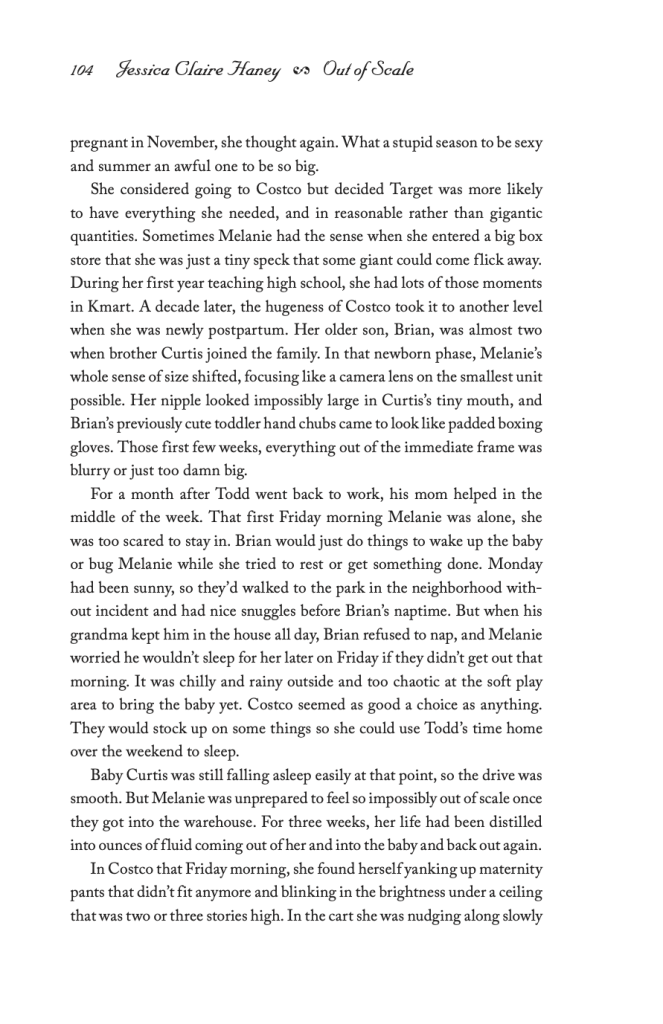
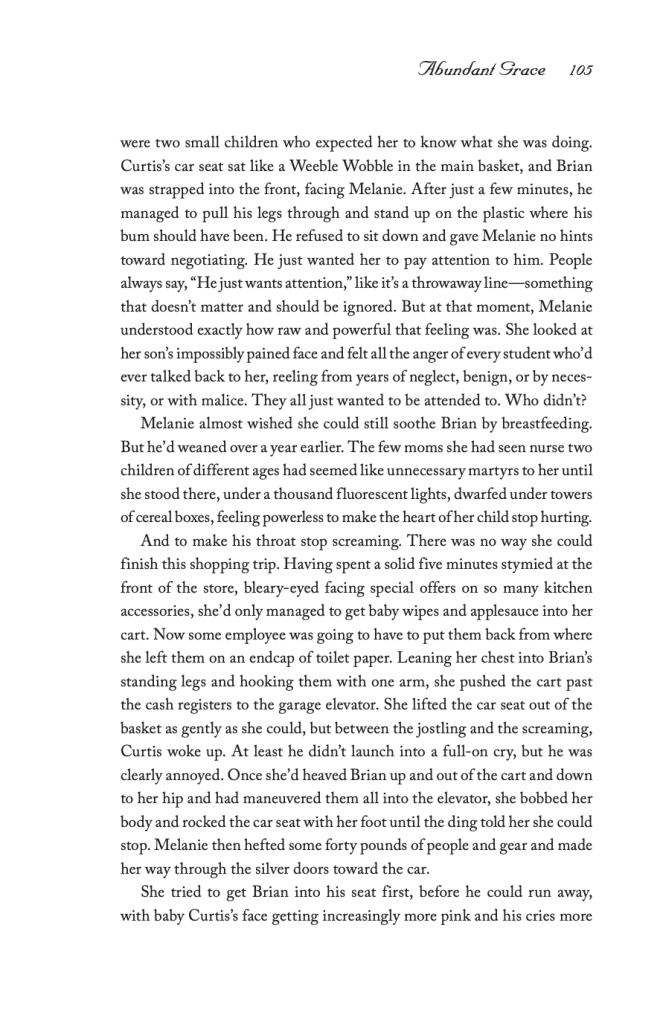
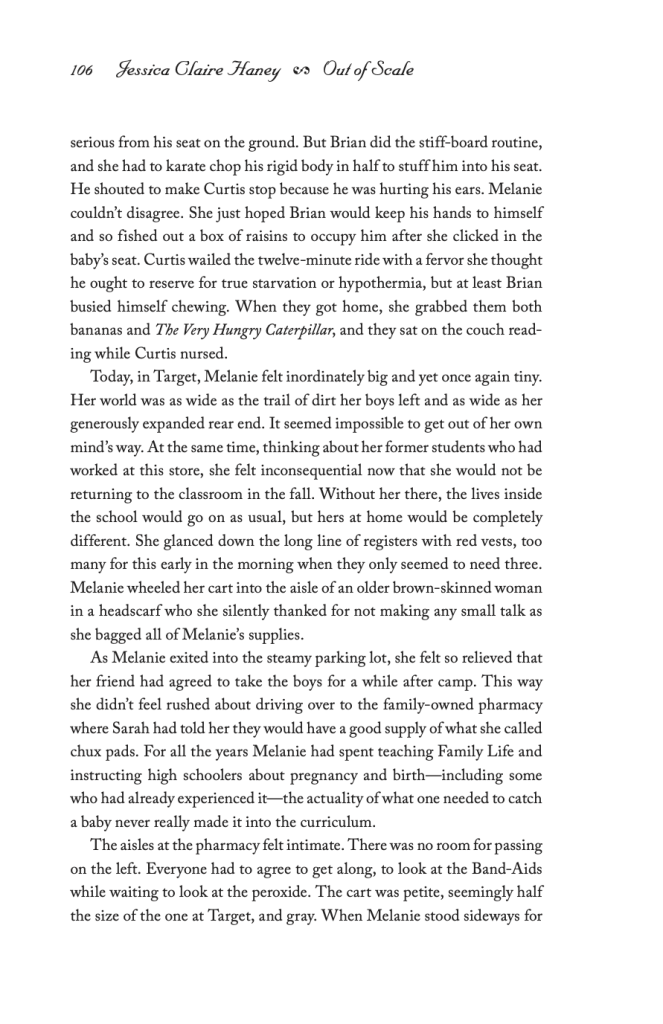
“Out of Scale” buzzes with the restlessness and discomfort of third-trimester pregnancy, of staying home postpartum, of navigating public spaces with children. There is yanking and flailing and nudging and clutching and grabbing. Haney offers us oscillating images of scale: Costco’s vastness; the narrow intimacy of the family pharmacy; Melanie, who is alternately “dwarfed under towers of cereal boxes” and “inordinately big.” We feel the tension between the expansiveness of birthing and the maddening constriction of mothering. We feel Melanie’s identification with her child’s desire for attention, and the way this wanting replicates itself in Melanie’s own psyche. She fears that she will soon be inconsequential to the world aside from her function as mother, her purpose erased beyond the reproductive labor she performs. (Haney is particularly adroit here, reiterating this theme as we learn that Melanie taught “Family Life” to high school students, which we can interpret as conservative rendering of sex ed, focused on biological reproduction as well as cultural reproduction through the conjugal family.) Once she has already started laboring, Melanie feels an even more acute desire to be attended to. “Now Melanie was the one looking for attention, negotiating for face time with her midwife,” writes Haney. “What would she have to say to get picked as important?”
America’s cultural – and political – imagination is rarely concerned with birthing and mothering bodies beyond their capacity for reproductive labor. Birthing and mothering are functional roles. By placing the story within Melanie’s interiority – not the interiority of her womb, but the interiority of her mind – Haney centers Melanie herself. Haney is a mother of two, also a former high school teacher, and also experienced rapid labor at home. Her background is in women’s studies and her fiction, nonfiction, and poetry broadly contemplate gender, maternal healthcare, and parenting. She writes this personal and intellectual depth into her protagonist, attending to Melanie’s discomfort and desire, her ambivalence and her contradiction.
Perhaps Melanie craves the certain magnitude of childbirth, especially in contrast to the incrementalism and repetitiveness of mothering, “when every decision could be questioned,” as Haney puts it. We sense in Melanie’s periphery the cultural pressure she feels. She initially pursues homebirth “only because she didn’t want to see her OB if she ultimately decided to terminate the pregnancy.” Later, Melanie worries that ambivalence will materialize into the accidental death of her baby.
I cannot read “Out of Scale” in 2023 without considering the criminal implications of Melanie’s multiple miscarriages, were this story to have been set in a post-Roe America. To be a birthing or mothering person in this country is to have every decision questioned, as Haney writes. It is also to be policed and criminalized. In Melanie’s story, Haney faithfully renders the high stakes of birthing, the way trauma is inexorable from reproductive labor, even as trauma’s harsh glint is dulled and faded by trips to Costco.
Haney’s command over the physicality of Melanie’s world allows us the irony of the final inciting image, in which the birthing supplies Melanie retrieved from the pharmacy literally propel her into labor. Here again, Haney transcribes each movement, as though we are watching in real time: “After accidentally knocking the smaller package of medium chux pads off the counter and onto the floor, Melanie squatted down like the yoga video lady suggested and felt like a balloon popped right above the pink donut where she imagined her cervix to be.”
Melanie moans rather than screams through contractions. In this word choice, Haney authenticates Melanie’s sensuality. Haney also provides us with a representation of labor that contradicts the images of shrieking, stirrup-splayed women we see in film and television. I remember my doula preparing me for my first homebirth: in 20 years of births, she said, I’ve never heard a woman scream.
The closing scene mirrors Melanie’s earlier exit from Costco, and together the two scenes bookend the story between the tedium of mothering and the force of childbirth. “Could she ever have imagined herself in this position?” Haney asks at the story’s opening. At its close, the immediacy of birth has devoured the questioning and ambivalence that gnaw at Melanie’s mothering. Haney performs her ultimate act of subversion by locating the story’s final authority within Melanie’s body. We leave Melanie on all fours, entering herself to find a new person.
 GRACE AND GRAVITY