
5/26/2022

Pamela Woolford is an interdisciplinary artist and keynote speaker, intertwining her work as a writer, filmmaker, performer, and immersive-media director to create new forms of narrative work about Black women and girls and others whose joy, imagination, and inner life are under-explored in American media and popular art. She is the recipient of six Maryland State Arts Council Awards, five film-festival awards internationally, a Changemaker Challenge Award from United Way of Central Maryland and Horizon Foundation, an aSHE Fund Micro-Grant, and a Baker Artist Award in interdisciplinary arts. Her latest film, Interrupted: Prologue to a Mem-noir, had a limited online release with a premiere event attended by 1.5 thousand people.
She is the author of more than 100 memoir, fiction, profile, human-interest, and think pieces published in The Baltimore Sun, Poets & Writers Magazine, NAACP’s Crisis Magazine, Harvard University’s Transition, and other publications. Her writings have been selected for anthologies, translated into German, and widely cited. She has been awarded a Storyknife Writers Residency, a NES Artist Residency, and an Official Citation from the Maryland House of Delegates and has been a Bisson Lecturer in the Humanities at Marymount University. As well, she has received numerous other literary honors, including a Pushcart Prize nomination for the story republished here, “Pleasant People.”
Her upcoming virtual-reality show Up/Rooted: Pamela Woolford’s Cabin Windows premieres in 2022 at a four-month solo show of her work at Joan Hisaoka Healing Arts Gallery in Washington, DC. To find out more about Woolford and her art, visit pamelawoolford.com.
Woolford is a member of Sundance Co//ab, Brown Girls Doc Mafia, CRAFT Institute, Women of Color Unite, The Gotham, and Women Writers of Color.
Alejandro Irizarry is a TV and film screenwriter from Caguas, Puerto Rico. He recently made his directing debut with his capstone short film, God Knows, made with American University’s District Cinema Society. He’s currently reworking the pilot script for his crime drama Double Vision, about corruption in the Drug Enforcement Administration the first draft of which made it to the quarter finals of the Austin Film Festival Screenplay Contest. He’s also researching a nonfiction book investigating real life corruption in DEA.
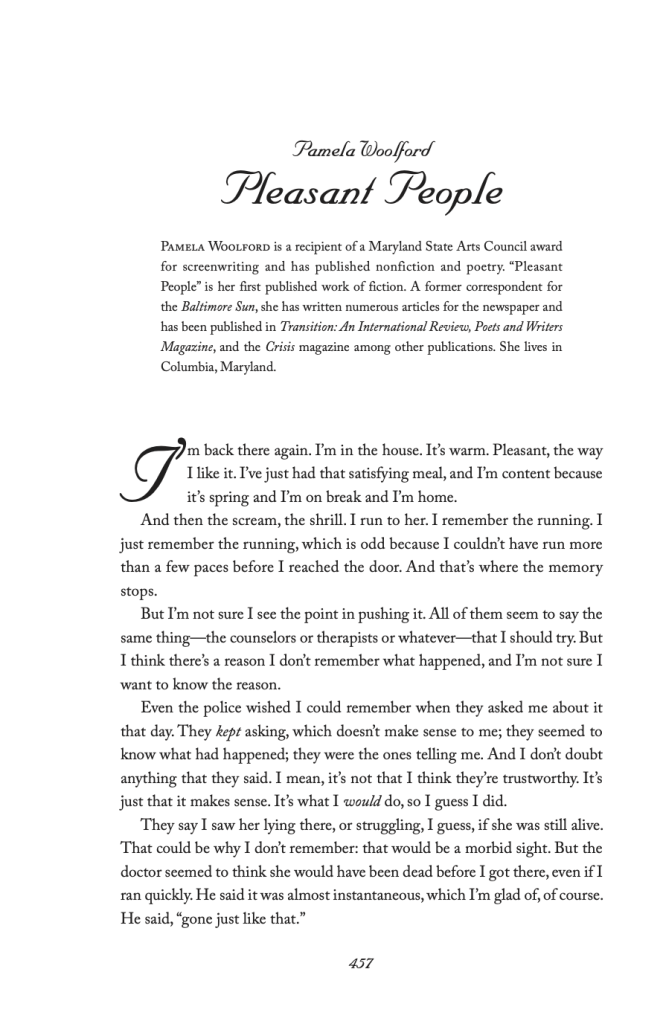
Introduction to “Pleasant People”
By Alejandro Irizarry
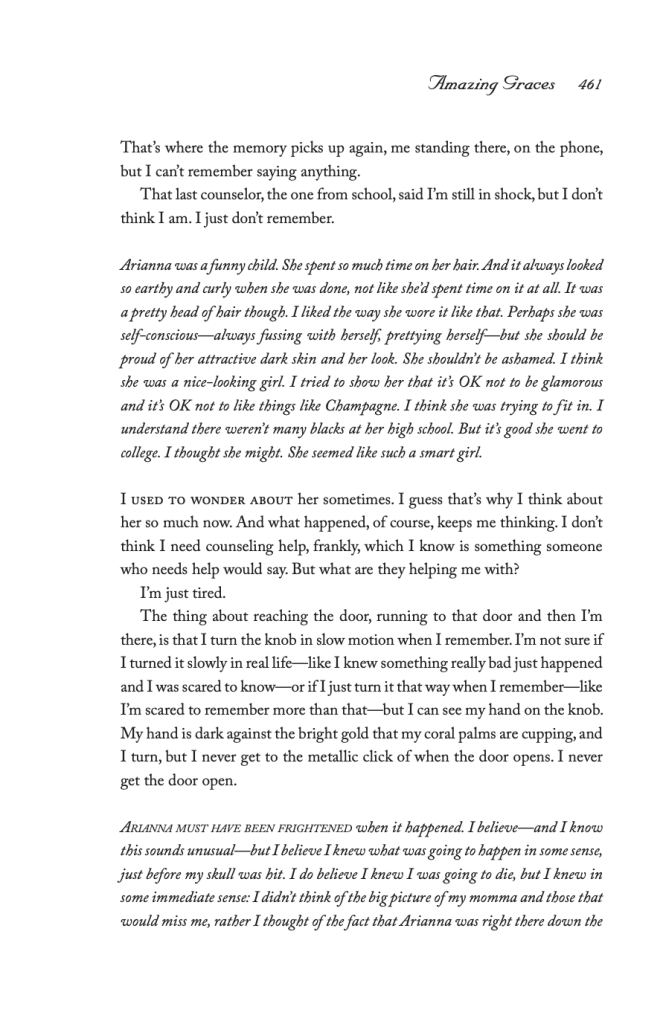
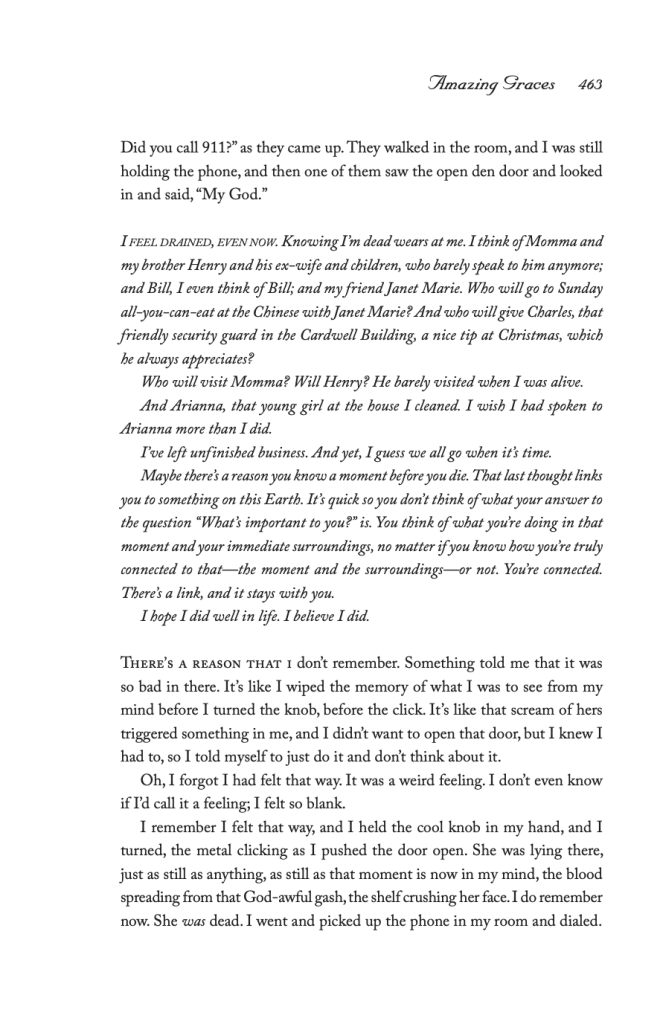
In interdisciplinary artist Pamela Woolford’s work, memory frequently takes center stage. In her story “Pleasant People,” memory is tucked away and even reveals misunderstandings between characters. But memory is what we have. As Woolford alludes to in conversation and speeches, reality escapes humanity’s grasp because our memories are always there, tinting the present. In “Pleasant People,” Woolford explores memory.
Woolford’s been a presence in the DMV literary scene for decades. After living in Manhattan for two years, Woolford returned to her home of Columbia, Maryland in the early ‘90s and started Jambalaya Magazine alongside Paula Richardson, Carolyn Greer, and Kristen Radden. Jambalaya Magazine and the subsequent Maryland Jambalaya-Fest spotlighted the diversity of people of African descent, especially in the Howard County community, where Columbia, Maryland is located. Outside of her own art, Woolford has helped raise millions of dollars for cultural and community enrichment programs through her work in development, PR, and marketing for museums, as well as work in arts and nonprofit administration. She promotes Black voices through her work in the most complete sense of the word.
Since Jambalaya’s shuttering in 1997, Woolford has truly earned her multidisciplinary artist title. She’s written for the Baltimore Sun as a correspondent, and her work has been widely cited in academic texts. She has performed as a dancer both solo and in group, practicing several forms, done voice acting, written essays, modeled for photography, done screenwriting, made films, choreographed, written poetry, written and directed an upcoming multi-genre virtual reality experience, written an upcoming memoir, and of course authored short fiction. All contribute to rounding out her expansive portfolio of work.
Hearing Woolford talk it’s clear she’s an artist who thinks a lot about memory. For each one of her projects, she’s acutely aware of the building blocks in her life that’s molded her work.
Spoiler alert: in case you want to read “Pleasant People” before being told elements purposely not revealed upfront in the story, I am going to discuss those things now.
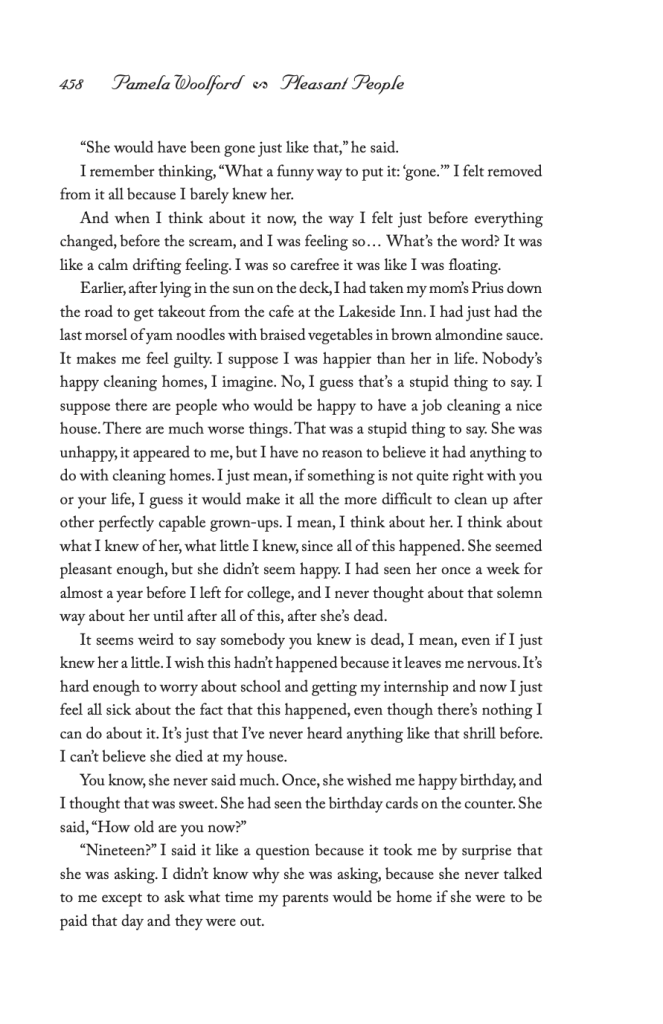
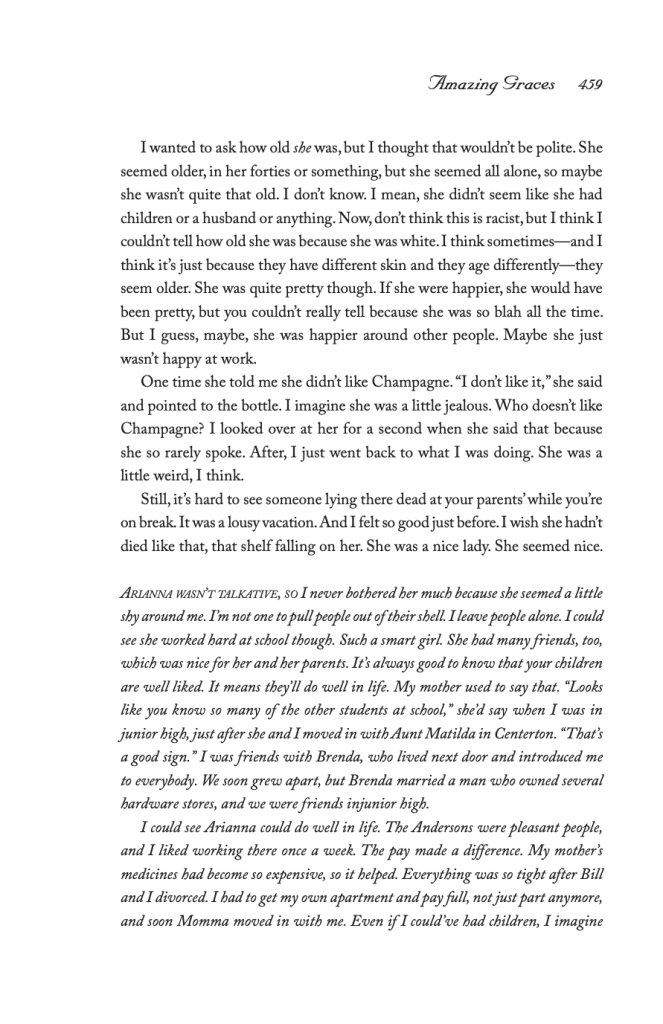
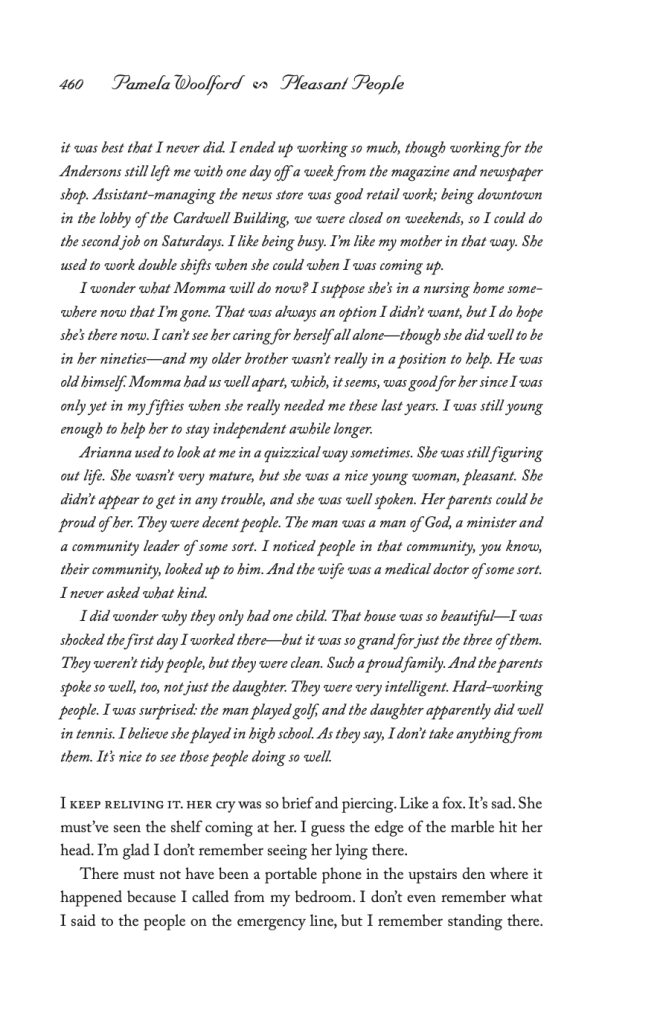
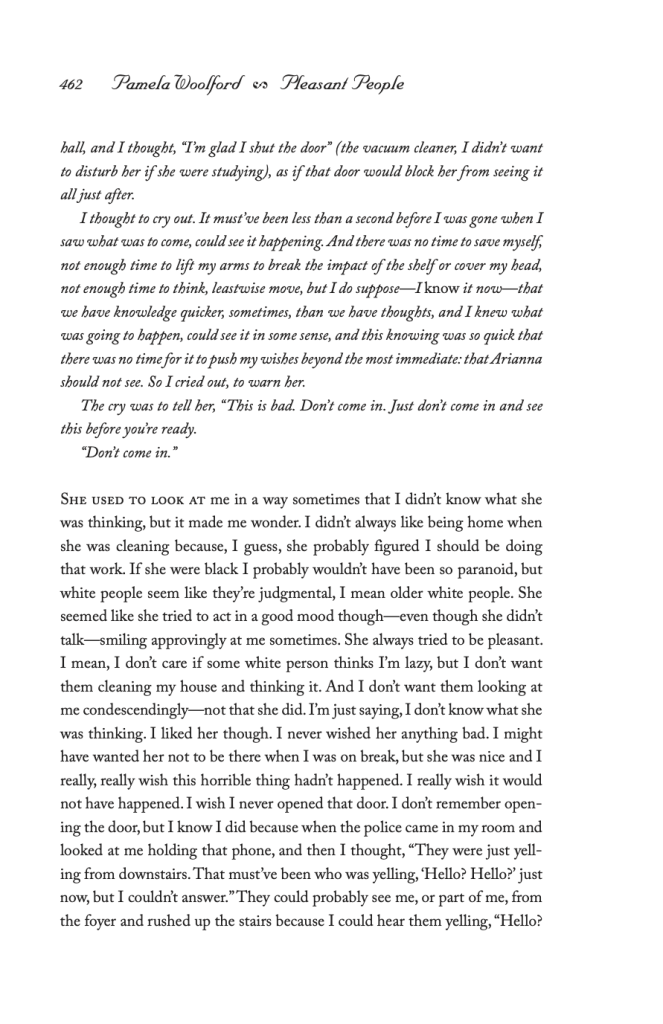
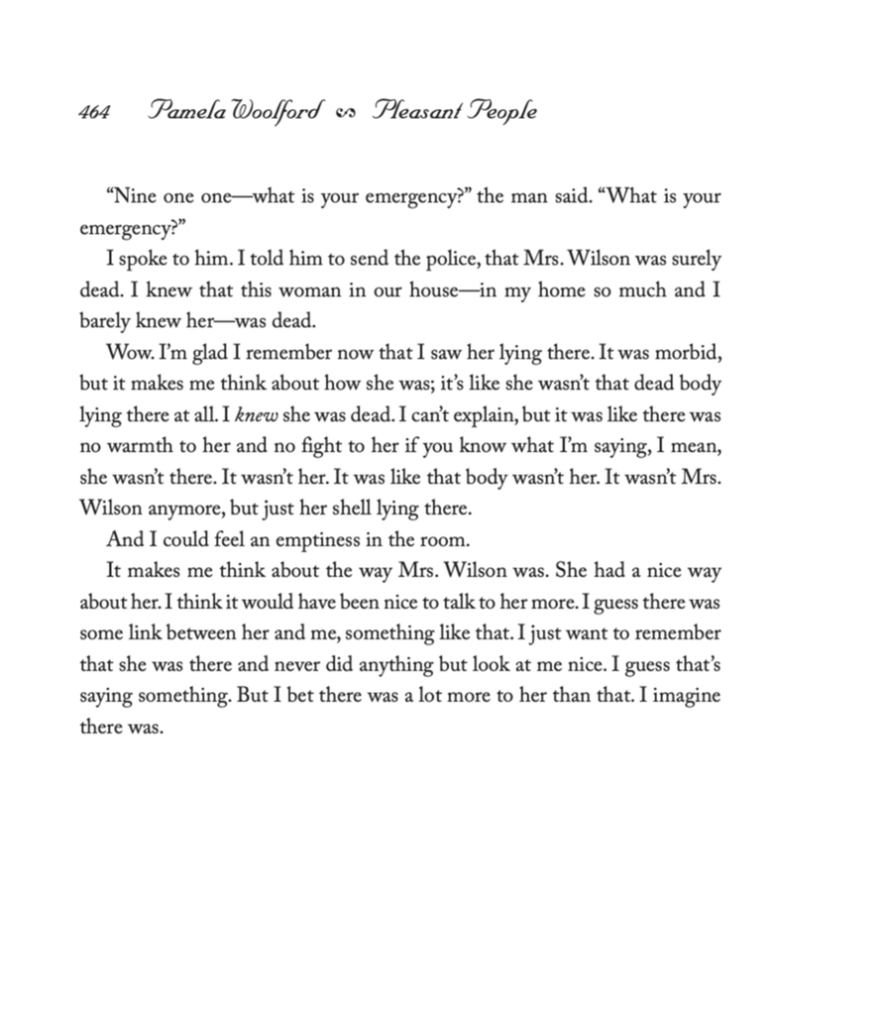
In “Pleasant People,” Woolford uses memory to expose the delta between different interpretations of reality through two contrasting first-person narrators: Arianna, who is Black, has witnessed the death of her family’s white house cleaner, Mrs. Wilson, who speaks after her death, reflecting on what she thought of her time alive. Together these characters showcase how memory works for us and how it fails us.
Woolford twists the stereotypical racial depiction of this sort of situation, a house cleaner working in a well-to-do family’s home. Here the family is Black while the house cleaner is white. The simple reversal of that employment dynamic alone pushes back against the limits placed on Black characters by historically white writing and publishing spaces.
Woolford stays close to the characters to truly inhabit their minds so that everything could be put in the full context of the characters in “Pleasant People.”
Both of the lead characters are equally real. Neither Arianna nor Mrs. Wilson could tap into the other’s mind to read each other’s intentions, so the best they could do is filter everything around them through their memories, the foundation that forms how they read the world. Their respective races and the resulting life experiences brought about by their races are key to this filtering, even if Mrs. Wilson never outright acknowledges it as Arianna does.
 GRACE AND GRAVITY