
4/14/2023

Amanda Miska is the former editor of Split Lip Magazine and Press. She received her MFA in Creative Writing from American University. Her stories and essays have been published at Catapult, Wigleaf, Midnight Breakfast, The Rumpus, and elsewhere. She lives in the Philly suburbs where she does a lot of other things besides writing but always wishes she was writing more.
Introduction to “Sam and Dee”
By Molly Stites
What is it to be known by your partner? To be seen as a moving, ebbing and flowing human being, instead of a stagnant body of pleasure? How does the comfort of attention make someone unaware of the fact that they aren’t being seen, or aren’t being treated as they should? In Sam and Dee, Amanda Miska explores the all too common trap of a partner being swept up in a love that feels fleeting, causing them to hold on tighter, even though they should just let go.
Sam and Dee starts off with the word “after.” It begins with an end, an allusion to a breakup, with Sam cutting off her hair, in need of change. This short paragraph is followed by a jump back in time, to when Sam and Dee were deep in their relationship and an end didn’t even feel possible. They had just moved in together and were close in proximity and emotion. Miska begins with a contradiction and a hint to the tone of change and rebirth of the piece. The rest of the story is told in close third, following the thoughts of Sam as she retells the story of her and Dee’s relationship, and ultimately, its end.
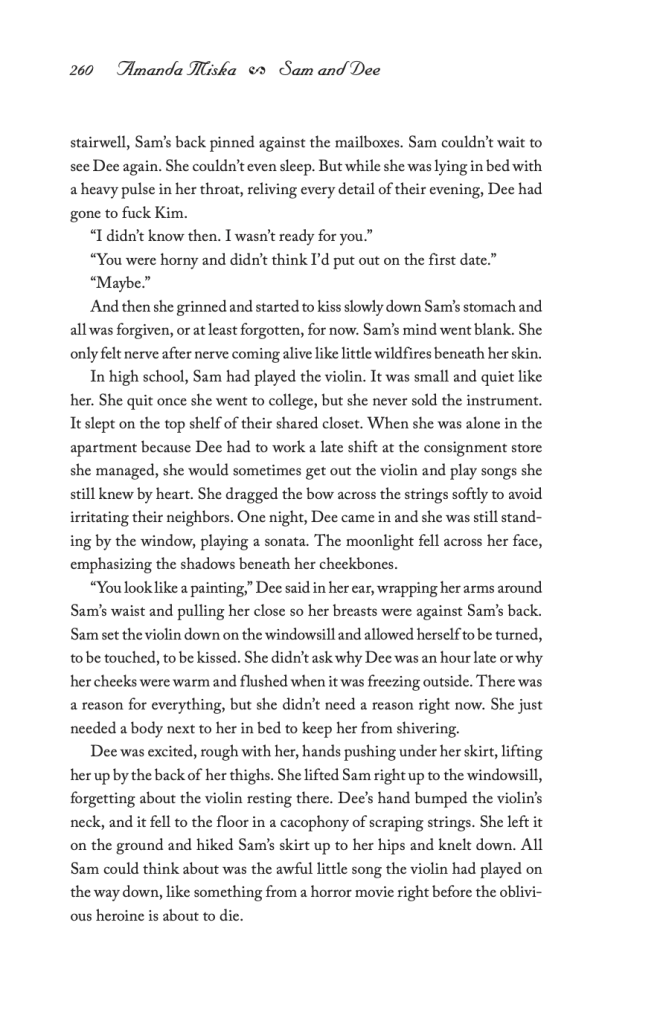
Miska paints Sam as someone who is passive and quiet, but is okay with that. That is just the way she is. Miska writes that, “In high school, Sam played the violin, it was small and quiet like her.” Dee, on the other hand, is loud and bold and always late. Dee takes what she wants from Sam, and Sam can’t think of anything else to do but give it to her. Miska writes of the intimacy between Sam and Dee, not necessarily something that Sam dislikes, but something she takes passively. Sam has visions of the type of touch, the type of love she wants. Throughout the details of their intimate relationship, Miska repeats references to art, especially paintings. “You look like a painting,” Dee tells Sam, when she arrives home late one night to see Sam playing the violin. Dee sees Sam as a stagnant image of beauty, simply there for Dee to enjoy at her whim. Sam allows it in the moment, but Miska pushes us forward in the story, causing us to wonder when Sam will take a breath, and ask for what she really wants.
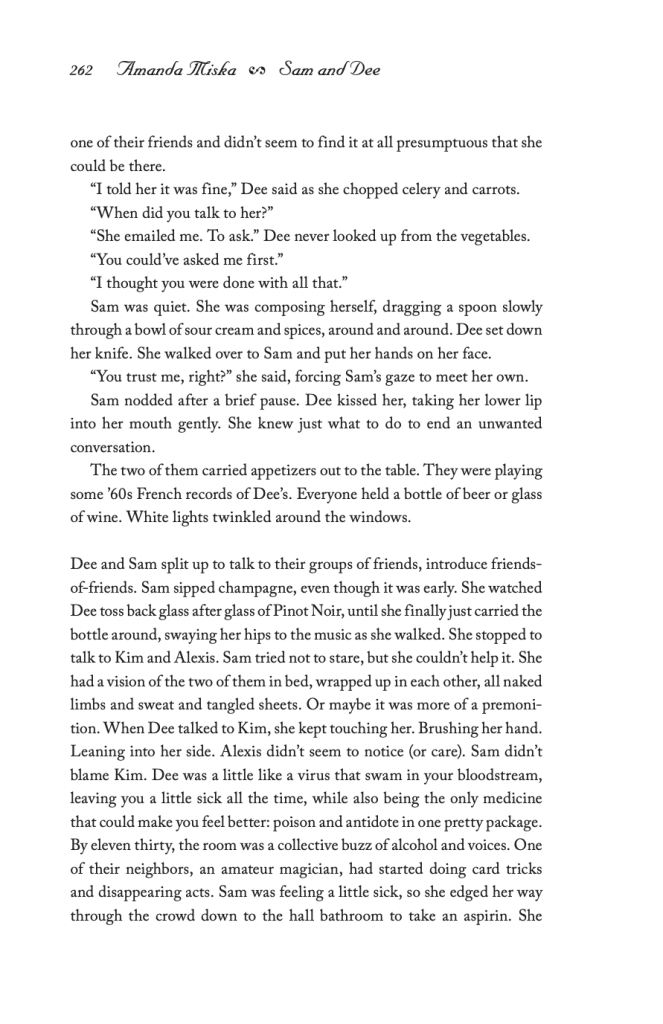
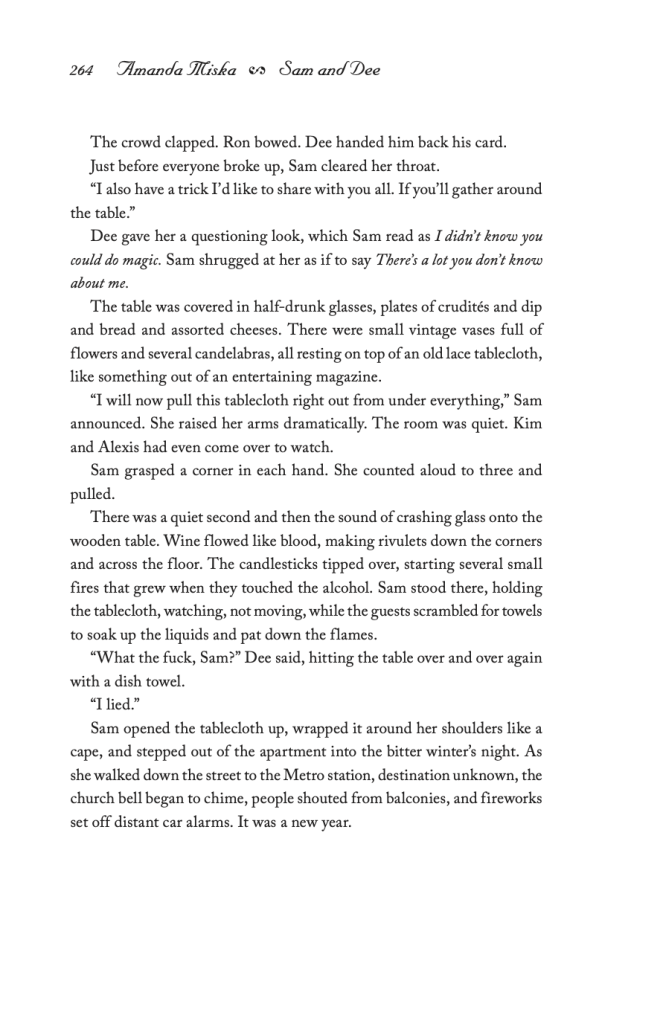
The story comes to a turning point with a New Years Eve party. The wine spills, kisses happen behind closed doors, and Sam shuts herself away in the bathroom. Dee monopolizes conversation, touching shoulders, touching lips, driving Sam away. The night ends with decisions made by both Dee and Sam, a flashback to the Sam readers saw in the first paragraph.
In the end, we see that Miska’s character of Sam is one who stayed around too long, but not one who is afraid to leave. Sam and Dee is not about Sam finding herself but finding the energy to walk away from something that feels exciting, something that feels almost stressful with potential and romance and desire. Because ultimately, that is not what she wants. The characters that Miska has crafted hold a strong weight in today’s conversations surrounding intimacy and love. They speak to the nuance that exists between partners, the blurry lines between wanting and not wanting, and going along with something for the pleasure of another or for true enjoyment. Her story allows for reflection on what is genuine desire, and what is influenced by others, whether another individual or society more broadly. Coming from the perspective of a woman, it hints at the idea of women falling into people pleasing roles, or allowing their peacekeeping sentiment to bring them into situations that ultimately don’t serve them. However this piece, especially at the beginning, allows readers to think about what a partner is willing to give up for the allure of love and attention. At the beginning, Sam felt enthralled by Dee. “She was the kind of person you never get tired of,” Miska writes. As the story goes on, we see Sam getting tired of the person she is with Dee.
As I read this piece, I found myself fascinated by the character of Sam, and the traits she represents not only in myself, but in many others. Miska’s choices of what to share and what to not share, such as the detail about Sam’s love for playing the violin and Sam’s feelings after Dee cheats on her, allows us to understand Sam as a character within the context of the story. However, we are not bogged down by details of Sam outside of this world we are let into for a brief moment. These choices are clever, in allowing Sam to be specific in her own way that serves the story, yet still a bit malleable to the readers who have the pleasure of enjoying this piece, allowing them to see themselves in Sam.
In an interview for Smoke Log Quarterly Miska talks about her “obsessions” in writing. She points to themes of sex, love, desire and the body. These themes come through beautifully and boldly in Sam and Dee. By the end of Miska’s story, Sam realizes that she doesn’t like the person Dee sees her as. This is not her truth, nor is her infatuation with Dee. The comfort of having someone around no longer feels worth the emotional burden that it is to be used by Dee. The story is left with a hopeful look ahead to the future, one where Sam receives the kind of love she wants and deserves.



 GRACE AND GRAVITY