
4/7/2023

Hildie S. Block is a night owl, a writer, a teacher, whose day doesn’t start until after one cup of coffee with a little NPR. Her work has appeared in the Washington Post, Salon, Cortland Review, Gargoyle, (and about 50 other places). When not writing, she’s teaching, formerly at American and George Washington Universities and currently leading workshops at the Writer’s Center http://www.writer.org and on her own http://www.hildieblockworkshop.com
Zoe Smith (any pronouns) is a queer/non-binary poet and soon-to-be graduate of American University’s Women’s, Gender, and Sexuality Studies and Creative Writing programs. They believe that poems are houses for grief, mourning, and joy and considers herself very lucky to have found a place in the world of poetry. Prior to attending university, several of their creative non-fiction works were awarded regional silver and gold keys by the Scholastic Art and Writing Awards—in 2019 their memoir entitled “I am 12 years old” was awarded a Scholastic national gold medal. You can find her current work in the Spring ’23 edition of the undergraduate literary journal AmLit. Most of all, she’s just happy to be here!
Introduction to “Snakes”
By Zoe Smith
In July of 2010, I was nine years old, flying as an unaccompanied minor for the first time to summer at my Aunt’s house in my father’s homeland of West Texas. The day after my arrival, we held a belated-birthday celebration so that there was an excuse for the adults to make someone’s famous sangria recipe while my cousins and I were kept at bay by unrestricted backyard pool access. We splashed until our fingertips pruned, then lay side by side, like sticky sardines on plastic lawn chairs until suddenly, I heard a soft hissing reminiscent of the sound of a baby’s rattle coming from the bushes behind us. Slowly, I sat up, squinting in its direction. A pair of eyes with slits for pupils flashed—a spot of light that had managed to poke through the branches illuminated the coiled hive of a massive snake, looking directly at me, teaching me about something I didn’t know yet.
Historically, snakes have many connotations relevant to different belief systems. In the Christian tradition, they’re associated with the garden of Eden and therefore symbolize temptation or lies. The Gen-Z among us might recognize reverberations of this in our own vernacular: she’s such a snake. In other cultures such as those emergent of ancient Greece, Egypt, and Indigenous North America, snakes represent rebirth, fertility, and immortality. In the Chinese zodiac, the snake can imply hostility but also a heightened sense of acumen (I myself was born in the year of the snake). Snakes have lent themselves metaphorically to the literary world in many ways, several of which are simultaneously embodied and resisted in the short story “Snakes,” by Hildie S. Block.
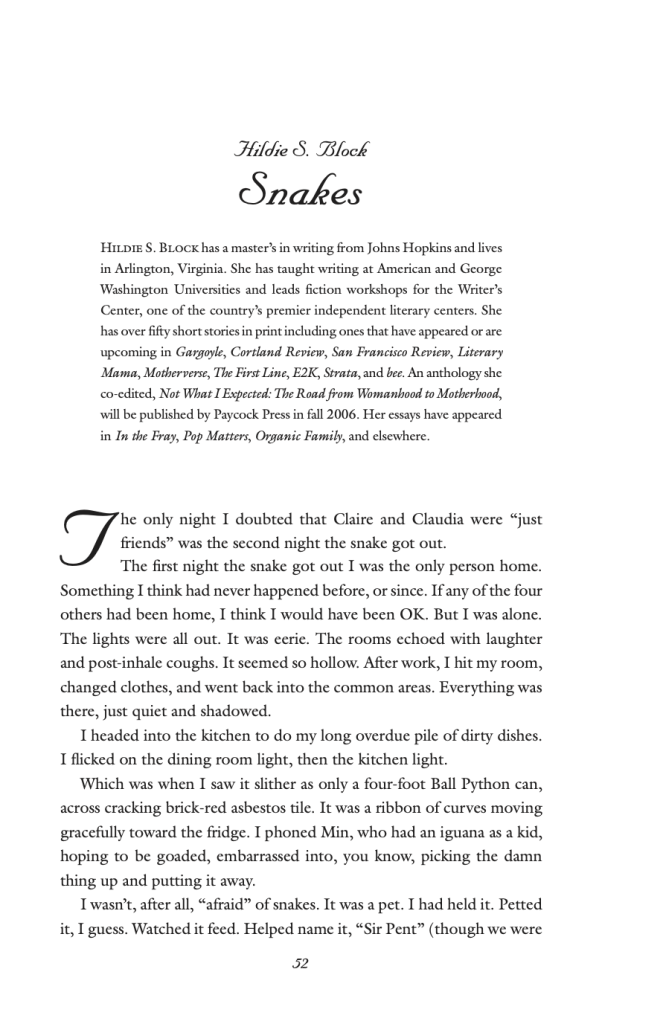
In the case of the unnamed narrator of “Snakes,” the snake in question is a four-foot ball python with a penchant for escape artistry. The snake, though of indeterminate gender, is named Sir Pent and belongs to the speaker’s roommate, Claire’s ex-husband, who abandoned his reptilian pet for a new life in Seattle—er, Olympia, Washington with a new woman named Amy. The narrator, afraid to pull the snake from where it is increasingly disappearing beneath the fridge, hides and waits for Rip, another roommate, to come home and wrangle it back into its terrarium. This is a story told in two parts—the story of the first two times the snake escaped and, somewhere hidden between, stories of identity and connection, found family, and the otherwise bizarre entanglements that can only arise out of having roommates.
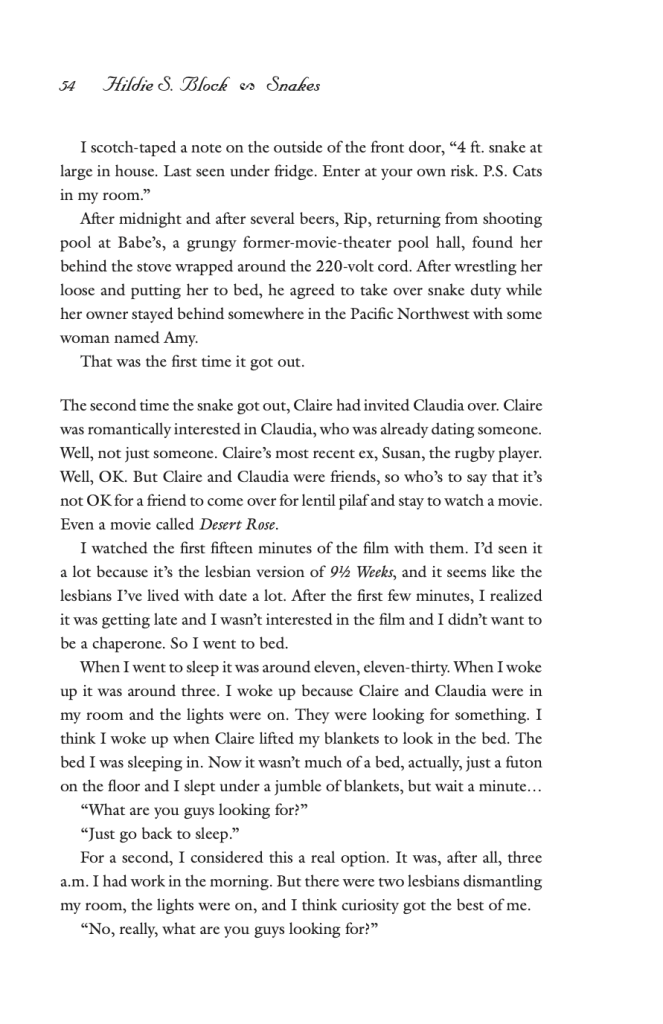
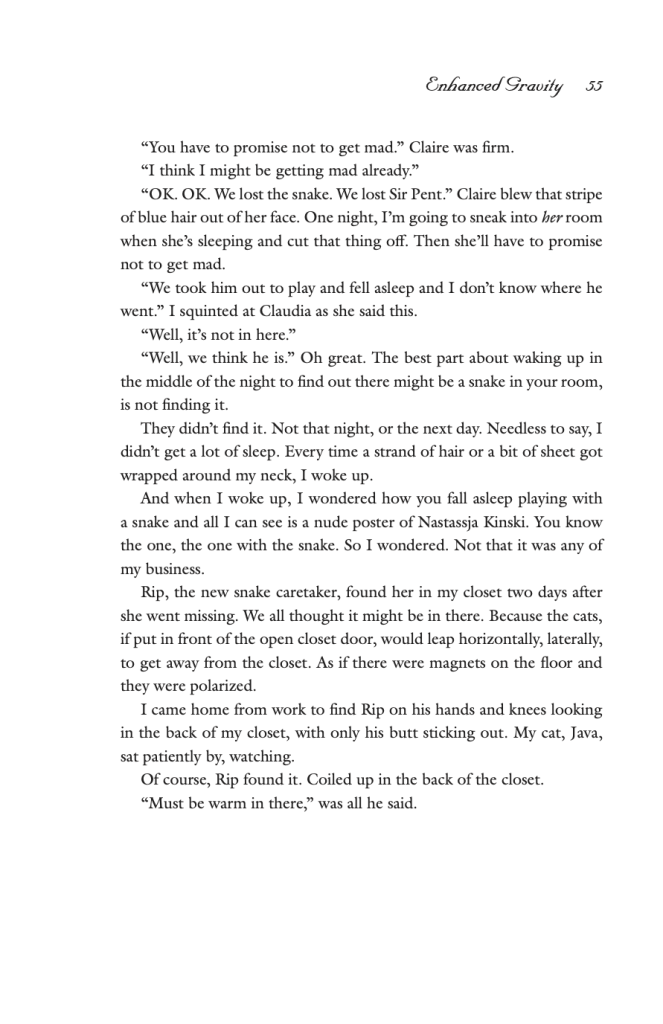
On the second occasion of Sir Pent’s escape, the python inadvertently lets the proverbial snake (read: cat) out of the bag when the speaker is awoken by two women in search of it. Claire admits that after the narrator observed her and her friend, Claudia (for whom Claire has romantic feelings), watching a queer-coded movie, the pair took Sir Pent out to play before falling asleep. The narrator, curious as to how anyone could sleep with a loose snake about and haunted by the idea of it in their room, can picture nothing that “nude poster of Nastassja Kinski. You know the one, the one with the snake” (which, though a bit before my time, even I remember). It was then that they couldn’t help but notice that perhaps Claire and Claudia weren’t “just friends” after all. When the snake is found a few days later, he is in the warm safety of our narrator’s closet—a metaphor that almost speaks for itself.
“Snakes” was initially published in 2006 as a part of the second volume of the Grace and Gravity Project entitled Enhanced Gravity. It is an excerpted story from a novel Block wrote about living in a group house not far from American University, where she spent some time teaching throughout the 2000s following the completion of her MFA at Johns Hopkins University. She’s written over 50 published short stories, which have been featured in print in various, distinguished publications. An anthology she co-edited, Not What I Expected: The Unpredictable Road from Womanhood to Motherhood debuted in 2006 and is available for purchase online here. Block’s work most gracefully tackles the gravity of everyday life. In her fictionalization of apparently mundane settings and characters, she imbues a sense of universality that is evocative of the undulations of a snake, slithering through life.
Block also has taught classes at George Washington University and is a long-time collaborator of The Writer’s Center in Bethesda, Maryland, where she leads workshops specializing in fiction and worldmaking. Since 2006, she has led workshops of her own for writers of all ages, focusing on “book-length” projects—she knows how frustrating it is for novel writers to enter shorter workshops having to re-explain their entire project to a new group of people each time. Block’s philosophy is that “a writer, by [her] definition, processes the externalia of life—the shit that happens to them—by writing about it. That’s how they come to understand it, make sense of this crazy world and keep sane.” And while personally, poetry is more my own preferred style than literary fiction, no words could have resonated more strongly with a young queer writer finding their niche. I was drawn to “Snakes” not only for the richness of its content but also because Block’s identity as a teacher shines through even in a fictional narrative. It is a story that has something palpable to impart, reminiscent of the rattle of a pit viper’s tail minus the sinister consequences.
From a critical perspective, “Snakes” is an obvious product of Block’s commitment to the practice of writing and channeling the world around her into honest, relatable fiction. What surprised me most about this piece was its use of both subtle, cerebral humor–a divorced male Nirvana fan’s snake in the closet of his queer ex-wife–and overt humor–a nameless person hysterically jumps atop a table to avoid an intruder in the kitchen, a la Tom and Jerry. I found myself rumbling with laughter reading these moments of irony and imagery, their lightheartedness intensified by their juxtaposition with the intimate and vivid details Block employs to describe the home itself, such as the “rooms [which] echoed with laughter and post-inhale coughs.” From the first line of “Snakes,” Block encircles the reader immediately into the narrator’s world, this community of people who take care of one another, who keep each other’s secrets, and herd each other’s cats away from a loose snake. She holds us here with this carefully crafted imagery, by letting us in on the inside jokes and making us feel like other neighbors of Sir Pent.
I was struck repeatedly by the story’s ability to show me a home that I not only reside within but have built, amongst and alongside other queer folks who heard the rattlesnake’s tail shaking in their own families, who have never felt allowed to truly let down their hair. We gather in each other’s kitchens, sharing food, stories, and thanks to one another. We pet-sit, do chores together, spot each other money or ingredients or favors when someone’s in need. “Snakes” not only managed to pull me towards this home and community as if they were my own but allowed me to revel again in its significance, to see the snake as a symbol of rebirth in a queer sense and understand the enduring immortality of these seemingly ephemeral moments shared between people who care deeply for one another.

 GRACE AND GRAVITY