
11/21/2022
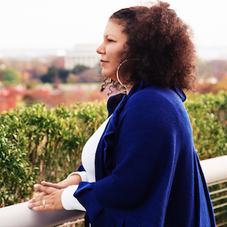
Sarah Trembath is an editor, writer, and educator. She has been teaching since 1998 and joined the AU faculty in 2014. Her written work has appeared in Radical Teacher, the Santa Fe Writer’s Project Quarterly, the Rumpus, Everyday Feminism, Sally Hemings Dream zine, Azure literary journal, DCist, the Washington Independent Review of Books, 1455 Magazine, VoiceMale, and the Grace in Darkness anthology of DC women writers. She has written two books: It Was the Scarlet that Did It (poems, Moonstone Press, 2019) and This Past Was Waiting for Me (poetry and creative nonfiction, Lazuli Literary Group, in press). She was the 2019 recipient of the American Studies Association’s Gloria Anzaldúa Award for independent scholars for her social justice writing and teaching.
As an educator, Professor Trembath sees her purpose as helping students express critical thinking through writing. She is currently a Dean’s DEI Fellow in the College of Arts and Sciences, a member of the Writing Studies Program/Library joint committee on information literacy, and a doctoral candidate in the School of Education’s Leadership and Policy Program. Her dissertation research explores students’ critical thinking around culturally biased narratives in commercially produced K-12 textbooks.
To learn more about Sarah Trembath’s work, visit her website.
Isaiah Washington is a senior at American University, being a part of the university’s Honors College and Frederick Douglass Distinguished Scholars Program. He is majoring in Literature with a minor in Political Science. As one of the university’s Honors Program Associates, he serves as a teaching assistant for the Honors Complex Problems Course, “Black is Beautiful.” He is also the Co-Editor-in-Chief for The Blackprint, which is a student publication that centralizes students of color, and the president of Circle K, a community service organization. He is the Programming Director for the AU BIPOC Student Affinity Group as well as the College of Arts and Science Undergraduate Council. He serves on the institution’s Literature Department Outreach Committee. He is an Emma Bowen Foundation Fellow, composing news stories for an NBC affiliate. He intends to pursue a career in journalism, creative writing, and public policy.
Introduction to “Swaying with Wicked Grace”
By Isaiah Washington
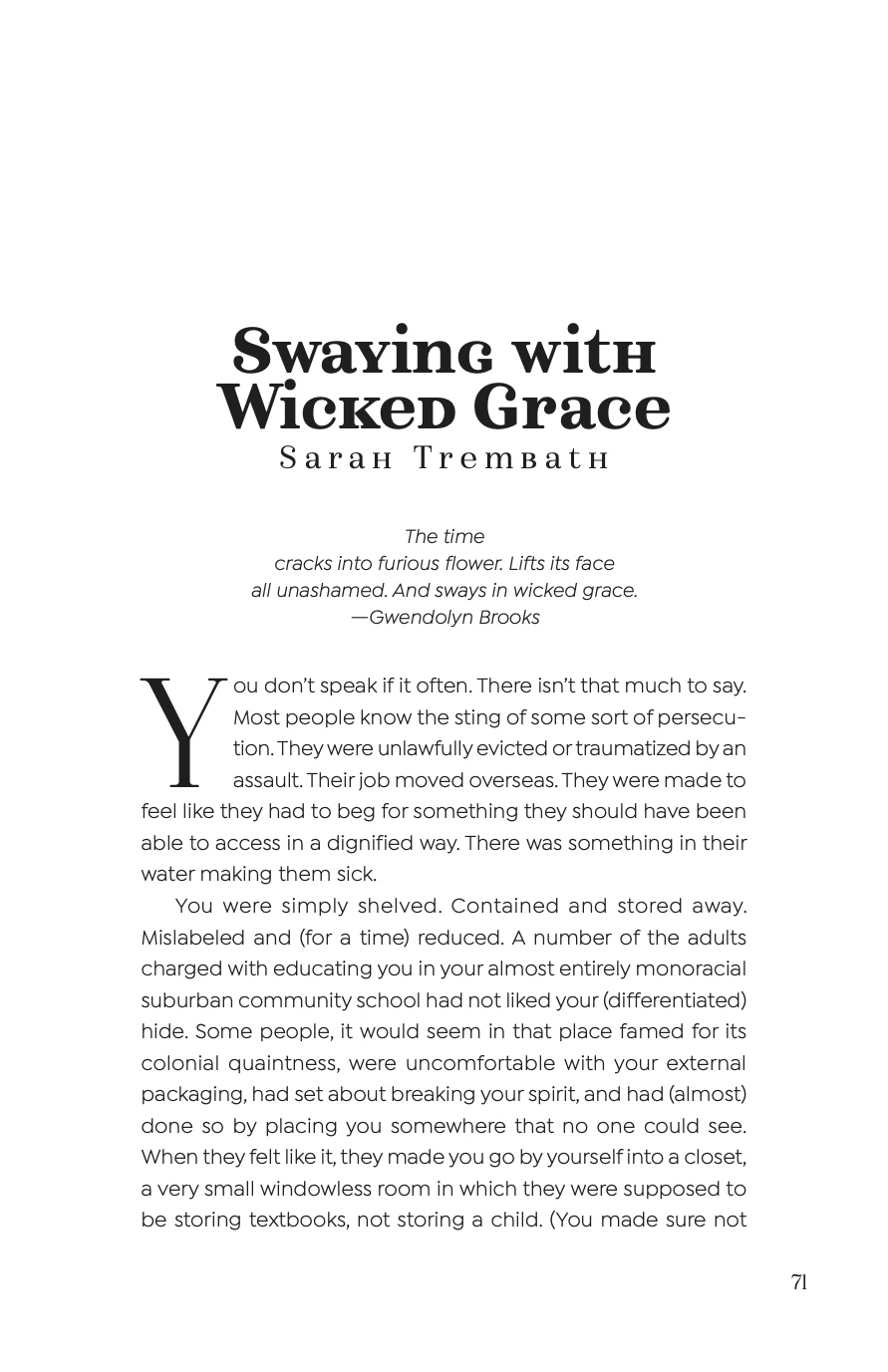
“Swaying with Wicked Grace” derives its name from the Gwendolyn Brooks poem “The Second Sermon on the Warpland” featured in the epigraph. The modification of “grace” captures the exasperation and mettle tethered to surviving a racist environment during developmental years. Sarah Trembath vocalizes the pain of her younger self through Brooks’ phrase. Both joy and pain activate her. Both “Good Educators” and “Bad Educators.” The classmates who watch her pain and the girls on the gymnastics team who see her pain.
Trembath opts for second person, sharing in a Grace and Gravity interview how the perspective lengthened the “distance” between her and “a hurtful memory.” The “you” also affords a direct acknowledgment of the child Trembath bloomed from. In addressing “you,” she addresses the pain of that child and shows her what that pain produced. This work of “history-based creative nonfiction” is also shadow work, unshelving the child and making her visible in the light on her own terms.
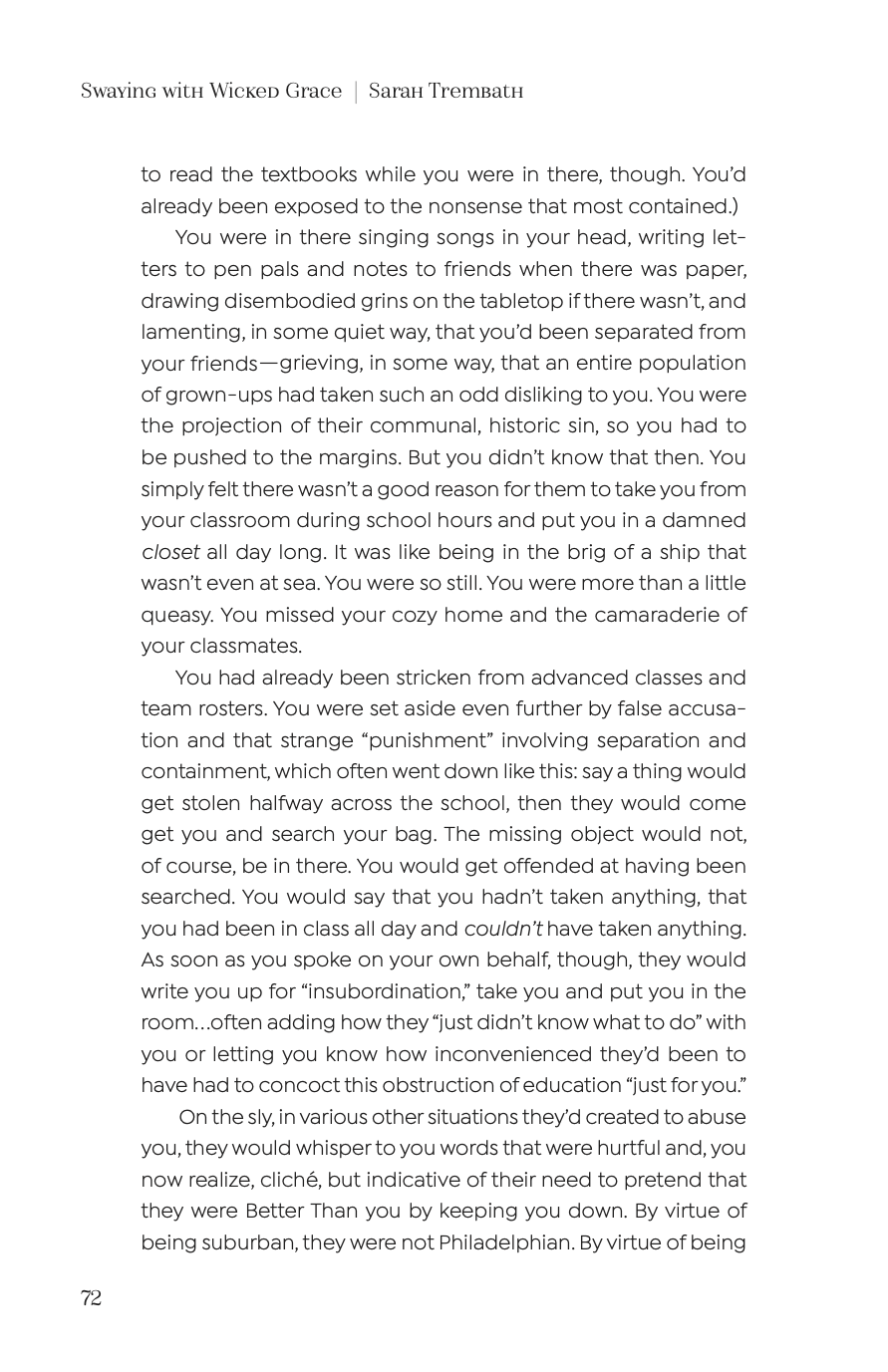
Trembath frees the child of solitude, understanding her racial trauma through precedents. Her school experiences of being dislodged from advanced classes and sports teams and being accused of stealing are not unique to her, and that mere fact delivers her comfort. In fact, “over half a million low-income children and children of color [are] missing from AP courses nationwide.” The report “Girlhood Interrupted: The Erasure of Black Girls’ Childhood” unearthed that “Black girls are more likely to ‘experience exclusionary discipline outcomes for subjective reasons, such as disobedience/defiance, detrimental behavior, and third-degree assault, all of which depend on the subjective judgment of school personnel.’ ” The punishment Trembath faces as a young girl then is not a judgment of character as Dr. King dreamed of but a reflection of the U.S. education system’s commitment to see a Black girl with a voice as dangerous.
Trembath effectively and importantly accepts that there are people who have been shuffled a worse hand, a set of cards so soaked and tattered that they are illegible. She begins the piece with a litany of hardships that do not belong to her, admitting that “there isn’t that much to say” about hers. She reflects on her time abroad, “It humbled you.”
Nonetheless, Trembath’s being “shelved” had material consequences for her self-concept and relationship with education. That word choice is well-suited for the site of her racial torment, the classroom and more specifically a closet meant for “storing textbooks.” Those textbooks, which you would believe would be an escape for a writer, spoken word artist, and editor like Trembath, participate in her oppression. Trembath has made those vehicles for erasure the focus of her dissertation research, “explor[ing] students’ critical thinking around culturally biased narratives in commercially produced K-12 textbooks.” “Swaying with Wicked Grace” charts this journey from the child who must enter school with war paint (she calls it a “fake-smile”) to the adult who is now pursuing a Doctor of Education in Education Policy and Leadership.
As a professor at American University teaching the school’s college writing seminars and African American literature course, Trembath is now in the position of power to be the “Good Educator” she did not always have. In helming a class like “Assessing Textbooks for Truth,” Trembath provides a challenge to the books in the closet that served to suffocate her, not liberate her. To her future in drafting two books and several syllabi, Trembath retorts, “who knew.”
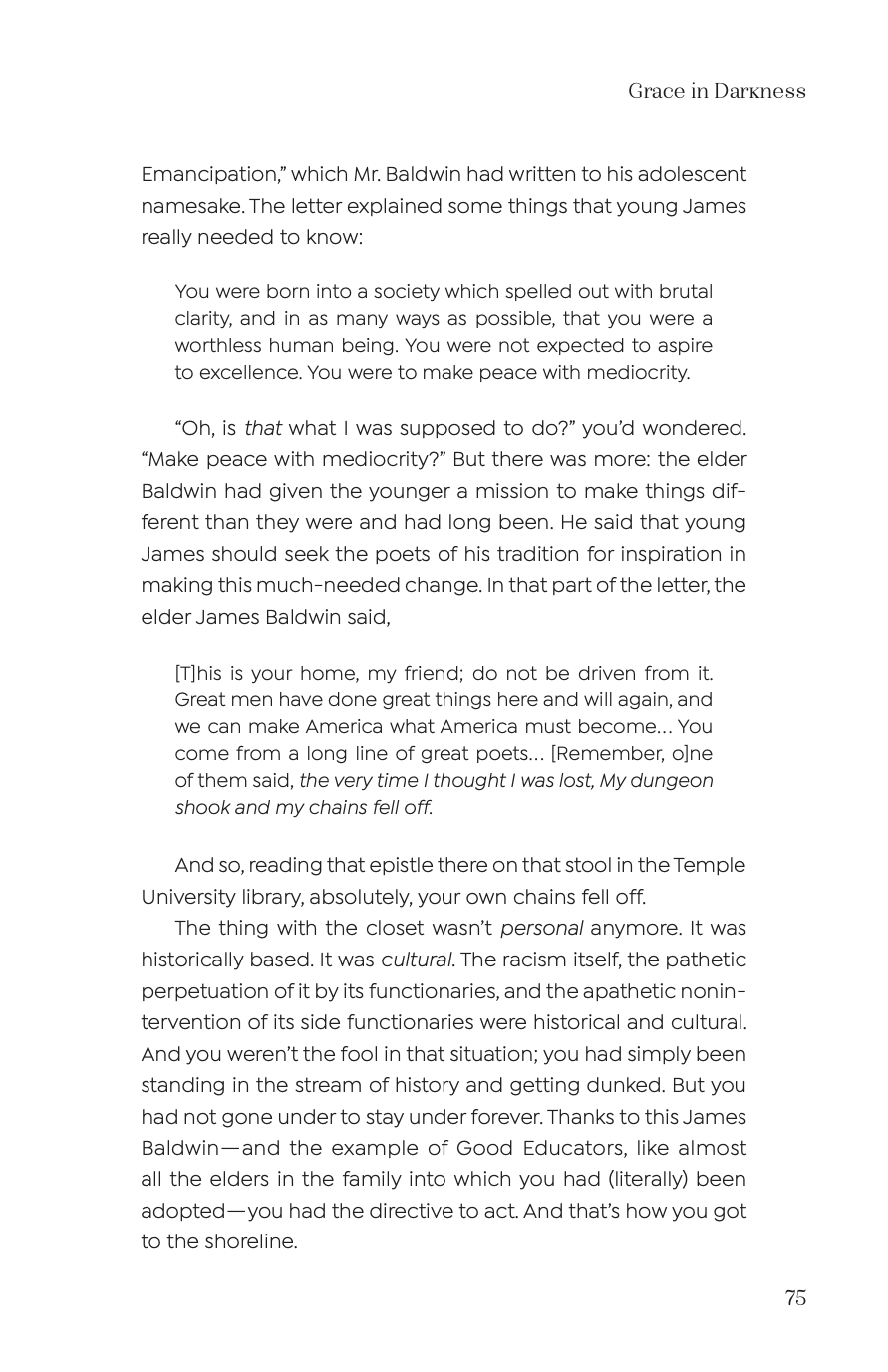
Trembath also focuses on the books that affirmed her. She begins with Alice in Wonderland imagery, feeling like Alice as she tumbled down an “absurd rabbit hole” and stenciling the “grins” of Alice’s impish friend, the latter connecting to the “wicked[ness]” found in the title. Trembath found catharsis in “Letter to My Nephew on the One Hundredth Anniversary of Emancipation,” passages lifted and rehomed in her meditation. “Elder” James Baldwin among many others whom she lists are her literary godparents, the magic dust of their wand-pens transforming “you” into a commander of prose and poetry.
For Trembath, writing is a mental escape when physical escape is not possible. Notes are passed through the slits of the closet’s vent between Trembath and her friends and “little puppy-love boyfriend.” Writing makes porous that which is impermeable to the Black body. In making racism understandable to herself, Trembath exposes the instability of its illogic. Racism is likened to an “odd disliking” and “weird stereotypes.” It is “absurd.” And like the community of writers Trembath enters to dissolve its distortion, racism has an ancestry, Trembath labeling the harm she resists as “the projection of their communal, historic sin.” Race gets named similarly. The child has a “(differentiated) hide” and “external packaging.” These phrases are removed from humanness, mirroring the way in which race gets operationalized to determine a human’s true quantity of humanity.
An indispensable observation Trembath makes is how bystanders too buttress racism. She calls them the “watchers” while “seers” are anti-racists, an active position in which racial equity is made real. Anti-racism is a concept key to Trembath’s work, her being appointed a Dean’s Diversity, Equity, and Inclusion Fellow in AU’s College of Arts and Sciences. Accessible conceits like “watchers” versus “seers” can be spotted throughout her career. Her first book This Past Was Waiting for Me published in 2018 deploys a colonialism conceit to understand the unflavor-ing of Chocolate City she witnessed, likening the actions of D.C.’s police force to the colonial agents of the European colonization projects.
Trembath also makes similar capitalization choices across her works, hitting Caps Lock for “Better Than,” “Bad Side,” “Bad Educators,” and “History” in this piece as she does with “Someone Else” in a poem titled “Themba.” In rendering these select words in uppercase, Trembath recognizes their mystification and the power given to them. “Good Educators” and “Sisterhood” are also capitalized. They are the “grace” and they are just as powerful.
She makes frequent use of parentheses: “(for a time)” “(differentiated)” “(almost).” These self-edits clarify how the piece serves as that letter to a younger version of the author. “Your (mostly) intact spirit” is most illuminating. Not having to be the soldier in the classroom anymore, Trembath allows herself a concession. She was not completely alright, not always strong. She validates that truth, the parentheses dually being an embrace of the child and a rupture of the “strong, self-sacrificing, and free of emotion” Black superwoman schema. Lines indicative of a retrospective wisdom such as “But you didn’t know that then” and “you now realize” keep the innocence many Black girls are not afforded an association with intact.
“Swaying with Wicked Grace” glitters in the light of its consistent maritime imagery. “It was like being in the brig of a ship that wasn’t even at sea.” Trembath continues, “You were more than a little queasy.” When she finally gets to hit the water, coming “to the shoreline,” her literary forebears speak to her, sirens enchanting her, wondering where she had been for so long. The “still[ness]” she experienced gets upended with the fluidity of this new education, this spillage from Temple University’s library stacks. Confinement exchanged for vastness.
Trembath reminds herself and the audience that the voice is an instrument in delaying submergement. “It is the imperative of the silenced to speak.” And so she speaks, peeling away at the duct tape indented onto the child’s mouth, empowering her against the adult actors of her racial strife. Trembath knows silence, among “recant[ing]” and “cry[ing],” to be the goals of racism. She details how self-advocacy is the igniter of its biggest blaze. How dare you speak up? Speak back? The volume of Grace and Gravity in which this piece is excavated begins with a quote from Audre Lorde, “We’ve been taught that silence would save us, but it won’t.” Even as a little girl, Trembath knew that accepting silence was to accept defeat. And so she sang. She wrote love notes. She drew “disembodied grins.” She spoke. And now she teaches others to do the same.





 GRACE AND GRAVITY