
4/21/2023

Molly McGinnis studied literature at American University. Her writing has been featured in Guernica, CQ Researcher, Hobart, the Journal of Clinical Oncology – Oncology Practice, and the Washington Independent Review of Books. She lives in Washington, DC, where she works as a clinic administrator for George Washington University.
Ellianie Vega is a writer based in Washington, DC. Her work explores themes of embodiment, queer futurity, and killing respectability politics. She has been published by the Academy of American Poets, Cutthroat Literary Journal, the National Museum of Women in the Arts, and Thin Air. She is currently pursuing an MFA from American University, where she is the fiction editor of FOLIO Literary Journal and is working on her first novel.
Introduction to “The Bright Codes”
By Ellianie Vega
Since 2020, society on a global scale has had a tenuous relationship with physical reality. Now living in a COVID-endemic world, we seem to be split between occupying virtual realities with those we’ve never met in real life and reentering the physical world with unprecedented intensity. The digital world may allow for genuine connection, but it still has an air of unreality to it, and physical events that don’t have digital verification of their occurrence can feel just as unreal. COVID, an illness that spreads invisibly, has had the side effect of making some of our lives feel more and more physically unstable with no certainty of a full-bodied future on the horizon. Written in the backdrop of another invisibly spreading outbreak, Ebola, Molly McGinnis’ “The Bright Codes” speaks directly to how we can accidentally fade into the background and feel as if we’re disappearing. “The Bright Codes” is a masterclass in understanding the way that we minimize ourselves in the face of global uncertainty while gently leading us back to reality through human connection.
A 2017 American University graduate, Molly McGinnis’ fiction is entrenched in science and focused on capturing the unreal. Since graduating, McGinnis has worked in the field of medical ethics and has written for organizations such as the American Society of Clinical Oncology (ASCO) and The American Institute of Physics. It’s no surprise that McGinnis’ work is so heavily tied to medicine, biology, and computer science. In McGinnis’ stories, strings of icicle lights resemble DNA, lit MRI scans float like jellyfish, and the world sometimes appears to be made of spinning molecules. In a 2018 interview with Grace and Gravity, McGinnis described her work as having “genetic markers” of dislocation, disappearance, fading, and descriptions of lights. But while many of her works explore the scientific mysteries of the natural world and their shifting truths, McGinnis is ultimately unmarried to genre and believes that “you just have to choose the one that will be best for the story.” Aside from her works of fiction, McGinnis has also published poetry and creative nonfiction in journals including The Adroit Journal and Guernica.
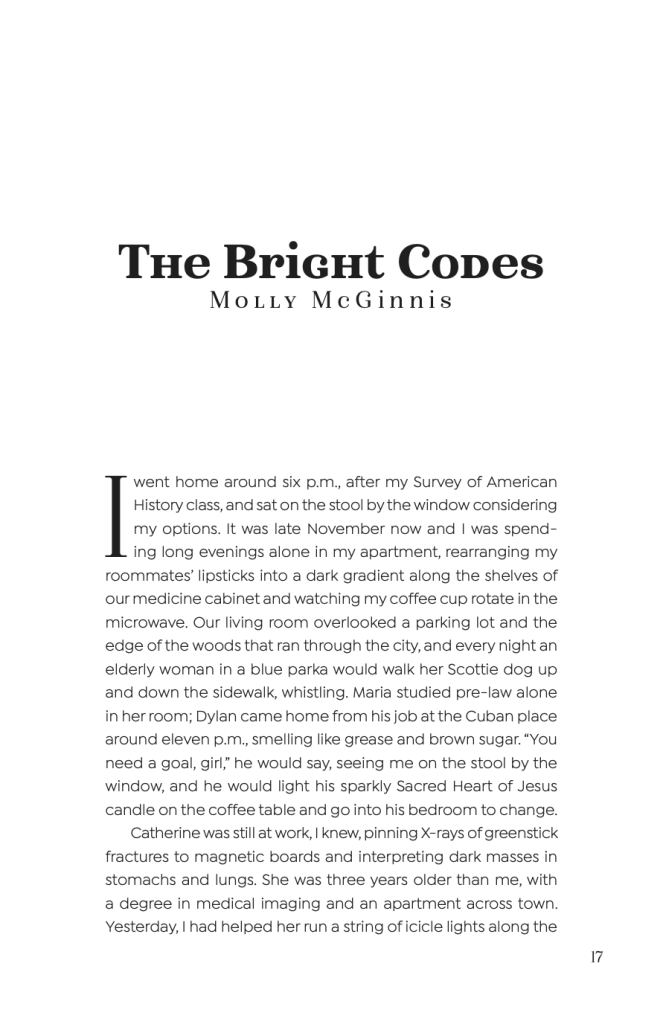
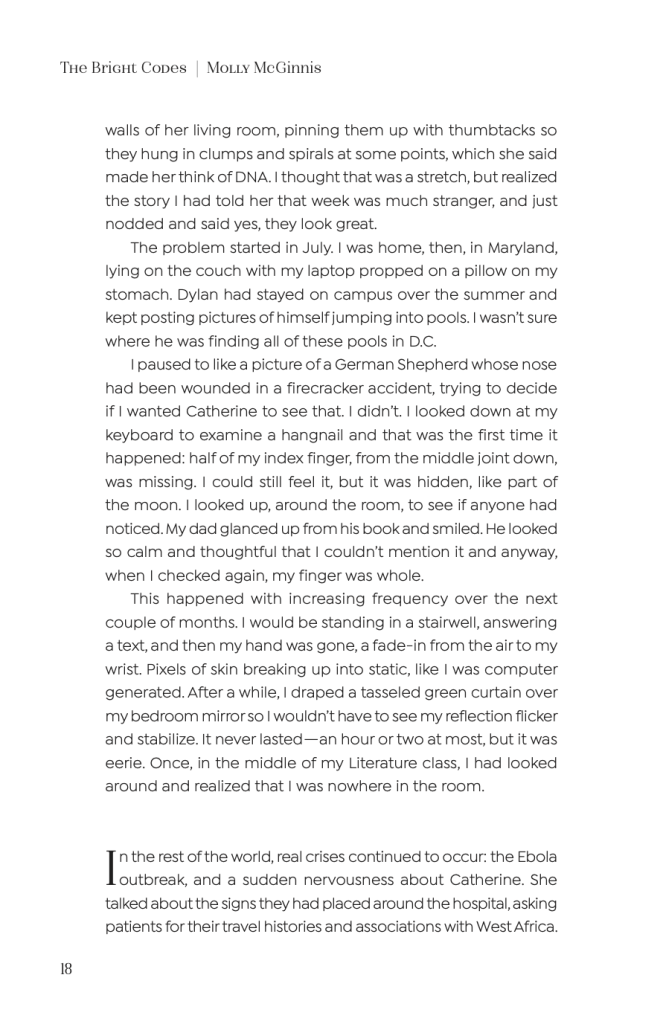
“The Bright Codes,” featured in Grace in Darkness, is told from the first-person perspective of a college student named Lisa as she watches herself fade in and out of reality while, “in the rest of the world, real crises continued to occur.” Lisa’s invisibility begins when she notices that the middle joint of her index finger is invisible, but tangible, almost as if it were a hidden sliver of the moon. She remarks that, “there’s no way to prove that this is real; all people ever notice is that I’m missing, like I just didn’t show up. They don’t ask why.”
McGinnis brings her readers into Lisa’s uncertain reality using slipstream style and glitchy, gorgeous language. Lisa’s “pixels of skin break up like static” and illuminated MRI scans “float on the walls like moon jellies.” Lisa begins to occupy the world without a point of reference and becomes absorbed by her surroundings literally and metaphorically, causing the reader to question whether the world is falling apart or if Lisa’s experiencing a psychotic break. Even though it may be easy for readers to slip into Lisa’s captivating description of her unreality, Lisa herself stays psychologically anchored to the world around her with the help of friends and family that ground her… at least at the start.
The unexpected heart of “The Bright Codes” is the tethering relationship between Lisa and her older sister, Catherine, who is the first person Lisa confides in about her unpredictable invisibility. As an X-ray technician, Catherine spends her days turning the invisible visible, uncovering breaks and fractures, but also hidden dolls, silverware, crayons and more in locations of the human body they should never be. As someone whose job it is to uncover the unseen, Catherine’s inclined to believe in what might not be there, but she remains skeptical of Lisa’s condition. Having suffered from unnamed psychological problems in the past, Catherine pushes Lisa to go see a neurologist or psychiatrist, even suggesting that Lisa’s problem may be genetic. For Catherine, the “world seemed to stream around her in a series of bright codes,” and she believes that one day a researcher will crack the code of what’s wrong with her and everything will fall into place. Lisa and Catherine’s experiences are opposites of each other: Catherine lives in a world of brightness while Lisa falls into the dark.
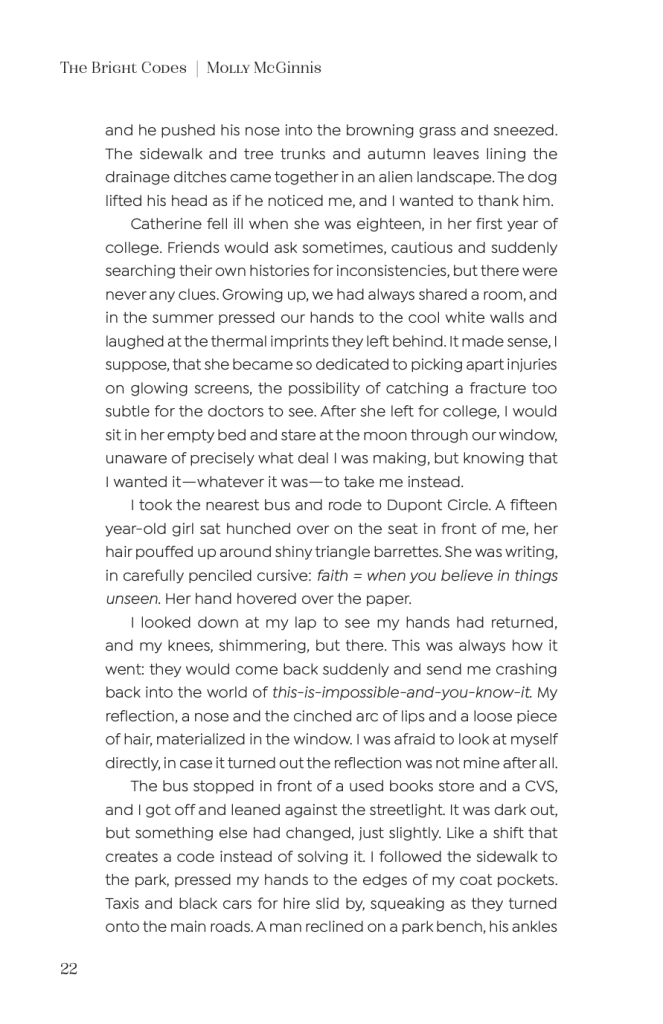
Throughout its pages, “The Bright Codes” pays careful attention to the depiction of Catherine and never allows her invisible illness to define her. Instead, McGinnis tried hard to stay away from tropes, and aimed to “write the illness in the context of Cathy, rather than write Cathy solely in the context of her illness.” While Lisa’s invisibility is described in vivid detail from the beginning of the story, the sudden illness that Catherine develops in her first year of college is unexplained until three-quarters through the plot, but the information doesn’t feel withheld. Instead, the absence of naming the condition allows Cathy’s experiences to never feel pathologized within the story. We do not need a name to understand what is happening to Catherine and Lisa: we can see from their eyes ourselves. At no point in the story do Catherine’s experiences with unreality diminish her authority or intellect and instead, she remains a guiding, grounding force within the narrative.
Invisible illness in all its forms—psychiatric, chronic, and endemic—is the core of this story. McGinnis originally began writing “The Bright Codes” during the 2014 Ebola crisis and began thinking about how Ebola was a “huge, invisible threat, where symptoms became visible only when it’s too late, and the other part of the threat was in its invisibility.” Within Lisa’s world, Ebola continues spreading while nobody pays attention in the same way that almost nobody notices Lisa’s decline.
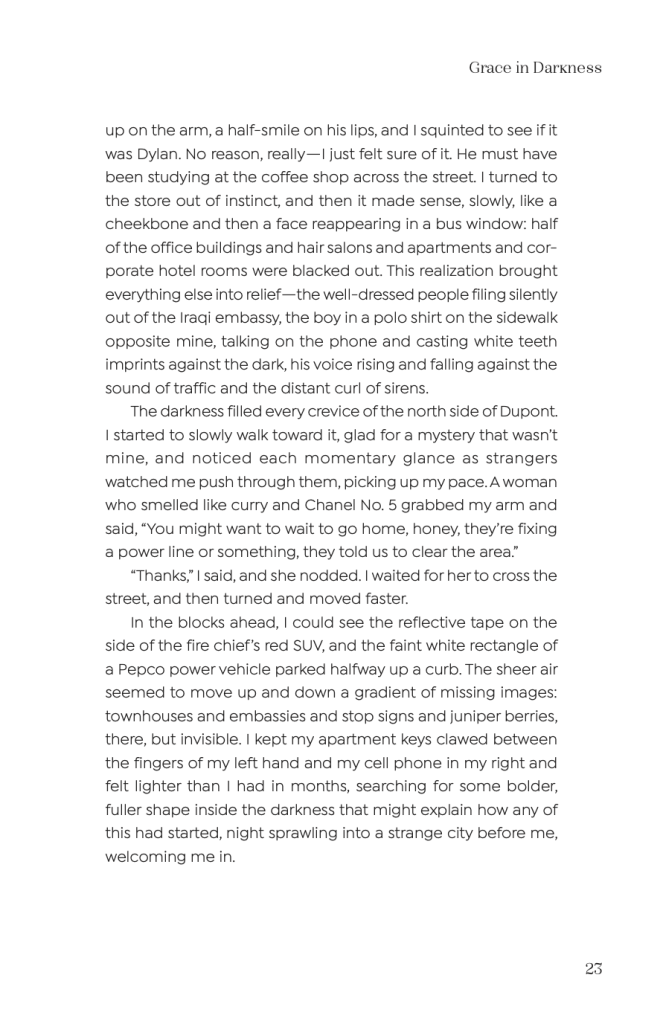
“The Bright Codes” climaxes in a stream-of-consciousness segment that blurs reality completely. After remembering what it was like to grow up with Catherine, Lisa remembers how she felt when Catherine first felt ill, and recounts how she wanted to make a deal and switch places with her to ease her burden. Lisa walks off a bus into a Dupont circle blackout, itching for a mystery that isn’t her own. She notices that even strangers can see her as she pushes her way through them and approaches the darkness. The landscape seems alien, but rather than fear the blackout, she searches for a “bolder, fuller shape” inside the darkness that “welcomes her in.” But rather than disappearing, Lisa becomes full bodied in the darkness, her invisible body coming back into focus, as everything else glitches out from her view. By ending with Lisa disappearing into the night, “The Bright Codes” speaks to how we can sometimes find ourselves again by diving into the darkness.


 GRACE AND GRAVITY