
4/26/2023

Daien Guo is a writer based in Washington D.C. She has published her writing in Lunch Ticket, Bodega, Furious Gravity, Little Patuxent Review, 3Elements Literary Review, and has been a resident at the Virginia Center for Creative Arts.
Karan Bacrabail Tekwani is an undergraduate at American University, majoring in Creative Writing and minoring in Transcultural Studies. Moulded by their time in South Asia and the United States, their work focuses primarily on the intersections of race, gender, sexuality, and pop culture.
Introduction to “The China Expert”
By Karan Bacrabail Tekwani
“My China is the world of a young child; it exists only in my memories and in the memories of those who were with me, who cared for me.”
“The China Expert,” by Daien Guo, is a rejection of the narrow lens through which the Western world tends to read those from beyond its shores. With gentle irony and poignant recollection Guo tackles rigid western preconceptions often casually imposed on huge swathes of the non-white world. In rejecting these preconceptions, Guo brings to the page vivid threads of memory spun into a resonant tale that grapples with the seemingly insurmountable pressure of retaining your sense of self in an alien world that insists it knows better than you. In rejecting these malformed preconceptions, Guo brings to the page vivid threads of memory spun into a resonant tale that grapples with the seemingly insurmountable pressure of retaining your sense of self in an alien world that insists it knows better than you. In an interview published on the Grace and Gravity website a few years back, Guo lays bare her intention to reclaim the Orientalist notion of the “China Expert,” a denomination born of tokenization, endemic to life in the diaspora, by centering her own memories of childhood. Having emigrated to the US from China as a young child and now living in DC with a family of her own, it is her memory of her early life in China that informs and underlines her writing and imbues her work with heart, color and emotive weight. Though she remained in China under the care of relatives while her parents left for the United States in search of a better life for the family, she was eight when she joined them in suburban Maryland, leaving behind a singular world of small town China filled with diverse and interesting characters, warm memories of loving relatives and quirky pets and a China she still finds difficult to reconcile with the Western perception of “China” as an entity where people don’t make the distinction between its government and its diverse and distinct cultures and individuals.
Opening within a drab conference room, Guo slips back through time tracing the thread of a distant memory. The dull gray carpet of the office building she finds herself trapped in morphs into the silhouette of her grandmother’s smocks, an effortless transition that lays bare the thesis of her story: the passage of time erodes even the sharpest of memories, but a thought put to page is a thought rendered immortal.
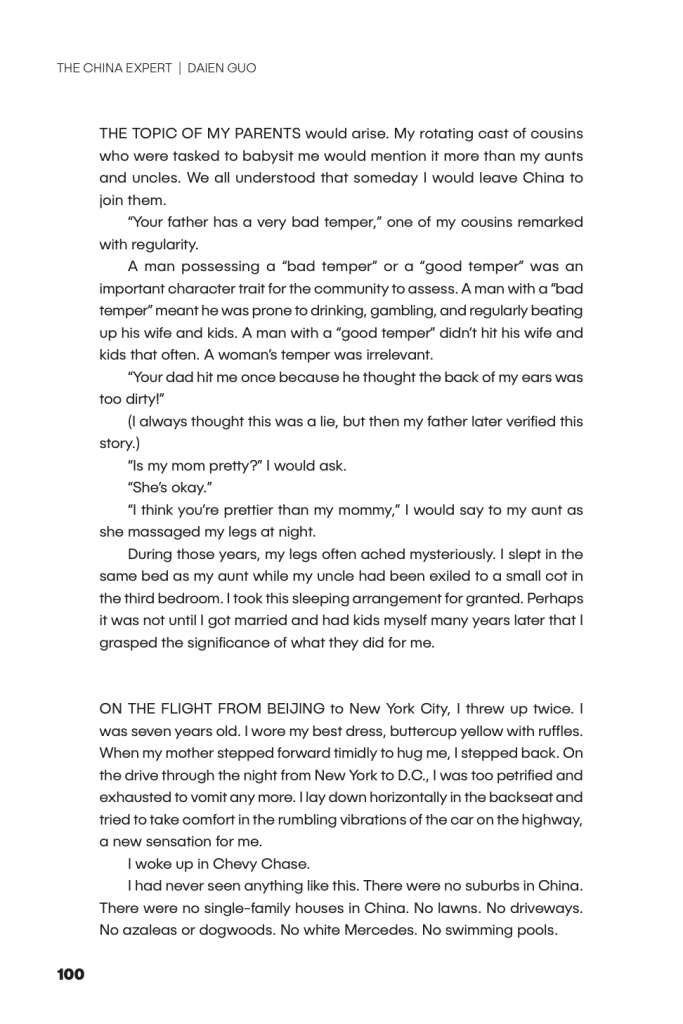
This sense of sentimental nostalgia permeates every word, as does a wonderful sense of irony–the piece is bookended with anecdotes that reflect on the cyclical nature of the American Dream. Immediately conjuring images of a staid government official both representative of the larger than life image of the Chinese government and western perception of China and Chinese people, Guo then proceeds to unearth a different kind of “China expert’: a child growing up in small town China, left behind by parents pursuing the American Dream in the tender care of relatives. Falling cats, de-feathered chickens, uncles, cousins, rivers and mountains, abundant food and quiet sacrifice weave a story of childhood that is quirky and warm, never emphasizing, but also never letting us forget, the child who was left behind, waiting. The China of her childhood memories is a study in contrast, full of love, color, and character, far removed from the tired cliches of the Chinese government put forth by obtuse coworkers. She describes it with love, colorfully and cleverly. Green and yellow trains, soy-drenched noodles; sunflower seed shells crunching on the floors of rail cars, cats in cardboard boxes and crimson roosters.
An autobiographical piece, “The China Expert” presents itself as the natural evolution of Guo’s writing career. In her interview with Grace and Gravity, Guo mentions that while she has written a variety of pieces covering a broad swath of topics, it is the pieces that explore her experience with and relationship to China that tend to draw the most eyes, a natural result, she notes, of Western fascination with China. Specifically about ‘The China Expert’ Guo says, “I said ‘Oh I don’t want to pander to people’s fascination about China’ but in a way, this title kinda does! I liked the title because it would suck people in…because everyone wants to read about China policy— [laughs] I don’t know why!”
Her repudiation of orientalist notions manifests in this piece as a vivid, intimate collage of childhood memories that effortlessly avoids becoming excessively saccharine, that I found immensely relatable, myself having immigrated to the United States from Singapore with my parents at the age of nine.
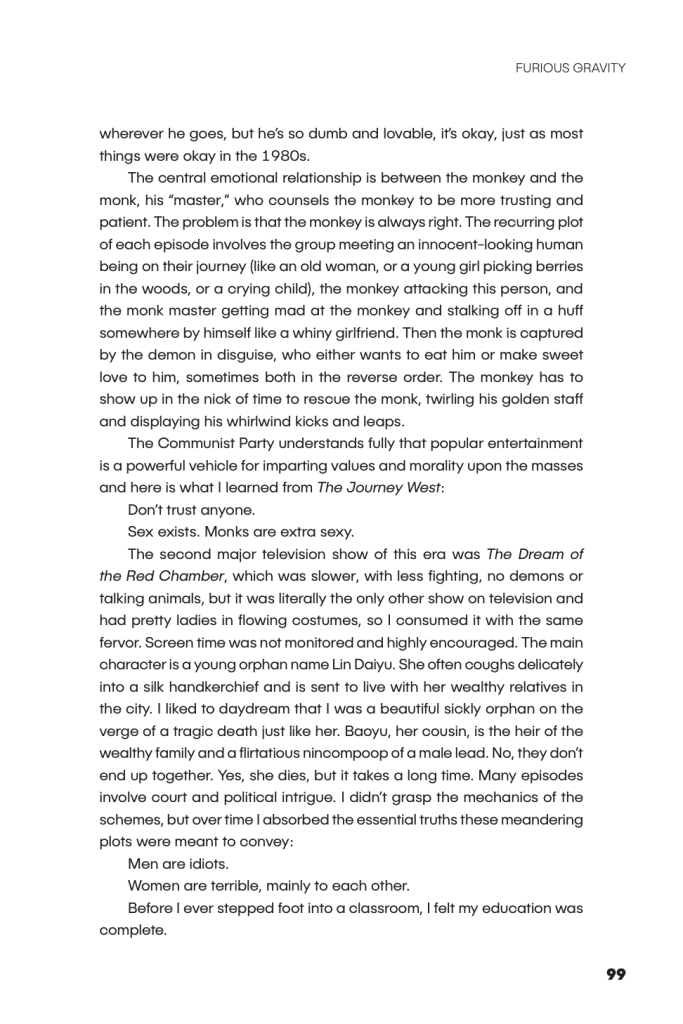
These musings on childhood past are intercut with observations on culture and politics that foreshadow the adult she will become: Guo describes in detail two seminal television programs that were popular during her childhood as both entertainment and propaganda, her use of irony firing on all cylinders as she writes, seemingly to the very white men whose drudgery prompted this current of introspection, that “The Communist Party understands fully that popular entertainment is a powerful vehicle for imparting values and morality upon the masses,” with reference to television shows The Journey West and The Dream of the Red Chamber. I’m sure, though, not one of them could wait for the new Top Gun.
The thematic core of Guo’s writing reverberates with common themes in migration literature: identity and memory, assimilation and alienation Her story speaks to the experience of many first and second generation Americans. Yet the transition from wide-eyed wonder to suburban contentment is dealt with without cliche or derision. It’s the natural order of things. Similarly, the equally complex task of attempting to reconcile childhood memory with her day job as a ‘China expert’ is accomplished without melodrama. They both must exist, one in the heart and the other in the mind.
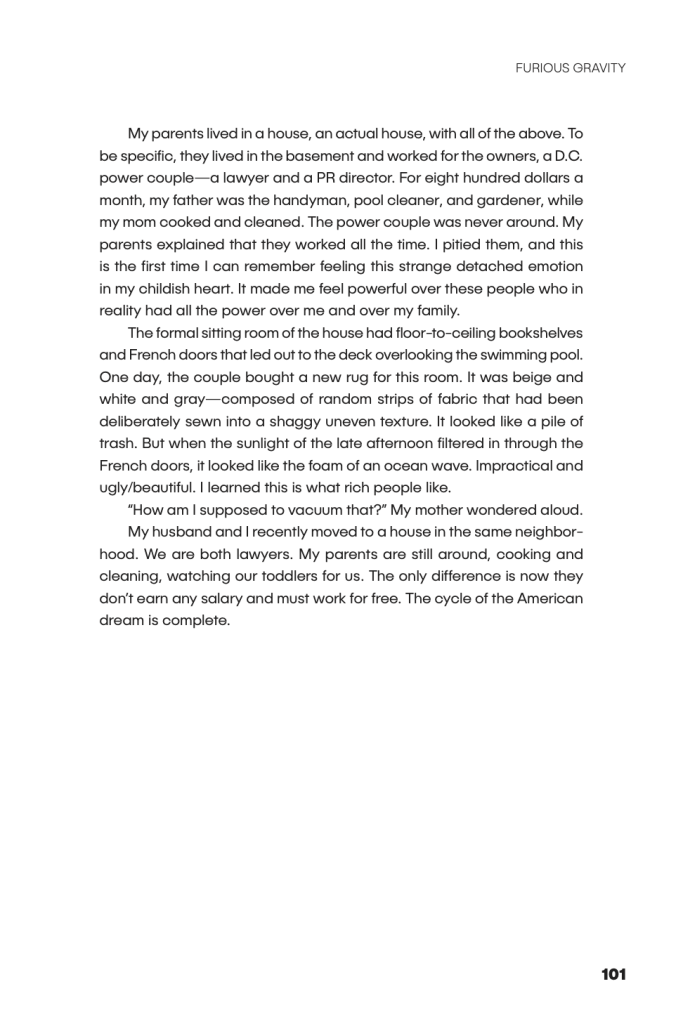
Closing just as it opens (with a twist of irony), The American Dream, turns out to be a basement in suburban Maryland where the parents are caretaker and handyman for a wealthy family. But the child turns out alright. A lawyer, married to a lawyer living with her kids in the same suburb where her parents lived as hired help in a basement. It’s just that now, her parents care for her family and babysit her kids.
“My husband and I recently moved to a house in the same neighborhood,” she writes. “My parents are still around, cooking and cleaning, watching our toddlers for us. The only difference is now they don’t earn any salary and must work for free. The cycle of the American dream is complete.”
 GRACE AND GRAVITY