
4/24/2023

Caroline Bock is the author of Carry Her Home, winner of the Fiction Award from the Washington Writers’ Publishing House, and LIE and Before My Eyes, young adult novels from St. Martin’s Press. The winner of the Writer magazine story award and the Adrift short story award, her creative work has also recently appeared in SmokeLong, Brevity, Gargoyle, Grace & Gravity: DC Women Writers, Jarnal and more. She is the co-president at the Washington Writers’ Publishing House, a nonprofit independent literary press based in Washington DC. A graduate of Syracuse University. she studied creative writing with Raymond Carver, and earned an MFA in Fiction from the City University of New York. She lives in Maryland with her family and is at work on a novel. To learn more about Caroline Bock’s work, visit her website.
Olubunmi Adeloye is a research assistant and graduate student at American University who studies Literature and Technology. She is focused on West African history and mythology in fantasy and other speculative fiction. She is currently working on creating video games, her first novel, and building an online database of Shakespeare’s Soliloquies.
Introduction to “The Critique Group”
By Olubunmi Adeloye
When I was in middle school, I used to have friends that would read my stories and talk with me about them. Even though they weren’t writers themselves, these friends were the first people I showed my writing to and wanting to entertain them was what inspired me to write every day. Over the years, I lost contact with those friends and eventually started to write less because I had no one to share this passion with.
“The Critique Group” is about a group of writers who gather together to talk to each other about their work, though we don’t actually see any critiquing in this story. Instead, we see the four women talk to each other about their families, their love lives, and their fears. The age gap between the oldest and youngest woman is 21 years, but this doesn’t affect how close they are. These women are ‘lucky’ to have found each other and that is the core theme of this story.
“The Critique Group” starts with the word “we” for this reason. The only time the word “I” is said is by the man that comes in at the end. The narrator uses the word “we” instead of “I” because when you become part of a group, a collective group identity is formed and she associates her personhood with the rest of the women in the group. The women that form the group are individual people but they become one when they gather.
“The Critique Group” shows how women can empower each other “to write about anything.” It is tender to see how the other women in the group react to the youngest one by gathering towards her to “urge her to write more.” For the youngest one, the intergenerational friendship between these women means that she has three older women as supportive mentor figures and role models which all young women need.
“The Critique Group” was written several years ago but it has aged as well as the wine the women in the story drink. The COVID-19 pandemic led to lonely years where social interaction was prohibited and we’re still in the early stages of gathering together in person once more. There have been many bonds that were lost or never formed due to the restrictions of the pandemic. This is why I was so delighted when I reached out to Caroline Bock and she told me that this critique group of hers is still together. As a reader, I had the sense that friendship between the women in the story could survive anything so I was happy to hear that their friendship really did transcend time and a pandemic. Caroline Bock has had multiple novels published and received critical acclaim that I’m sure her friends from her critique group have been there with her to celebrate, and that she’s celebrated their own successes as well.
Reading this story personally inspired me so much that after, I went to find a writing group of my own. When I reread this story after attending the writing group, I was able to see the story in a whole new light. Some experiences can’t be taught or explained, they can only be felt. There’s nothing like arriving in a warm room on a rainy night, sitting down with your laptop knowing that you won’t be getting much writing done anyways, and being able to spend precious time just talking with other writers about anything and everything. We talk about books, life, work and our writing but it doesn’t matter what we talk about. All that matters is that we’re gathered together and even though we’re different people, we have a shared connection that transcends all our individual quirks. I’ve now written several stories this semester, more than I’d done in years, and I couldn’t have done it without the support of my writing group but finding a supportive community isn’t the end point. It’s only the beginning.
The following is a selection from Abundant Grace, page 14.
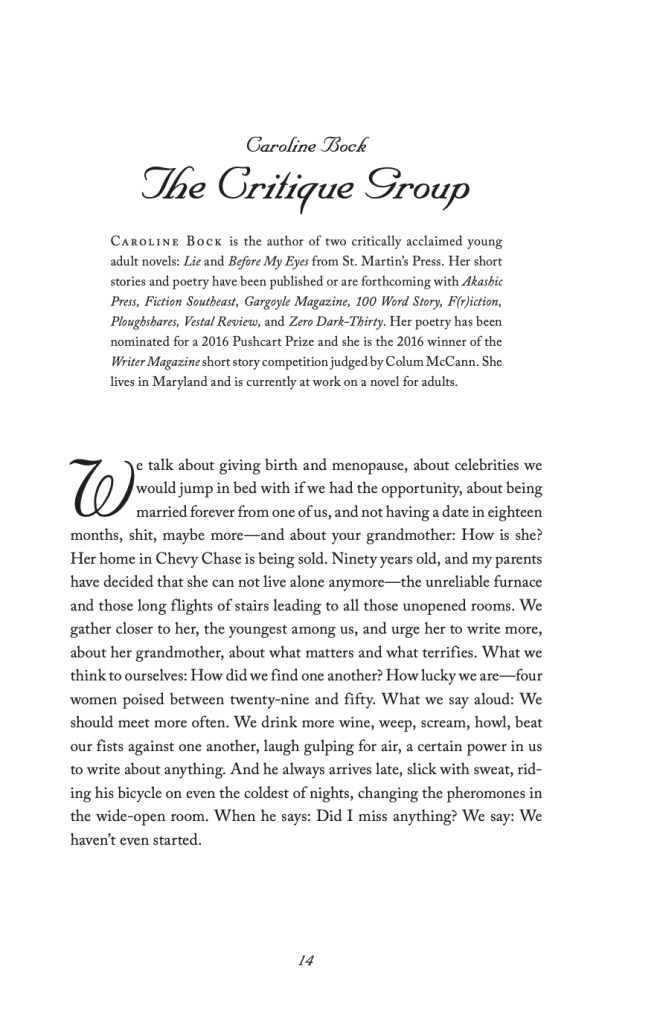
 GRACE AND GRAVITY