
4/7/2023

C. Jenise Williamson is an educator and creative whose short fiction has appeared in Satire, Painted Bride Quarterly, and The Fiction Week Literary Review among other small presses. She founded the creative writing program at Bowie State University after receiving her MFA from the University of Maryland. She continues to take Scottish fiddle lessons and zooms occasionally with Scottish friends abroad. To learn more about C. Jenise Williamson’s work, visit her website.
Jack Hawkins is a writer with a BA in English from Vanderbilt University and is currently pursuing his creative writing MFA at American University. His Dell Award winning short story “Hellish Takeout” is slated to appear in the upcoming June issue of Asimov’s Science Fiction magazine. Jack’s speculative fiction pieces tackle all the lovely-slash-horrifying absurdities, hypocrisies, and grotesqueries of living in modern society.
Introduction to “The Fiddler’s Wife”
By Jack Hawkins
While acquiring proficiency in any instrument is no small feat, violins and other members of the string family have garnered an intimidating reputation as being especially difficult to learn. There are no keys, no frets, no safety nets – just fingers rapidly darting along tautly fastened catgut strings as another hand minutely alters bow pressure for every note. Plainly stated, fiddles are pricey little monsters to master, but Scottish husband-slash-father Tocher in C. Jenise Williamson’s “The Fiddler’s Wife” is a consummate professional of the craft. His skill is commendable. However, it is through a series of hyper-intimate moments shared with his wife Fay that readers come to understand how reaching success in artistic fields affects loved ones. For despite Tocher’s notoriety, “The Fiddler’s Wife” is without question a woman’s story, one deeply seated within a melancholic, beautifully rendered Scottish setting which begs readers to lose themselves in its uniquely immersive charm.
Originally released in Enhanced Gravity: More Fiction by Washington Area Women, Williamson’s narrative is split into dual parts, though said parts aren’t relayed directly one after the next. Rather, they’re divided and slotted into place like a shuffled deck of cards. After an opening scene introducing the main couple, the story segues into an italicized chat held between a pair of dishwashers, the implication being that one of them has dreamt up the entire Fay-Tocher storyline. These vignettes only contain lines of dialogue; blocks of traditional prose are meanwhile stripped away, resulting in a dreamy disconnect wherein these halves feel divorced from each other yet also oddly inextricable. Williamson treats her story akin to a discussion, ping ponging back and forth. There’s a paradoxical cleverness in how she manages to hold true to the classic axiom of show-don’t-tell whilst implementing so many conversational exchanges for the sake of character building.
Combing through her catalog of stories featured in publications such as Satire, Painted Bride Quarterly, and The Fiction Week Literary Review, it’s quickly apparent that Williamson harbors a fondness for dropping readers into the midst of things – not so much in the middle of action but rather history. A story of hers titled “The Prisoner” begins long after most of the climactic, life-altering events have unfolded for its characters. The focus falls not on how a life has changed. It focuses on what happens after, and dialogue, for Williamson, conveys that story more effectively than anything else. Ergo, she refuses to bog down her plots with extraneous details pertaining to – say – Tocher’s past. The specifics explaining why he acquired a passion for fiddling, the first meeting between he and Fay, the ages of their children – the story requires none of these because their histories are already woven so seamlessly into the text. For example, the fact that Tocher possesses Scottish heritage is made abundantly clear because of his thick, phonetic dialogue. The words “Lie doon” open the story, and their simplicity belie just how much work they’re accomplishing within the wider narrative. Williamson permits readers the basic joy of feeling her characters, intuiting their internal states and possibly even finding something with which to resonate.
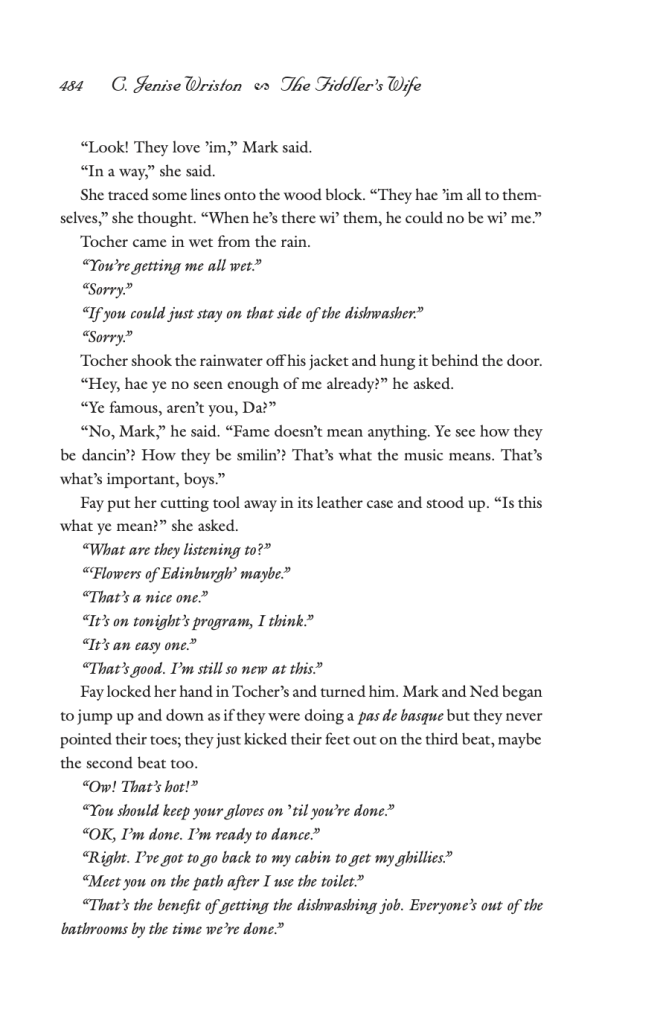
As someone who did quite a bit of violin from elementary through high school, I find myself latching onto one specific quote from Tocher: “Fame doesn’t mean anything. Ye see how they be dancin’? How they be smilin’? That’s what the music means. That’s what’s important, boys.” Now, I obviously couldn’t match Tocher’s expertise with the fiddle. I was never all that great, but I find myself wholly in tune (pun intended) with his perspective on how the act of playing music is less pleasurable when it takes place in a vacuum. Williamson, herself a fiddler, writes in her blog on the holistic nature of creative expression. She writes, “Performing any creative act in a worthwhile endeavor improves creativity in other endeavors. I took up the violin, danced Scottish reels and strathspeys, remodeled kitchens, sculpted models of original landscape designs… While they weren’t works of fiction or essays, they fed my creative desire.”
The Fiddler’s Wife” takes this philosophy a step further, framing art as a sort of connective tissue for humanity. In my experience, the gig itself does not generate the most happiness. It is the confluence of factors surrounding it – teachers, peers, friends, and family commingling to create something utterly fantastic that separately would have been impossible. What makes “The Fiddler’s Wife” so brilliant is how it leans into this idea that artmaking is inherently conversational.
To those unaware, “tocher” is the Scots term for dowry, a marriage settlement given to the groom by the bride or her family. Similarly, Fay surrenders a portion of her happiness to allow Tocher to go off on his excursions. “‘[The dancers] hae ’im all to themselves,’ she thought. ‘When he’s there wi’ them, he could no be wi’ me.’” When he travels, the joy he creates belongs to the dancers, not to Fay. Tocher may do his damnedest to adhere to the altruistic principle that music should make people smile, but in pursuit of this goal, he has inadvertently detached himself from the ones he cares about most. Fay too practices her own art – one that may not be as popular as her husband’s yet nonetheless valuable. It is because of her art that she declines Tocher’s offer of travel, much to his consternation. Fay proves here that she is by no stretch a pushover. There is an undeniable strength in her commitment. These two are engaged in a dialogue, and try as he might, Tocher experiences difficulty accepting his wife’s decision.
The tale of Fay and Tocher concludes with everything tied up in a clean bow. The dishwashers, on the other hand, are still a rather mysterious element. In a story that relies so heavily on subtle characterization, there isn’t much to go off regarding their lots in life. One can infer that they are fans of Scottish culture, but aside from that, we don’t even know if these two are in a romantic relationship. Here’s the thing, though: It doesn’t matter all too much. Why? Because they are still finding elation in the universal joy of creation by attending the dance and entertaining themselves with stories.
There are as many reasons for creating art as there are people on planet earth. It can be a method for self-expression. Some create for the pure novelty of the act, pleasure from a job well done. There’s fame – that’s always a solid motivator. For others, the incentive lies in the fun associated with the act, and sure, art is fun when done by oneself. It’s therapeutic, ameliorative, and a thousand other synonyms that I could easily rattle off. But above all else, art should eventually be shared with the ones we love. It is only then that it transforms into something truly spectacular.



 GRACE AND GRAVITY