
4/20/2023

Raima Larter, a former chemistry professor in Indiana, harbored a secret passion for writing fiction and poetry, which she stowed away in drawers. She is a writer with a Ph.D. in Chemistry from Indiana University and an MA in Writing from Johns Hopkins. After several years of service in the US federal government, she decided to pursue writing as a full-time career.
Her literary works include two novels, Fearless, a contemporary mystery/thriller, and Belle o’ the Waters, set in late-1850s pioneer America. In addition, Larter has authored a collection of short stories titled, The Gate of Heaven and Other Story Worlds, published in 2012, and another collection, Motherhood and Other Magical Realms, published recently in 2022. Both collections hold rich and compelling stories that deal with the complex realities of life and have swept into the speculative realm, challenging the reader to distinguish between what is real and what is not.
Raima Larter has authored essays, fiction, and poetry in publications such as the 2009 anthology, Gravity Dancers, the Washington Independent Review of Books, Flash Fiction Magazine, and others. Larter’s short fiction writing received awards, including her story “Time to Leave,” which won third place in the Writers’ Journal 1998 Fiction Contest. She is also the creator and author of the blog Complexity Simplified, which explores a broad range of topics from science to spirituality and writing. As a freelance science writer, she contributes to various organizations, such as the American Institute of Physics and the American Institute for Cancer Research. You can find more information about Larter and her work on her website.
Hope Hamerslough, currently an undergraduate at American University, studying Literature and Studio Art and an active participant in the AU Dance Company. Born and raised in Boulder CO, she possesses a profound intellectual and emotional curiosity for nature and self-expression through art. Her writing style highlights a sense of curiosity and wonder, accompanied by a deep respect for the natural world. At 19, she recently completed her first unpublished novel and plans to pursue an anthology of poetry as her next project, while simultaneously working on her personal manifesto. Having worked with various artistic mediums, as well as with the body and mind, she recognizes the immense power of language and aims to encourage others to pursue their passions and live countless lives through the magic of literature.
Introduction to “The Gate of Heaven”
By Hope Hamerslough
Do you believe in an afterlife? What do you think happens after we die? Have you ever wished for something more but the factual evidence to support your belief was lacking? Raima Larter opens a gateway to this exploration as you question your reality and existence. As a former Professor of Chemistry at Indiana University – Purdue University at Indianapolis (IUPUI), her research focused on complex systems, particularly in biophysical settings which explore the intricate web of nature that binds the earth, stars, weather, and elements, interweaving them into the fabric of our physical world. As a scientist, her background in this academic realm influences her writing, and she explores a range of themes, including spirituality, nature, and the mysteries of the universe.
A significant interaction exists between science writing and science fiction. In each form, storytelling is integral. As a result, a reciprocal exchange of ideas and inspiration exists between these two domains. In an interview with Little Patuxent Review, Larter discusses these themes further with her new book Spiritual Insights from the New Science. In response, her fiction writing takes on new exploration and brings her audience into worlds that transcend reality. Larter’s diverse writing experience, scientific background, and interest in exploring the unknown suggest that her work is driven by a desire to understand the world and our place in it and to invite readers to join her on that journey of discovery. “The Gate of Heaven” is a captivating story examining other worlds’ mysteries and the unknown. This short story’s richly detailed settings, complex characters, and lyrical prose invite readers to explore their understanding of life, death, and what lies beyond. Other recurring themes in her writing include spirituality, nature, and the power of human connection. This short story was published again in a collection of short stories titled “The Gate of Heaven and Other Story Worlds” by Complexity Simplified Publishing. In her author’s note, Larter explains how this story derives from an actual event:
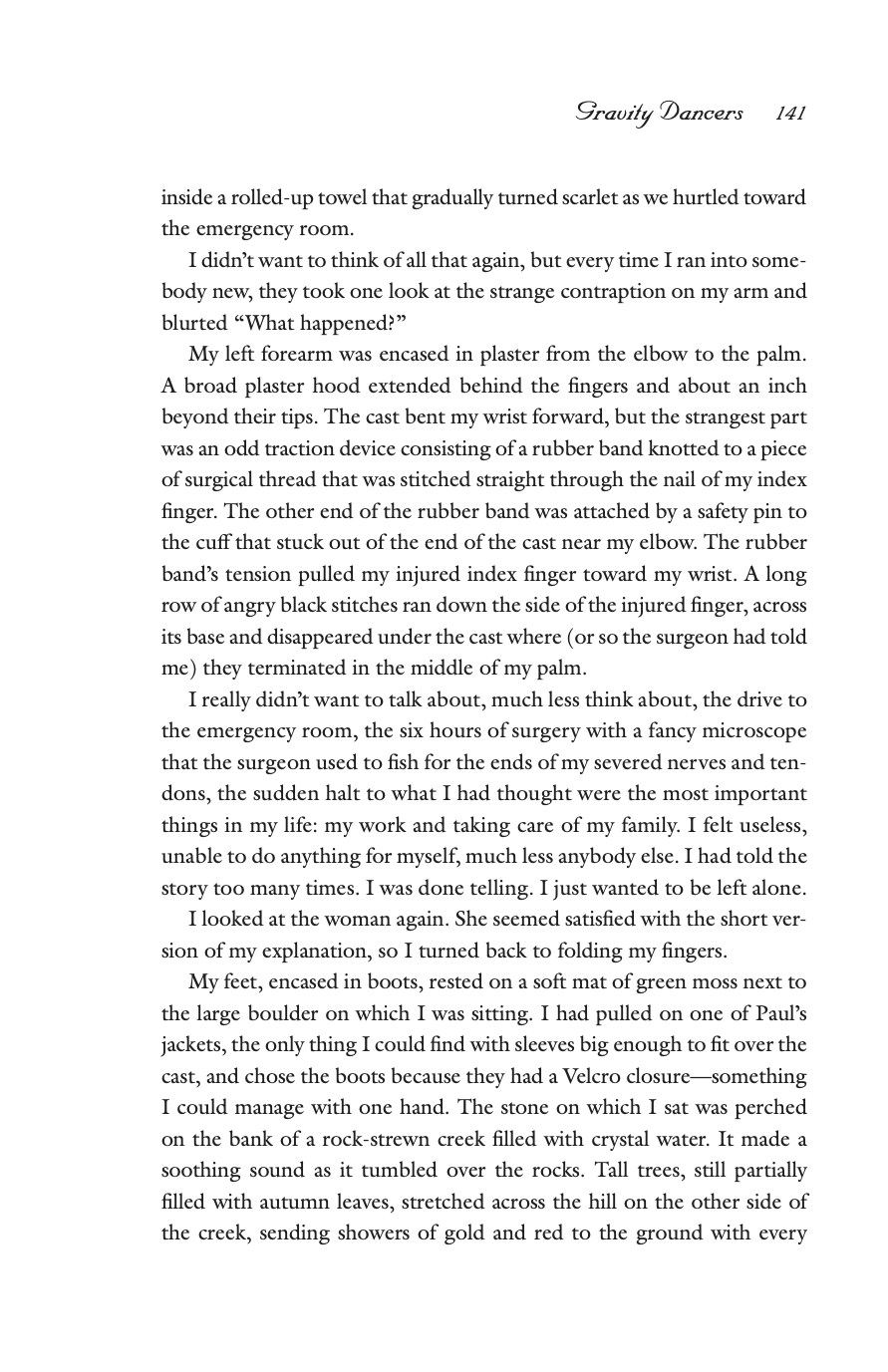
“I did, in fact, encounter a woman in the woods as I was doing my finger exercises, and she had two very odd dogs. I saw her a few times after that first meeting and was surprised to find that I had begun to wonder if she only existed when I took my walk in the woods, disappearing as soon as I left to go home. My mind ran away with that question, and this story was the result.”
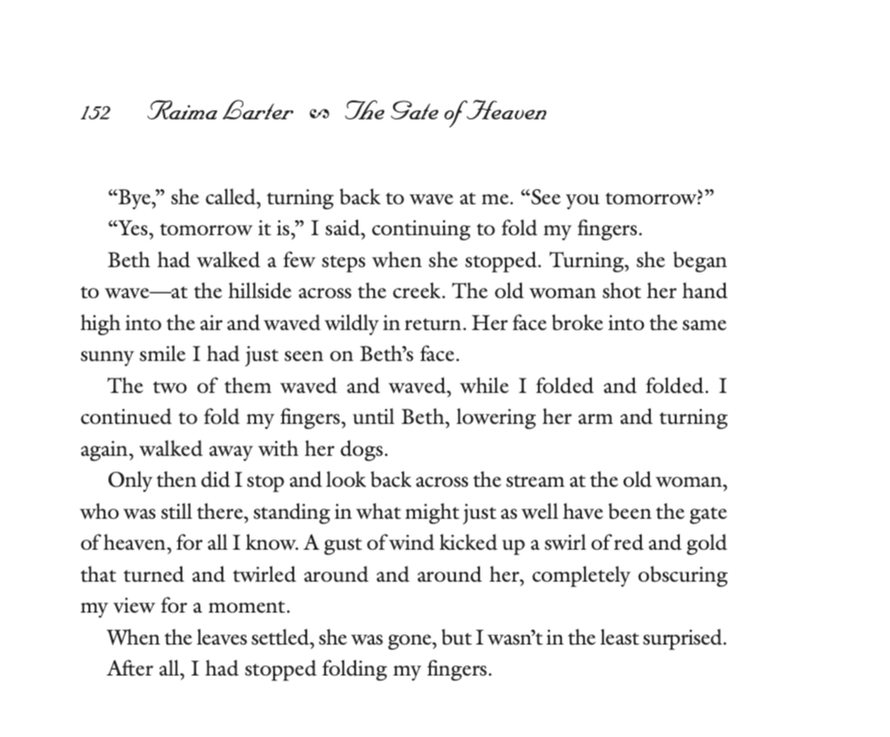
In “The Gate of Heaven,” the protagonist, Anne, is presented with a ‘gate’ that leads to another world, representing the afterlife. However, this gate presents itself to her and she realizes she has a secret ability to conjure an unseen world through the movement of her fingers. Larter utilizes bodily motion as a means to access the afterlife. In certain works of literature, words may not be essential, and ink can be used to illustrate the physical manifestation of transcendental awareness, like how silence reinforces speech. Anne’s injury of her hand serves as a catalyst for Beth’s initial curiosity about spirituality, and their close relationship gives Anne a segway to explore her newfound abilities. Rather than relying on dialogue, Larter employs body language as a form of communication between the two characters, which enables both women to perceive the gateway to heaven in their own way. Once Anne realizes she can shift the world with this repetitive finger exercise, she quiets her mind and focuses on the present moment. Anne taps into a deeper level of intuition and spiritual awareness, seeing colors with more hue, and feeling the breath of the wind like its protection.
“The Gate of Heaven” prose is evocative and lyrical, conveying a sense of mystery and wonder throughout each word. She crafts the stories, settings, and characters that are richly detailed in a way that invites the reader to imagine their interpretations of the mysteries presented. As a reader, we get to see the interiority of Anne but also a narrative distance which allows readers to draw their conclusions and interpretations without being influenced by her perspective. She beautifully describes the moment Anne realizes her more significant purpose:
“I knew, in a way that went beyond intellectual knowledge, that the trees and the creek and the mossy green stone were connected in a deep way that I had not been aware of until that moment. And, furthermore, I realized with mounting excitement, the woman and I and all that was—even her dogs—were all part of a great, holy body I could now vividly sense.”
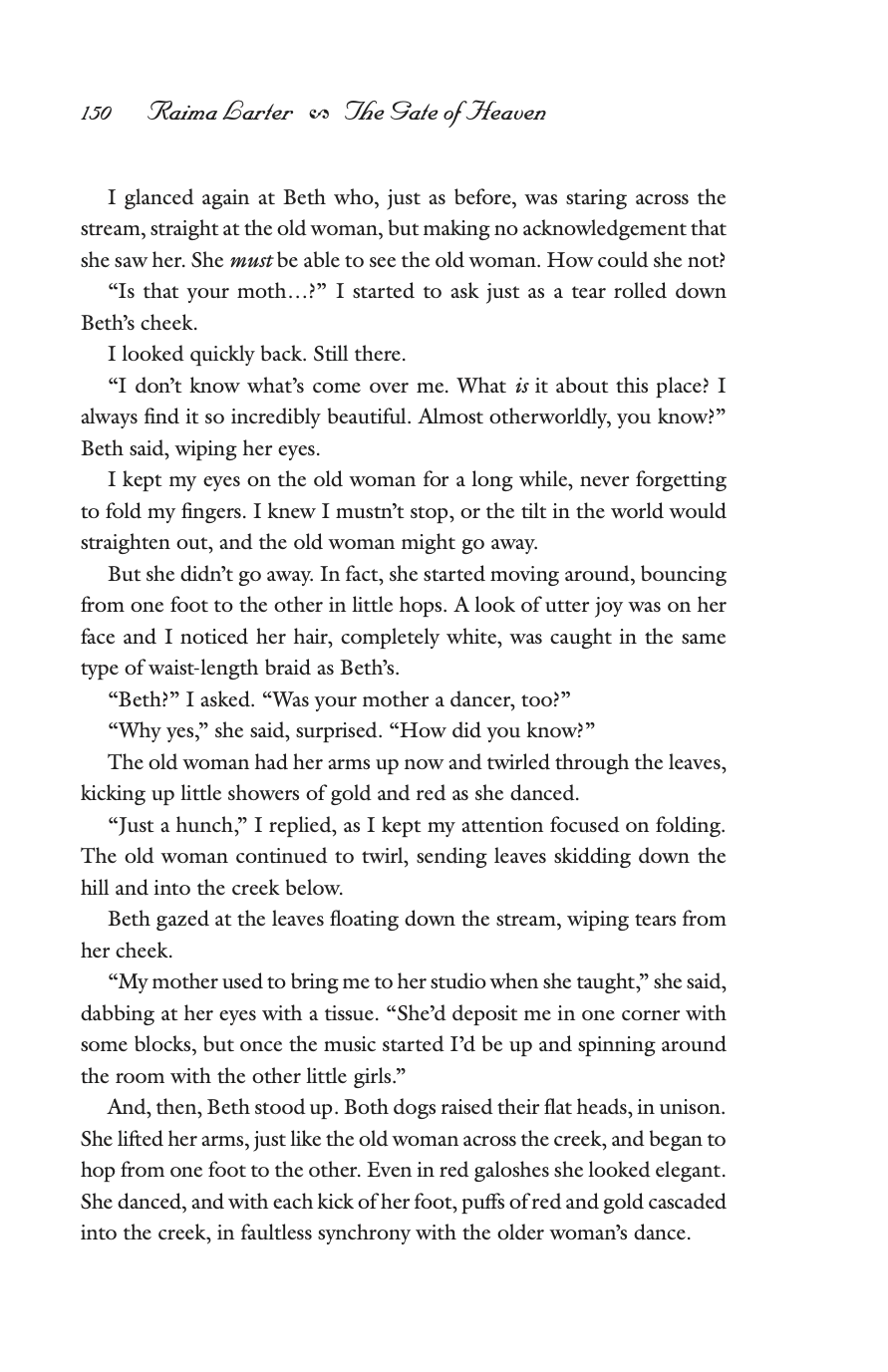
This story is the most powerful in this regard. It explores the boundary between life and death, the possibility of an afterlife, and how human connection and interaction influence both. Through Anne’s internal struggle, the story explores the theme of death, the unknown beyond it, and the connection between the living and the dead. Anne begins seeing Beth’s mother through the gate, which looks like curtains of light opening in the forest. Anne’s role in the story then shifts to act as the agent between life and the afterlife. In a way, humans are all agents of the afterlife, as we carry the memories of those we love and have lost through our everyday lives. When you see the sun start to set and the colors of life embodied in the clouds it is like how Anne feels a charged presence while doing her finger exercises. Larter employs Anne’s character not only to be this agent of the afterlife but because as humans we are born from this earth, so why can’t it be that we control what happens after?
Larter’s writing is driven by a desire to explore the more profound questions of reality and to invite readers to contemplate their understanding of the world around them. In a world where death and loss are an inevitable part of life, this story provides a glimmer of hope that there might be more to our existence than meets the eye. Larter’s imaginative descriptions of different worlds and planes of reality offer readers a window into a world that is both otherworldly and captivating. As a student of literary prose, I feel that Larter has brought into question the power that we have as people in this grand universe. Navigating the world in its totality is a challenge in itself, and as humans we know that an afterlife is inevitable, so to cope with this fact, we invented hope. Larter has embodied this feeling of hope, bringing into play the idea that we might be able to access the beyond and try to understand what happens after this life. Larters’ ending to this beautiful story brings back the question, what happens after we die? Though this story gives us little resolve– forces readers to answer this for themselves–it does however solidify that humans might find a powerful spiritual connection to the beyond.








 GRACE AND GRAVITY