
11/17/2022

Yohanca Delgado is a 2021-2023 Wallace Stegner fellow at Stanford University and a 2022 National Endowment for the Arts recipient. Her fiction appears in The O. Henry Prize Stories 2022, The Best American Science Fiction and Fantasy 2021, The Paris Review, One Story, A Public Space, Story, and elsewhere. Her essays appear in TIME, The Believer, and New York Times Magazine. She holds an MFA in Creative Writing from American University and is a graduate of the 2019 Clarion workshop. She is an assistant fiction editor at Barrelhouse, a 2021 Emerging Critic at the National Book Critics Circle, and a member of the inaugural Periplus Collective mentorship program.
To learn more about Yohanca Delgado’s work, visit her website.
Introduction to “The Midnight Zone”
By Nadia Shilova
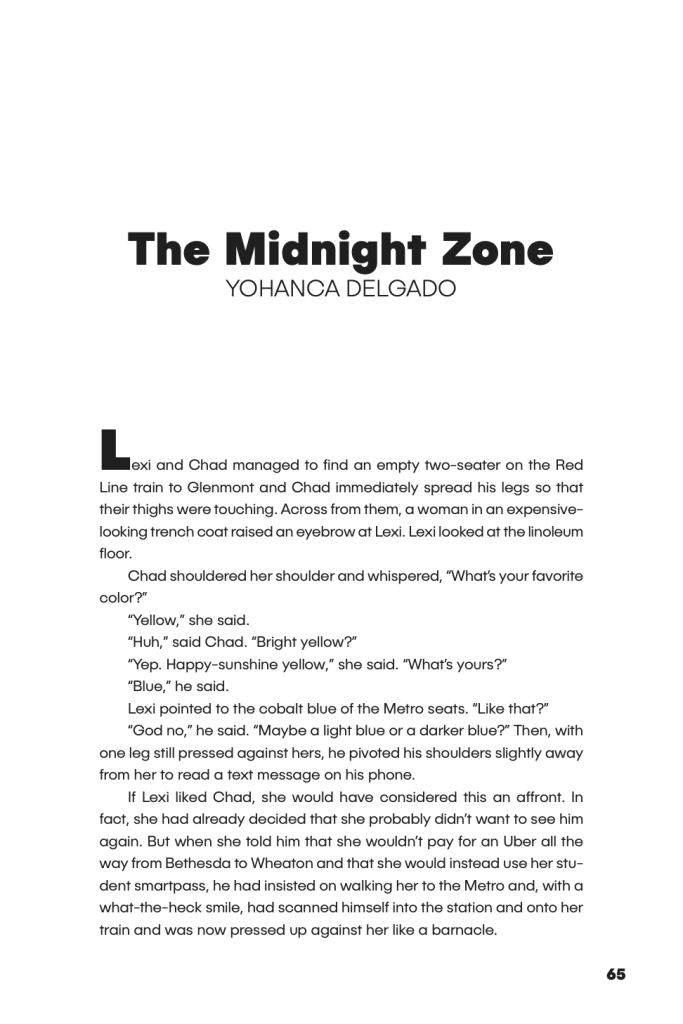
Every DC college has their own version of the stereotypical fraternity brother, but really, Georgetown frat boys aren’t too different from those of the George Washington University or American University. The bars of the city are packed with them and their greasy unwashed hair, perpetually covered by dirty baseball caps. Every college-age woman living in the district has at least one story where she had to interact with a representative of this demographic, and it is rare to see a happy ending to the majority of these often harrowing tales. As a graduate of the American University MFA program, Yohanca Delgado has likely heard all about these men from fellow residents of the district during her time there, allowing for truly excellent characterization and believability in her short story titled “The Midnight Zone.”
While this particular story focuses on women’s issues alone, Delgado has since moved toward even more complex topics in her writing, working at intersections of marginalizations in order to dissect power dynamics in interesting ways. As a born and raised New Yorker and the daughter of immigrants, Delgado has a unique background to pull from when creating fictional stories. In a 2020 interview with Radix Media, Delgado states that she has a profound interest in “the emotional and psychological displacement that’s inherent to the immigrant experience,” and she works with these difficult topics in her writing in order to shed light on some lesser known stories. Considering her work with Janelle Monae on The Memory Librarian, which tackles Afrofuturism and queer identities in a fascinating way through science fiction, it is, again, apparent that Delgado is focusing on marginalized narratives through interesting new ways, and finding even more innovative paths in fiction. Through her fellowship at Stanford and beyond, Delgado will continue to thrive and grow as an author and bring fascinating new projects to the world of American fiction.
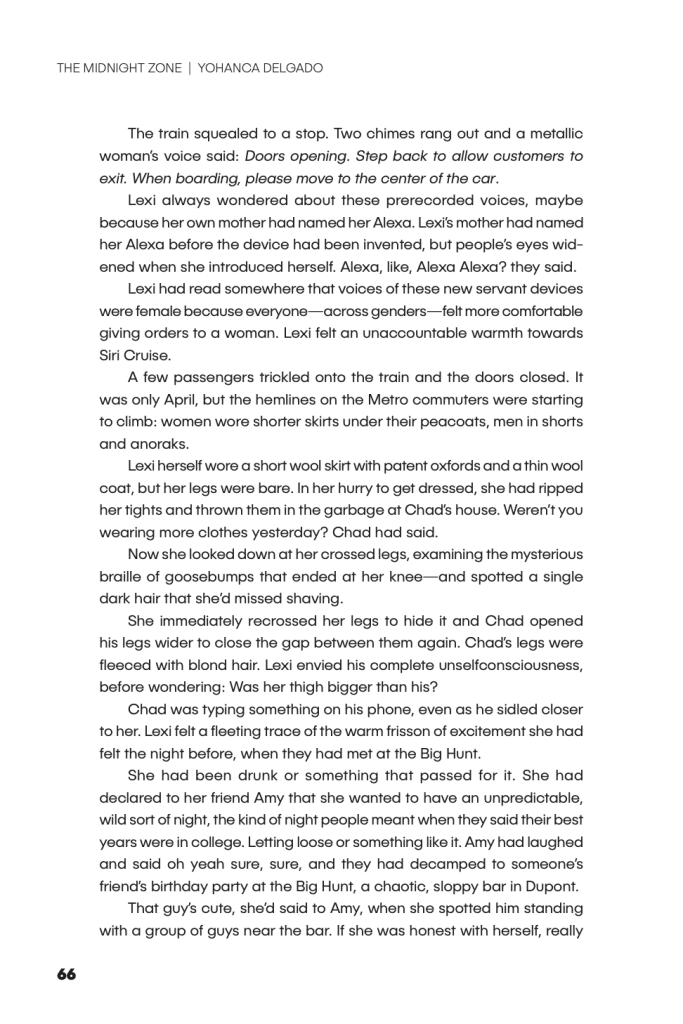
While her work has definitely evolved over the years she has spent writing after finishing her graduate degree at American, “The Midnight Zone” lets us reach back in time to Delgado’s MFA days in Washington, DC, with the city she was once quite familiar with acting as a vivid backdrop in this wonderful story. “The Midnight Zone” focuses on a DC-based student on the heels of the quintessential one-night-stand with a Georgetown frat boy, which is why I was immediately intrigued by it. My own time in the district has come to confirm my suspicions about the dating environment here, and the downright dangerous nature of Greek life and the men involved in it. Delgado’s Chad of Georgetown, with his perfectly fratty name, represents all the unbearable, deceptively sociable young men that roam the streets of the district and prowl the nightlife in search of sexual encounters with as little commitment involved as possible. Delgado effortlessly captures the aloof nice guy, lacking all self-awareness and consideration for his companion’s feelings about the situation they find themselves in.
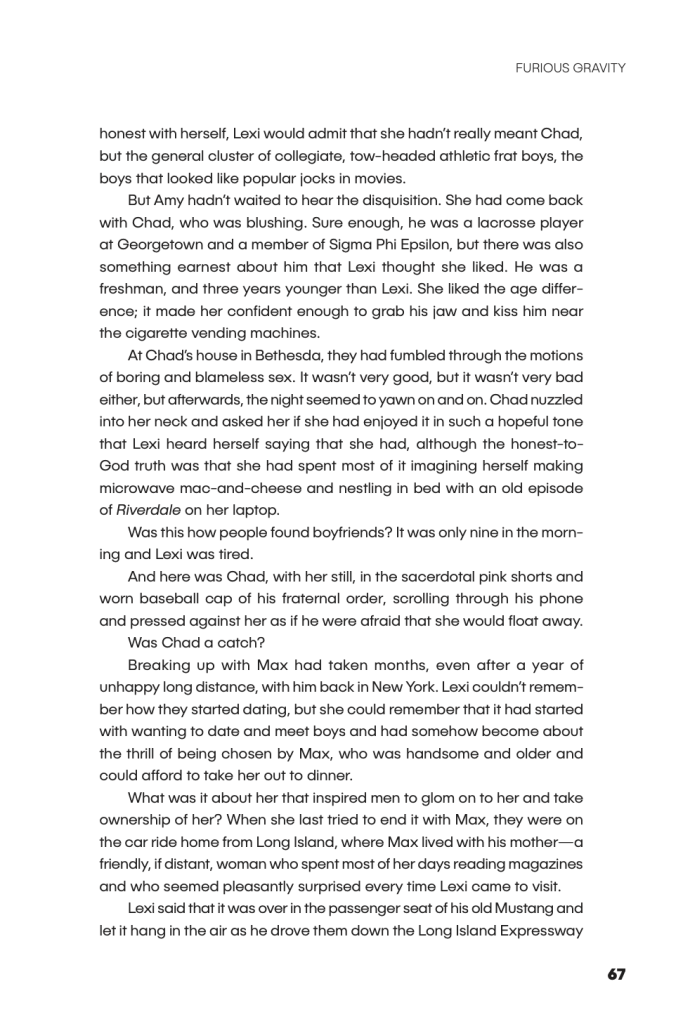
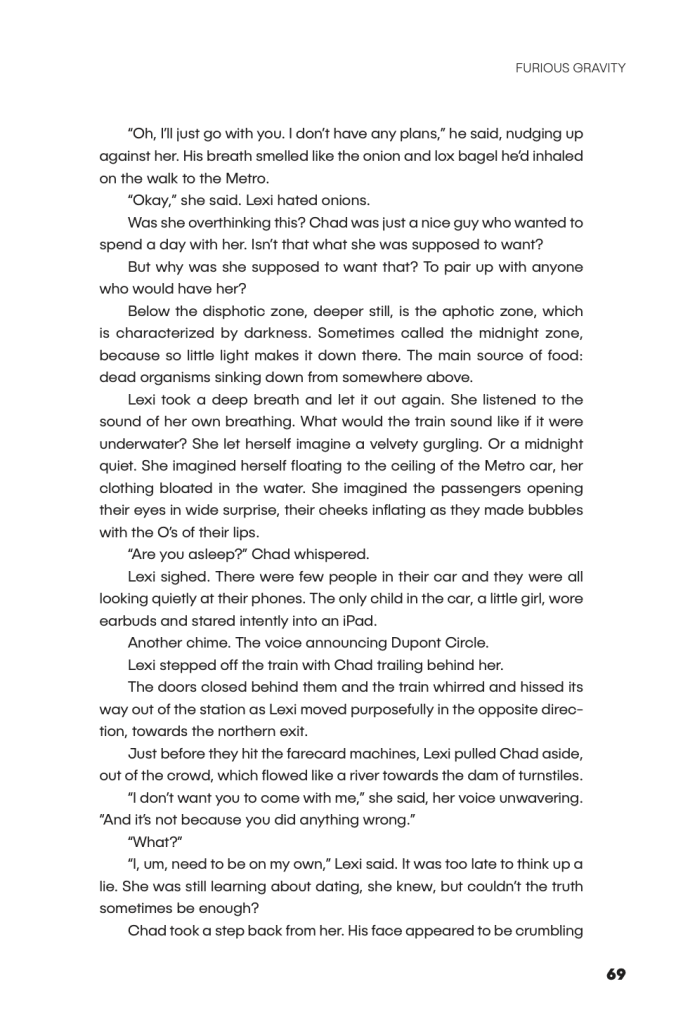
Chad seems to have few thoughts going through his head as he scrolls through his phone and presses his thigh against the protagonist, Lexi, whose perspective we are reading the story from. She, on the other hand, has an entire world of turmoil inside her head that he is entirely unaware of. We meet Lexi pondering her life choices as she sits on the metro with Chad after a drunken sleepover ensues and he decides to take the metro with her the morning after, just when she thinks she can be rid of him for good. Lexi’s inner thoughts, which are plentiful and integral to the story, govern the narrative. As the story progresses, we are submerged further and further into Lexi’s inner world, which brings about a number of revelations about her past relationships and her feelings about dating in general, and at the root of it all is this relentless self-analysis. It’s a short shift from recrossing her legs in order to hide a hair she missed shaving from Chad to wondering what’s wrong with her as a woman, and Delgado’s deliberate build-up of questions in this close third person narration participates in the conversation around how women’s relationships with themselves are so often negatively affected by their relationships with men.
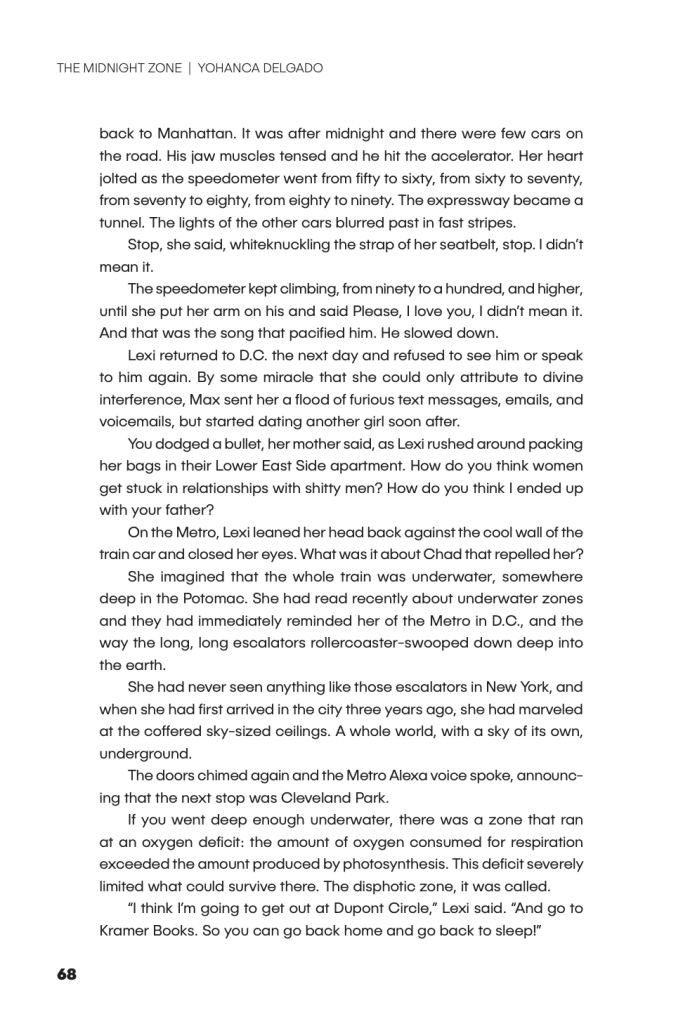
The metaphor that Delgado introduces in the title “The Midnight Zone” creates a whole progression involving the image of sinking deep into the ocean. She compares that neverending darkness and lack of oxygen to unintentionally sinking into a relationship with a man. An essential part of Lexi’s backstory is a past relationship where she sunk this way into a harmful situation with an older man named Max who became emotionally abusive toward the end of their time as a couple, eventually threatening Lexi when she tried to end things. This traumatic event runs through her head as Chad clings onto her; in between the paragraphs where these thoughts take place, Delgado expertly places bursts of information that introduce the scientific concept of, firstly, the disphotic zone, and then the midnight zone. These paragraphs are interlaced through the end of the story, as Lexi thinks back to her close call with Max and makes the decision toleave Chad behind instead of trying to make excuses for why she should want to spend the day with him. Thus, Delgado weaves together the metaphor of the midnight zone, and builds a sense of danger for the reader to pick up on, hinting at what might be hidden in the depths of a personality like Chad’s, who seems so unassuming on the surface.
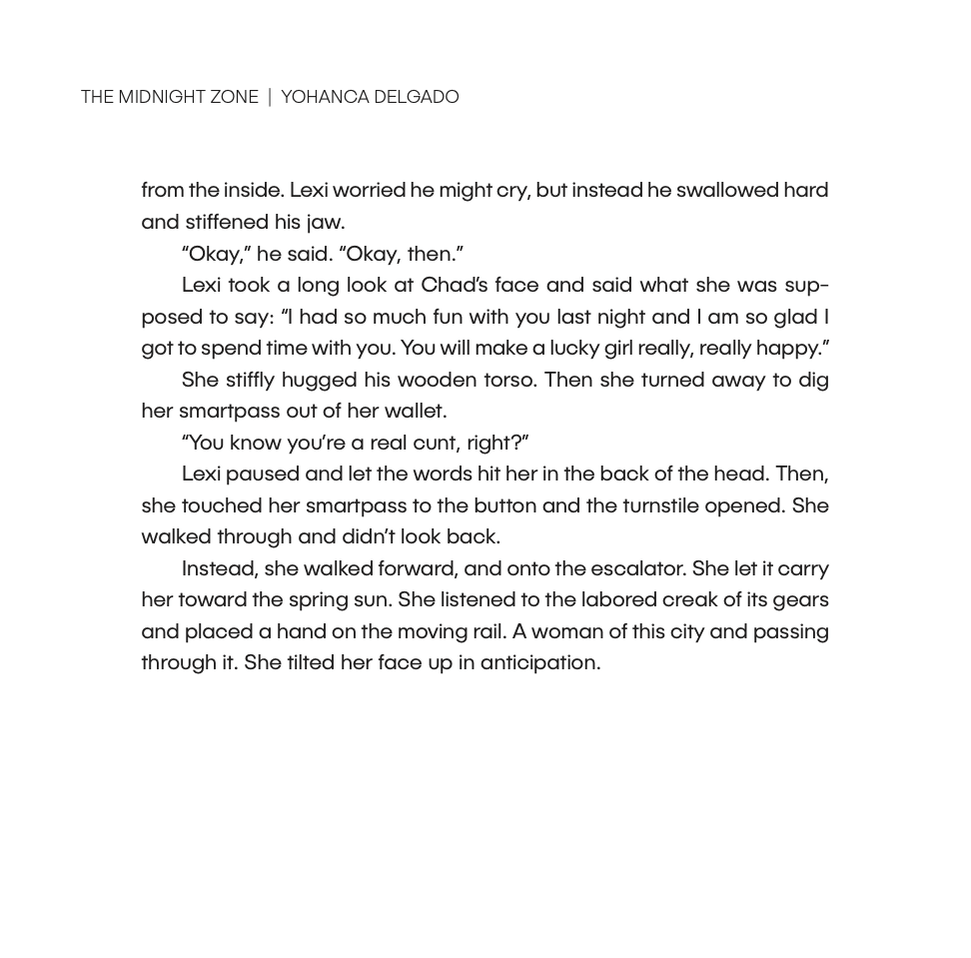
The ending of the story ties together the figurative choices made throughout it and officially highlights the commentary that the piece makes on relationships between men and women. Lexi makes a firm decision, bluntly telling Chad that she is not interested in continuing to spend time with him, leaving him on the metro. Delgado’s portrayal of her in this scene is still very realistic and grounded in what we’ve learned about her throughout “The Midnight Zone.” She is still worried about how she is perceived, so she makes her final words to Chad as kind and accommodating of his feelings as possible. However, when he inevitably insults her in retaliation for her rejection of him, she walks away without turning back. Finally, Delgado ends the story on a sentence where Lexi is described as taking the escalator out of the metro and toward the sun, escaping her descent into the midnight zone. By ending on this powerful moment, Delgado’s oceanic metaphor is complete and the reader can confirm for themselves that all along, Lexi was worrying about the feelings of a guy who does not care about her. By having this character choose herself and leave before she sinks any further, Delgado sends a message to women who engage in romantic relationships with men to re-evaluate their standards and get out before it’s too late, especially when, like Lexi, they can admit to themselves that they aren’t even interested in the man they are about to get involved with.
I imagine during her time in DC, Delgado’s unique perspective as a graduate student allowed her to look upon the trials and tribulations of undergraduate students she saw around campus from a short distance, and create a story that points them in the right direction when it comes to dating in the district. Personally, I was wary of Greek life coming to AU as a freshman, and now that I’m in my final year of college, I’ve seen my fair share of odd behavior from men just like Chad, and I’ve learned how to tell the harmless frat boys apart from the dangerous ones. Therefore, I think a story like this, where the author utilizes metaphor rather than spelling out the lesson plainly, absolutely accomplishes its goal of serving as a warning, but still allows for reflection, letting readers make their own decisions, which is quite helpful when it comes to young college students who think they have it all figured out.
 GRACE AND GRAVITY