
12/16/2022

Ramola D is the author of Invisible Season (WWPH, 1998), which co-won the Washington Writers’ Publishing House Poetry Award in 1998, and Temporary Lives, awarded the 2008 AWP Grace Paley Prize in Short Fiction and finalist in the 2010 Library of Virginia Fiction Awards. A Discovery/The Nation Finalist and five-time Pushcart Prize Nominee, she is the recipient of a 2005 National Endowment for the Arts Fellowship in Poetry. To learn more about Ramola D’s work, visit her website.
Introduction to “The Smell of Tulips”
By Indali Bora
Ramola D’s “The Smell of Tulips” is a narrative that simultaneously illustrates and questions common cultural notions within South Asian marriages. As a South Asian woman myself, I was drawn to the complex, candid, and raw display of relationship dynamics between partners and family members in this story. While I have personally observed the complexity of marital relations in South Asian media, I find that the topic of how harmful certain mindsets in our community can be on marriage is often sidelined. This most often occurs because South Asian values place great emphasis on maintaining tradition and history, both of which are fundamental themes that guide the main character, Pravin, in this story. This story distinguishes itself by probing into negative generational gender norms in the name of culture, for a community in which the preservation of such perspectives is rarely questioned. By building strong personification through language and character relations, Ramola carefully curates a marriage that is deeply tied to cultural values and brings in the larger thematic question of when certain perspectives must modernize. More specifically, her story juxtaposes traditional ideology on the roles of a man and a woman in a marriage against toxic cycles of patriarchy. By doing so, she challenges conventional expectations and reflects on the consequent effects of this cycle on self-image, love, and validation. This brings into focus the underlying core argument: Is obedience to these norms truly a recipe for marital success, or simply a notion to uphold toxic gender roles?
Ramola’s thematic approaches to South Asian culture closely align with her background and primary focus as an author. She was born and brought up in a city formerly known as Madras and now as Chennai, located in Tamil Nadu, India. Her first exposure to the DC writing scene emerged following her MFA education at George Mason University, after which she took on various roles in the writing community, such as being an instructor at educational institutions and volunteering to teach writing workshops at homeless shelters. Her writing style ranges between fiction, poetry, and essay, which is evident in the ways she is able to incorporate poetic writing devices and make fictional stories such as “The Smell of Tulips” feel alive and real.
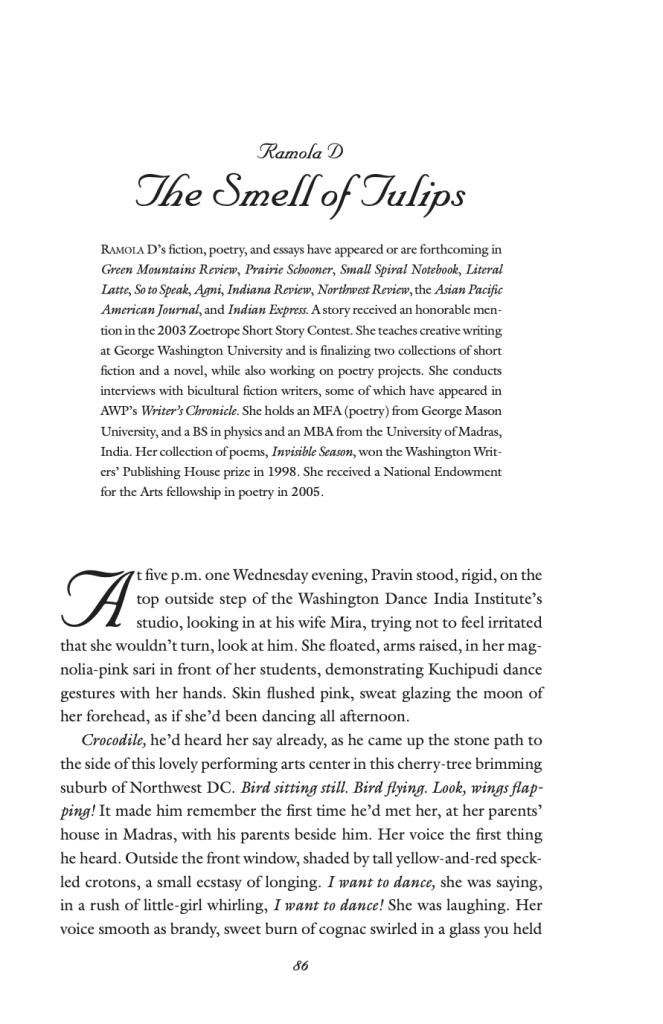
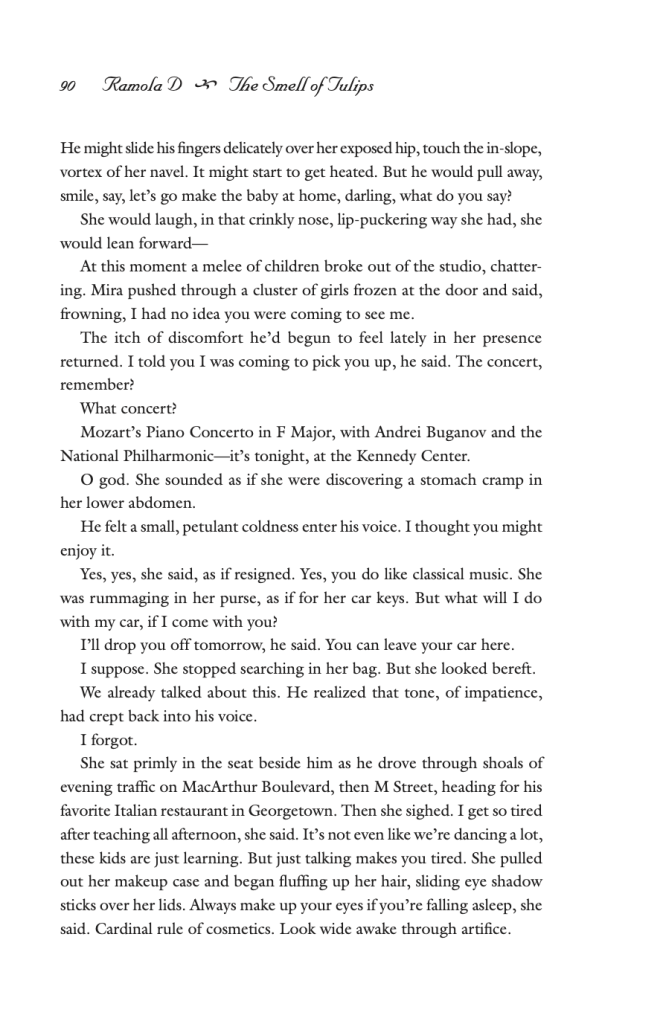
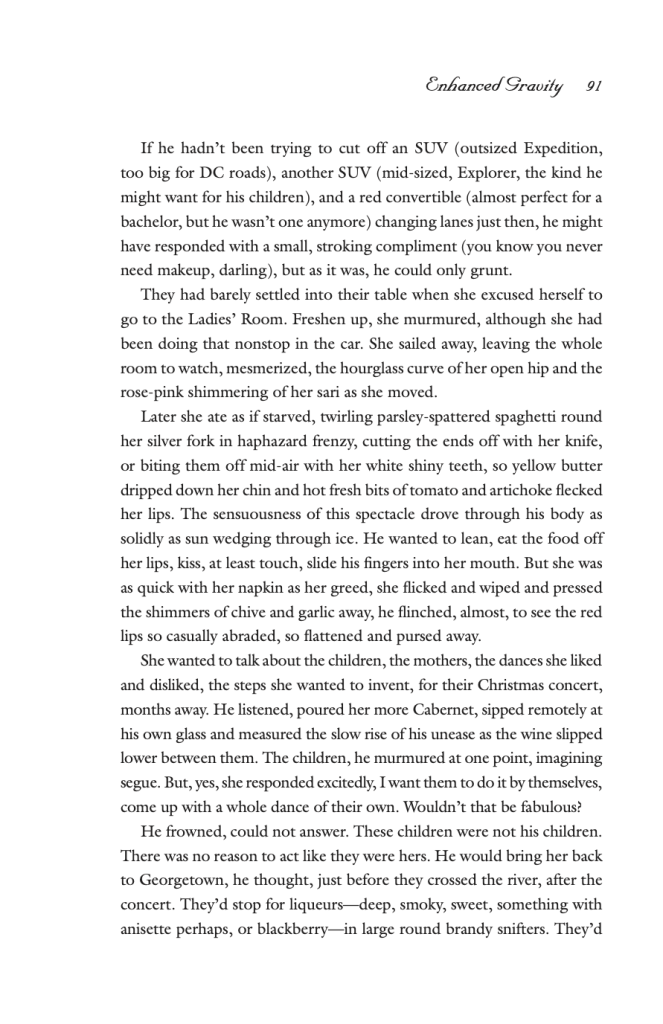
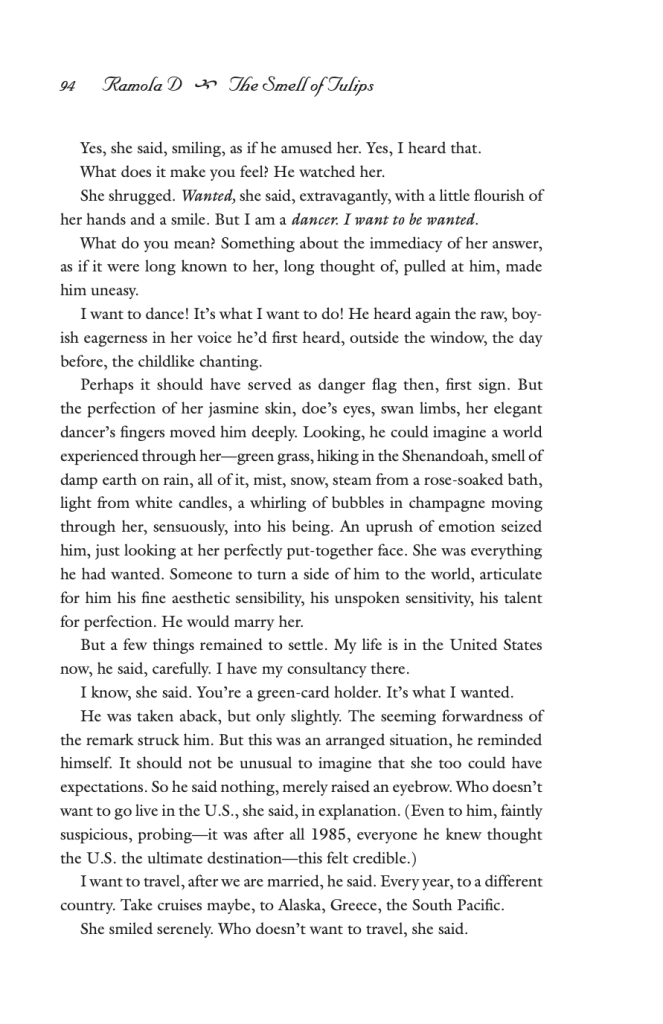
“The Smell of Tulips” is written in the third person following the relations between a married couple navigating an immigrant identity and relationship in contrast to American culture. In order to depict this dynamic, Ramola follows the narrative from the perspective of the husband, Pravin, and the entire story is revealed through his views on American culture and his relationship with his wife, Mira. He carries the voice of the piece, which is conflicted and restless. The following excerpt is a precise example of Ramola’s beautiful use of poetic language to depict this conflict from when Pravin sees Mira teaching dance in slacks and a sweater:
“He stared at the wall. A child’s warm foot floated up before him and he rubbed the sole, feeling the peel and blistering. Feeling how countries were drawn on the surface, as if on a map, whole coastlines and oceans in the cracks and the swells, islands breaking loose from plaster. Feeling how skin was only skin and could flake away from a wall, exposing whatever was beneath….His body inert, all sense of direction suddenly closed inside his limbs. He crumbled the plaster flake in his hands. Not sure, anymore, how to step, in what direction.”
Using Mira’s dance studio wall as a metaphor, the cracks of the wall directly tie to Pravin’s ideal world crumbling – a world in which Mira would be his submissive partner and together they could have a child to validate their marriage. But like the wall, this world is a fragile vision that as Pravin now comes to realize, is not what his marriage in America is truly going to be like.
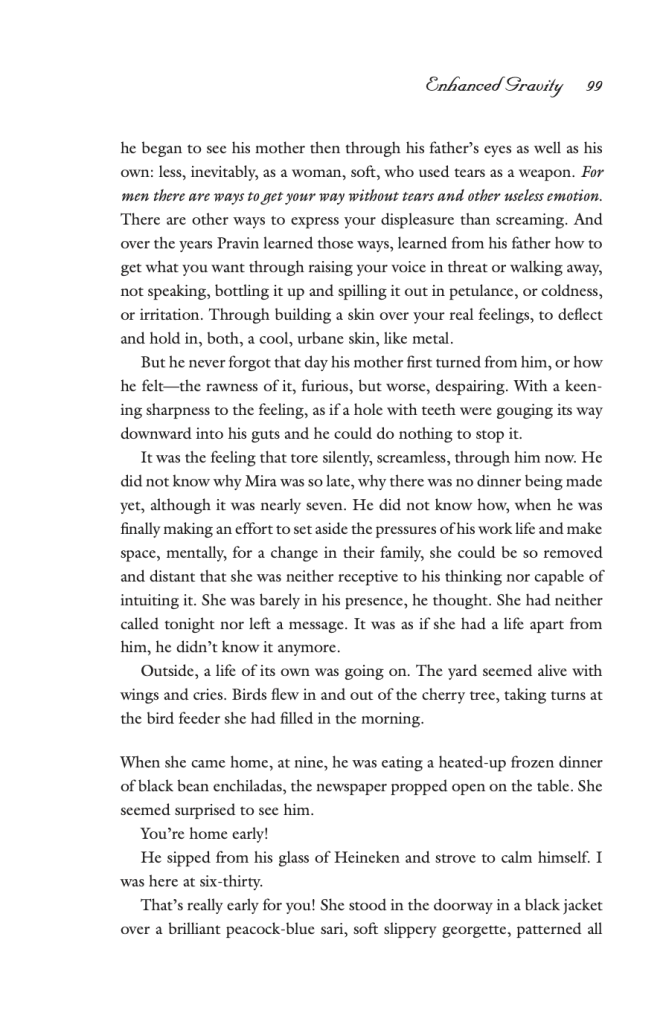
To further understand Pravin’s biases and where his voice stems from, Ramola articulates an important characteristic that shapes people’s perceptions: family. Regarding his expectations, we as readers can see that his thoughts stem from a toxic cycle. His voice is not just his own – it is a reflection of years of patriarchy and toxic masculinity he has grown up seeing. When Pravin acknowledges that “even on the days when he was silent with his mother, his father let him privately into his confidence, so he began to see his mother then through his father’s eyes as well as his own: less, inevitably, as a woman, soft, who used tears as a weapon”, we can understand that Pravin’s view of a woman comes from his father, whose perspective of women might have passed down generations. Through Pravin’s complex voice, Ramola allows readers to explore a less conventional perspective in understanding why toxic masculine mindsets are the way they are: from the perspective of the man himself. The analysis of this marriage from Pravin’s point of view depicts the external impact of a patriarchal mindset on a relationship but also further pinpoints the internal conflicts that emerge from specific cultural roots.
Ramola continues depicting the implicit harms traditional gender stereotypes have on a relationship by not only building a strong personification of Pravin but also distinguishing how his perspectives affect the role of others in his life. For example, Mira’s character is always seen through the lens of Pravin, who primarily views her as a status symbol, someone who is described as “both beautiful and elegant”. Evidently from this quote, for Pravin, Mira’s abilities extend only so far as the beauty in her appearance and dance. But over the course of the story, he begins to recognize how she is making a name for herself with her skill and talent that extends beyond beauty. Pravin feels threatened by this uprooting of the status quo, which is reflected in his constant anxiety about coming to terms with this fact. Success was something he learned from “how his father was, and some of his uncles, and his most deliberate professors in business school”, but never in the story does Pravin cite a woman being someone he looks up to or idolizes. This personification of the characters then translates into the representation of larger themes. Pravin represents the fear that surrounds changes to cultural notions of gender roles, Mira represents the image of gaining power beyond a stereotyped subordinate position, and Adrian, Pravin’s coworker who becomes close to Mira, can be considered a representation of the elements of a modern society which threaten the foundational values that build Pravin. These connections make Pravin a complex character, because he actively recognizes the shortcomings of his mindset, but cannot properly comprehend why he feels so. He thinks his understanding of women would lead to a good marriage, but in reality, his perception only further creates division and restlessness between him and Mira. His complexity is a stark representation of Ramola’s argument that though traditional perspectives may be flawed, they are not as simple to modernize without deep reflection on the history and culture and how they have been interpreted over the years.
“The Smell of Tulips” falls well within the thematic choices that often underscore other works by Ramola. Her other fiction short stories are also a careful, analytical dive into the complexity of relationships. In another one of her short stories, “In Another World”, Ramola similarly explores family dynamics and the impact of those perspectives on external relations, all while emphasizing significant moments through her articulate use of poetic vocabulary and distinct contrasts. In one particular moment, the main character in this story thinks of someone and “how he must sit, up in the guard tower at the Kasimpur railway station, waving the trains on, slowly, meticulously, the green cotton flag, the crimson flare, how the gods and lucifers and satans of his children’s visions must pass before him like crowned and haloed figures from a dream”. Although a short excerpt, the vivid imagery, and language in it make the railway station come alive. To readers, it brings emotion into relationships and life into something as stationary as a railway station, or as in “The Smell of Tulips”, to America and Mira’s dance studio.
When gender roles and perspectives are so deeply ingrained in family norms, they can be difficult to modernize. However, Ramola tackles this in a concise manner with an insightful look into a complex dynamic of a married couple navigating their relationship in America from a perspective that is seldom explored. It questions not only what is considered ideal roles in a marriage between two partners, but further questions the implications of harmful cultural stereotypes that can affect real relations and emotions within a partnership. Readers of all backgrounds can recognize the harms adherence to historical perspectives can create in modern times, making this a piece that extends even beyond just the South Asian community and allows us to reflect on how we as humans allow cycles of thought to repeat and may seldom stop to question their validity in our world today.






 GRACE AND GRAVITY