
11/22/2022

Riggin Waugh lives in Takoma Park, Maryland. Her tote bag-winning writing has appeared lots of places. She is the editor of two anthologies: Dykes With Baggage: The Lighter Side of Lesbians in Therapy (Alyson Books, 2000) and Ex-Lover Weird Shit: A Collection of Short Fiction, Poetry, and Cartoons by Lesbian and Gay Men (Two Out Of Three Sisters Press, 1994). Riggin has an M.F.A. from American University.
Lucy Heller is currently pursuing her MFA in Creative Writing from American University. You can find most of Lucy’s writing on The Alliance for Chesapeake Bay’s website, where she worked as the Communications Specialist for four years and published over 50 blog posts some of which were also published in the Bay Journal a local newspaper based out of Annapolis, Maryland. She’s now based in Alexandria, Virginia focused on narrative non-fiction writing with a touch of humor and hopes to make you laugh with her next sarcastic comment.
Introduction to “The Woman Who Didn’t Get Out Much”
By Lucy Heller
Riggin Waugh’s background in sociology, women’s studies, creative writing, and health communications all merge in her short story, “The Woman Who Didn’t Get Out Much.” Waugh’s story indicts the patriarchy and the impact it has on how women perceive each other. Ultimately the story is about female connection and friendship. The story takes place in 1975 as seen through Waugh’s marvelous descriptions of furniture, clothing, and colors. The themes of the text are relevant today as a reminder that while women can have different perspectives, it’s important to uplift one another in this patriarchal society. The two main characters are Donna, a teenager, and Alice, a woman in her early twenties. Waugh in 1975 was also around the same age as Donna, getting ready to graduate from High School.
Riggin Waugh has lived in the Washington D.C. area all her life. She graduated from the University of Maryland in 1979, where she majored in Sociology and received a certificate in Women’s Studies. For more than 30 years, she has made her home in Takoma Park, Maryland. Waugh received an MFA in Creative Writing from American University. Aside from her career in writing and editing for several health communication firms since graduating from college, Waugh is a vital part of the literary community. She’s the editor of Dykes With Baggage: The Lighter Side of Lesbians in Therapy (Alyson Books, 2000) and Ex-Lover Weird Shit: A Collection of Short Fiction, Poetry, and Cartoons by Lesbians and Gay Men (Two Out of Three Sisters Press, 1994). Both collections demonstrate how Waugh combines her knowledge of psychoanalysis and women’s studies, all while hoping for the readers to enjoy a “lighter” take on a subject that can usually be pretty heavy.
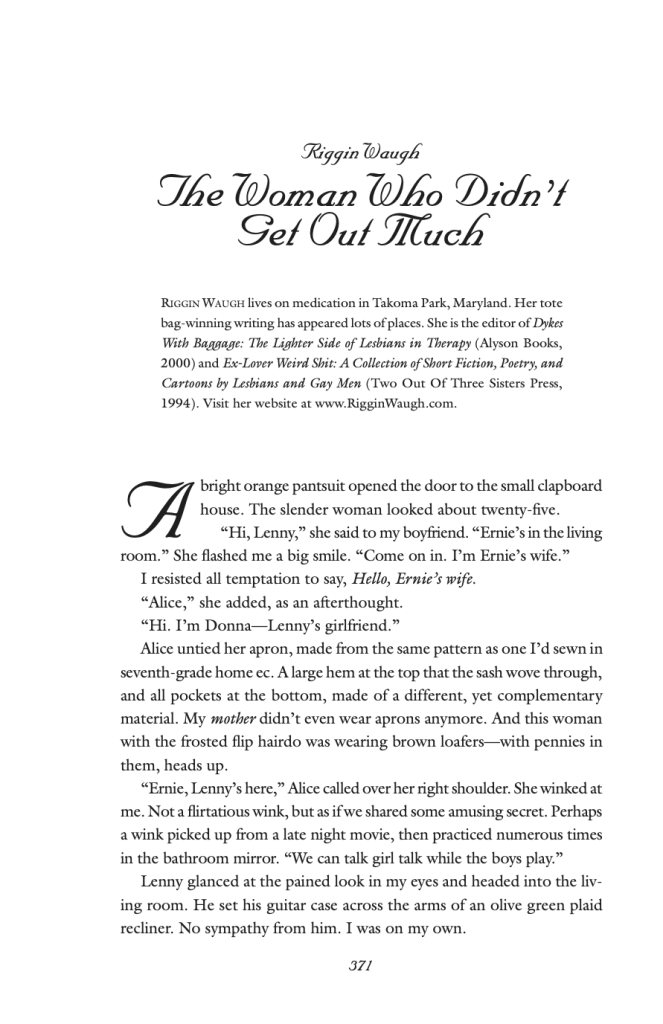
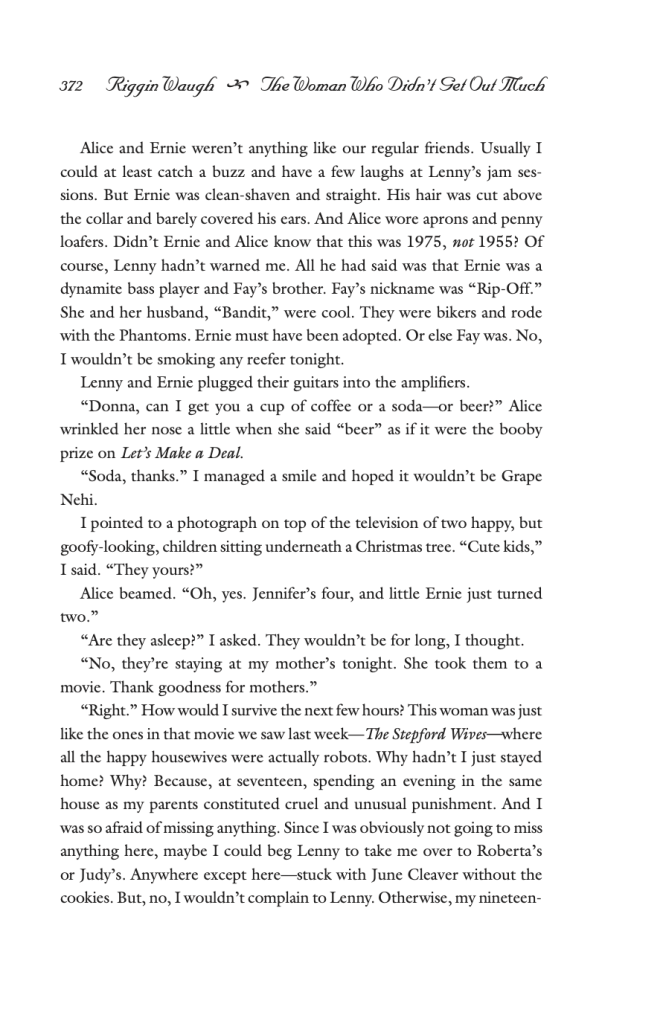
“The Woman Who Didn’t Get Out Much” certainly incorporates aspects of women’s studies and women’s relationships, as we dive into the perspective of Donna, the 17-year-old high school student who tags along with her boyfriend so he can jam with Alice’s husband. Donna immediately starts judging Alice as resembling the stereotypical “happy housewife” when she opens the door wearing a pantsuit, apron, and penny loafers and introduces herself as “Ernie’s wife.” Donna describes Alice as one of “The Stepford Wives” or “June Cleaver without the cookies.” As readers, we laugh at these comparisons because we can picture both the classic “housewife” as well as the stereotypical 1950’s mom. However, Waugh creates more sympathy toward Alice, and readers begin to notice some flaws in Donna’s perception. We want Donna to ease up on Alice and recognize some of her own sexist views.
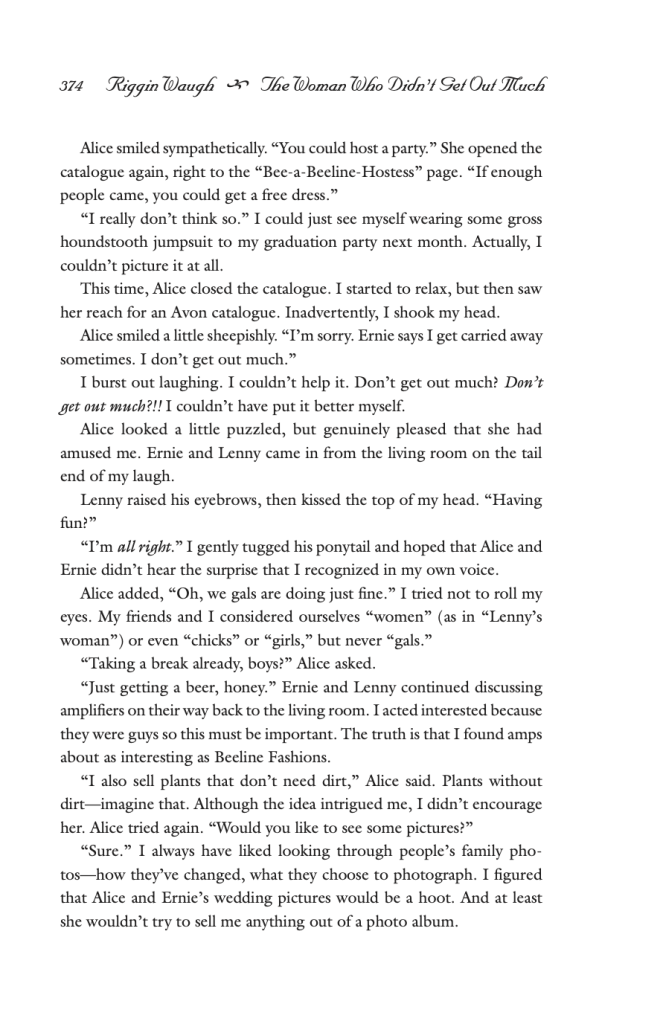
While Alice says things like, “We can talk girl talk while the boys play” and “oh, we gals are doing just fine,” Donna is subconsciously patronizing, without saying it out loud. For example, when Alice brings up selling plants that “don’t need dirt,” Donna is intrigued but doesn’t want to encourage Alice. However, when the men come into the kitchen talking about amplifiers, Donna acts interested because “they were guys, so this must be important.” The irony that Waugh writes in Donna’s character is humorous. Donna thinks so highly of herself compared to Alice, the housewife. She rolls her eyes when Alice, call the two of them “gals;” Donna considers herself a “woman,” as in “Lenny’s woman,” which in itself deserves an eye roll.
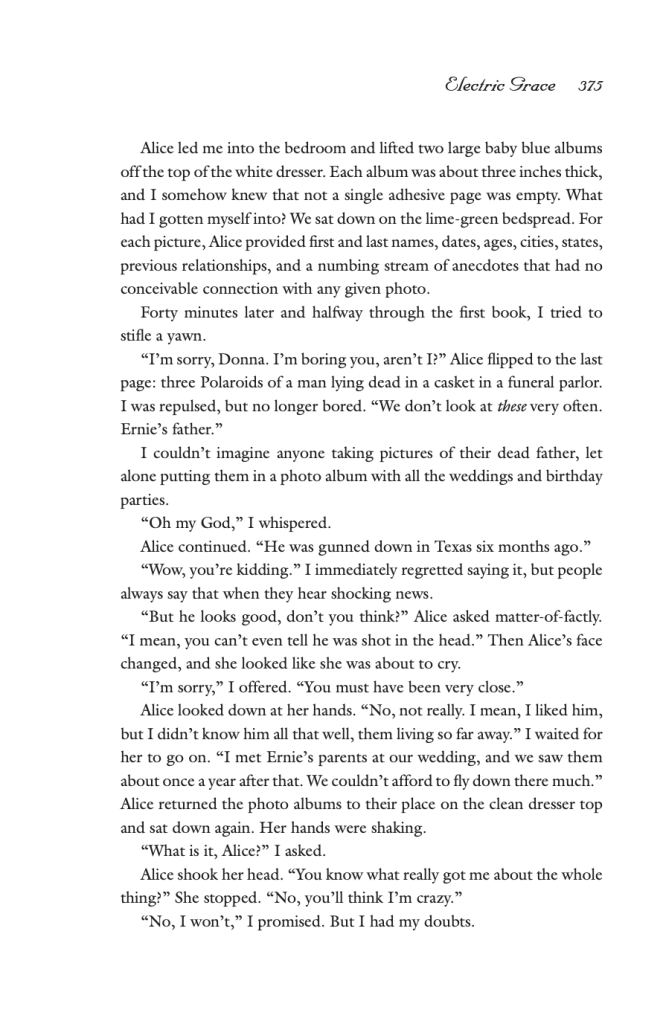
The story and the relationship between Donna and Alice takes a turn when Alice asks Donna if she’d like to look through some family albums. Once Alice notices Donna’s yawn, she livens things up with a photo of her dead father-in-law. Alice is very honest about the situation, admitting that she wasn’t despondent about her father-in-law’s passing. What Donna can’t believe is that Alice was really upset about missing the Pillsbury Bake-Off in Orlando to attend his funeral in Texas. But by the end of Alice’s explanation, Donna finds herself saying, “It makes a whole lotta sense.” There is a shift in their relationship between Alice’s honesty and Donna’s relating to Alice wanting to go to Disney World, “Alice started to reach for my hand but stopped herself. I reached over and put my hand on top of hers, still folded in her lap.” Donna shows sympathy for Alice and feels connected with her. The story ends with Donna asking, “Hey, Alice, “how do you grow plants without dirt?”
“The Woman Who Doesn’t Get Out Much,” takes place nearly five decades ago, however, the story could easily take place today. Waugh plays with themes of sexism in the 1970s, and while we live in 2022, these themes are still very prevalent in our lives. And while you may have a different lifestyle than your female neighbor, camaraderie is key in promoting social change. Overall the story is a powerful reminder that knocking down or judging other women will only amplify sexism.
The following is a selection from Electric Grace, pages 371-376.


Check out more of Riggin Waugh’s work, such as Ex-Lover Weird Shit and Dykes with Baggage.


 GRACE AND GRAVITY