
11/2/2022

Carmelinda Blagg’s short stories have appeared in a number of journals, including Halfway Down the Stairs, the anthology Best of the Web, The Lindenwood Review, Barrelhouse, Noctua Review and more recently The Rathalla Review. She has also served as a judge for Bethesda Magazine’s annual writing contest (category: adult fiction). From 2015 to early 2022, she served first as a contributing editor, then as an associate editor for the journal O Dark Thirty, the literary journal of the Veterans Writing Project. In 2010, she was awarded an Individual Artist Award from the Maryland State Arts Council.
She earned her MA in Writing from Johns Hopkins University. While Carmelinda originally hails from Texas, she has lived in the DC area since 1992. Previously she resided in Bethesda, Maryland and now currently lives in Washington, D.C. She has also been a longtime member of the Writer’s Center in Bethesda.
Fernando Manibog is a first-year MFA student at American University. He is interested in writing about the immigrant experience in America, questions of dual identity, and the search for home. Fernando, who is from the Philippines, used to work as an energy economist for an international organization. He has memoir, personal essay and fiction publications in several literary journals. His memoir piece Glossy Lips won the Winter 2018 Nonfiction Prize for Columbia Journal.
Introduction to “Without a Map”
By Fernando Manibog
All the essential elements worked together brilliantly in the first few paragraphs of Without a Map by Carmelinda Blagg: a stunning setting in the Eternal City, characters with strong motivations, high stakes, and a visceral inciting incident—a mugging that caused injury. But the piece held much more than what I was able to grasp on that first sitting. It had a special quality I had not figured out yet, something intelligent, deliberate but discreet, and even mysterious about its grounding.
On my initial reading, I was captivated from beginning to end by the agency gained the protagonist, when she ran away from her numbers-obsessed husband Gerald who was too distracted by stock indices to care that she had just been mugged and was injured. The story’s setting in Rome—where Mariel chased and stalked the boy she fixated on as the thief—was a huge plus. The theft reminded me of my sister getting pickpocketed during our visit to Rome. Its labyrinthine streets also ramped up the story’s suspense. But writing this piece as a thriller did not seem to be the writer’s intention. On my first read, I have merely enjoyed the surface but there was something else breathing inside. What did it mean? How was it made such that I could not put it down, and it kept gnawing at me? How did the artist achieve that effect?
So, I read it a second time. Slowly. With a pencil to write on the margins. I was astonished. The story is a Möbius strip in its structure.
A Möbius strip is a single surface that cannot be oriented (left or right, up or down) and keeps continuing in a loop, allowing time to be experienced in a nonlinear way, potentially to infinity. Round and round you go, only to end up in the same place. Beware! Unwary victims can be trapped inside. You may think you are making progress but really you are in a hopeless circuit with no chance to escape.
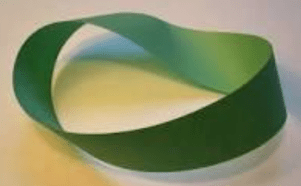
That was the true predicament of our hapless Mariel in the story. She left her husband in the hotel room and aimlessly traced the surface of a street in Rome, only to find herself encountering and chasing the suspected boy-thief three times, reminiscing happier days with her husband three times only to reaffirm their marital estrangement three times, and finally standing on a circular street that leads to nowhere except back to her hotel, from which she had been trying to escape. Unbeknownst to her, our Mariel seems to be trapped inside this mathematical art of Dutch graphic artist M. V. Escher (1898-1972), whose fascination with the Möbius strip inspired his woodblock Mobius Art II:
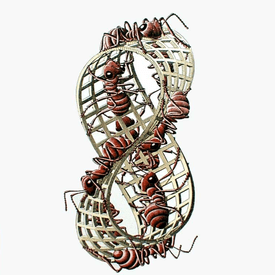
Is Without a Map’s Möbius band structure esoteric? Not at all. Although referred to as an impossible shape, the Möbius strip has everyday applications in architecture, engineering, and design art, such as pedestrian walkways, conveyor belts, jewelry, toys, Möbius chess for four players, the Recycling logo, and—for people of my certain age—continuous loop cassette tapes and ribbons for typewriters, which I still possess and treasure.
And in literature too! The Möbius strip structure is found in major literary works, including Arthur C. Clarke’s Wall of Darkness, stories of William Hazlett Upson from the 1940s, Marcel Proust’s In Search of Lost Time, Frank Capra’s It’s a Wonderful Life, John Barth’s Lost in the Funhouse, and the films Donnie Darko and Avengers: Endgame. The Möbius band drives plots of speculative and science fiction, where elements of the plot repeat with a twist—much like Mariel finding a changed context for the boy each time she encounters him—thus trapping their protagonists in a negative loop of eternal futility.
What a dreadful curse, to be eternally futile. This thought got me worried about Mariel and had me sitting down for a third reading of Carmelinda Blagg’s enthralling story. I loved the Rome setting and the suspenseful chase and the marital deterioration narratives as well as Mariel’s final catharsis and escape, but–
Although Mariel chose to run away, will she come back? Does she even have a choice? This is a Möbius strip story form, after all. She is in a fourth dimension where she thinks she is escaping towards freedom from marital distress but is really returning to where she started, potentially in reverse. The story has hints that reversal could happen. Are her three encounters with the boy-thief distinct representations of her inevitable recycling? Boy 1: back to the younger Gerald she fell in love with but who later stole her agency then ignored her? Boy 2: back to the Gerald who was memorably charming and funny, then boy 3, the Gerald who now needs to be punished for what he has done or failed to do? If Mariel returns reversed, will she have totally forgotten Gerald’s detachment and their painful distancing? Would she start all over again as a starry-eyed young bride and dutiful wife dancing around a distracted husband who was already working his way into an addiction to stock markets?
Is it Mariel’s destiny to be trapped in a time warp that loops and repeats? Rewound only to be re-wounded? Forever? What dangers does that presage about my own karma, about yours, about the repetitious grind of our daily lives that we accept without question?
Carmelinda’s interest in writing stories originated from her mother’s love of the arts and the way her voice evoked the rhythms and patterns of narrative when she read to her children. Authors who have influenced Carmelinda’s writing include Eudora Welty, Flannery O’Connor, James Agee, Alice Munro, James Salter, Marilynne Robinson and many others, more recently Italo Calvino for his essays and stories. Poetry has been a strong influence in her writing and W. S. Merwin, Louise Glück, Jose Luis Borges and Wallace Stevens are among the poets she admires.
Carmelinda believes strongly in character-driven fiction, by letting a complicated human being find something instead of starting with a plot. Her short stories are set in vivid worlds and feature complex characters tangled in complicated relationships.
The idea behind Without a Map took root during a trip by Carmelinda and her husband to Rome right at the time when the 2008 financial crisis erupted, subsequently leading to a global recession. The actual writing started only in 2016, fueled by the idea of how numbers control our modern lives. The obsession with numbers of one character in the story pulled in the larger world of mathematics, which provided the structural metaphor for the story’s Möbius strip form.
For its artistic impact and teaching moments, Carmelinda Blagg’s Without A Map deserves to be in the reading list of literature and short story writing courses. After my re-readings of Carmelinda’s story, I was unable to use my gym’s treadmill again. It was too painful a metaphor of so much in life that has been wasted running in place, getting nowhere.
The following is a selection from Grace in Darkness, pages 55-70.
- A Möbius strip a continuous, one-sided surface formed by twisting one end of a rectangular strip through 180° about the longitudinal axis of the strip and attaching this end to the other. It was discovered by two German mathematicians in 1858: August Ferdinand Möbius and Johann Benedict Listing. ↩︎
- Source: https://www.wikiart.org/en/m-c-escher/moebius-strip-ii, which provided a Fair Use rationale that the image is being used only for educational and informational purposes, and is widely available in the internet. The image is copyrighted by M. C. Escher. ↩︎
 GRACE AND GRAVITY