
4/26/2022

Heather Davis writes about family, hardships, and social justice. She has a bachelor’s degree from Hollins University and a Master’s in creative writing from Syracuse University. She has attended the Bucknell Seminar for Younger Poets, won the Hayden Carruth Poetry Prize at Syracuse University, a Larry Neal Writer’s Award, Bethesda Literary Festival essay and poetry prizes, and the Arlington Country Moving Words Poetry Contest.
Her book of poems, The Lost Tribe of Us, won the 2007 Main Street Rag Poetry Book Award. In addition, she has short stories in the Rehoboth Beach Reads anthology and a short story forthcoming in an anthology that focuses on Alzheimer’s disease. She has also had poems published in the anthology Written in Arlington, Marsh Hawk Press Review, Fledgling Rag, Northern Virginia Review, Cream City Review, Gargoyle, Poet Lore, Puerto del Sol, and Sonora Review.
To learn more about Heather Davis’s work, visit her website.
Baylee Teaster is an emerging writer from East Tennessee, currently getting her MFA at American University. Baylee writes about Appalachia, relationships, life, and death. She draws inspiration from her family ancestry, the stories her father told her as a child, as well as her own personal experiences with life and loss.
Introduction to “Be the Ocean: Everyday Lessons in Rage”
By Baylee Teaster
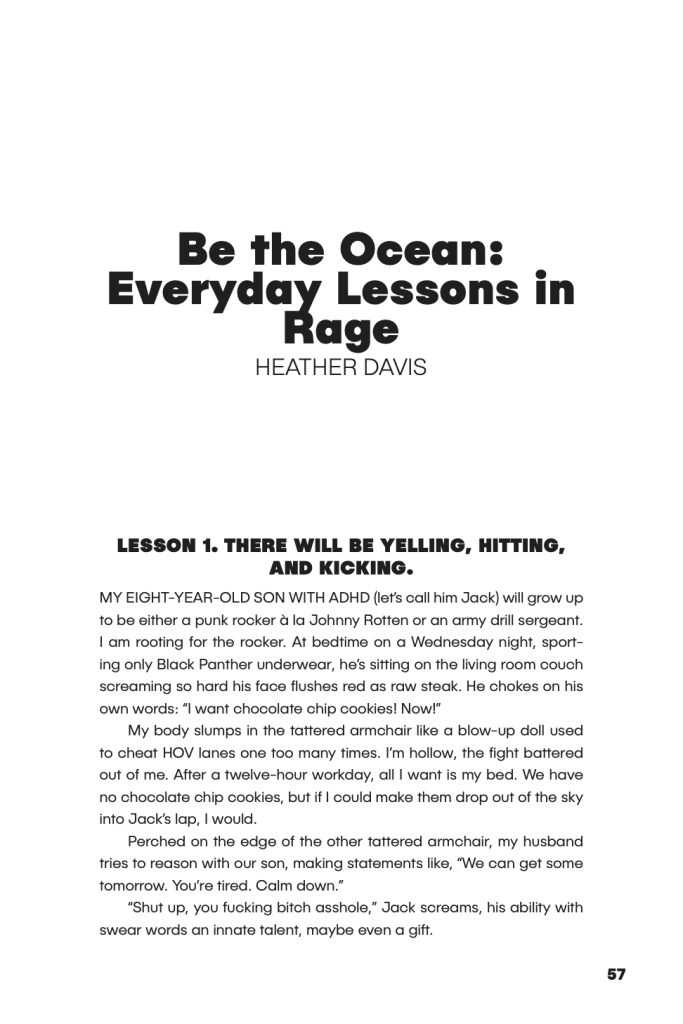
Heather Davis’s essay “Be the Ocean: A Lesson in Rage,” published in Furious Gravity, is about parenting a neurodivergent child. The themes include parenting, emotional intelligence, personal growth, and family. Davis talks about creating a safe environment where we can embrace, rather than judge, our initial emotional instincts while also learning how to control them. Through her writing, Davis warmly invites us to grab a seat on the couch and learn with her.
Immediately in the story, we learn that her child’s brain works differently and thus their parenting is unconventional. We see Jack upside down on the couch giggling, and we fall in love with him. Even though, just a minute prior, he was yelling obscenities at his parents. We forgive, just as she does, and are excited to continue this journey with her.
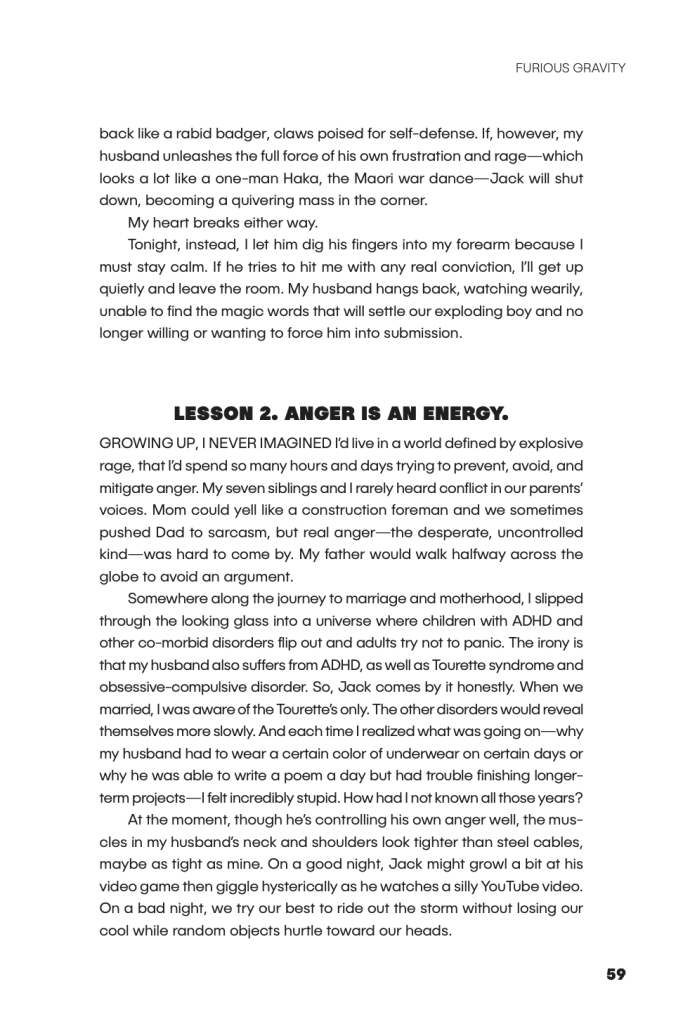
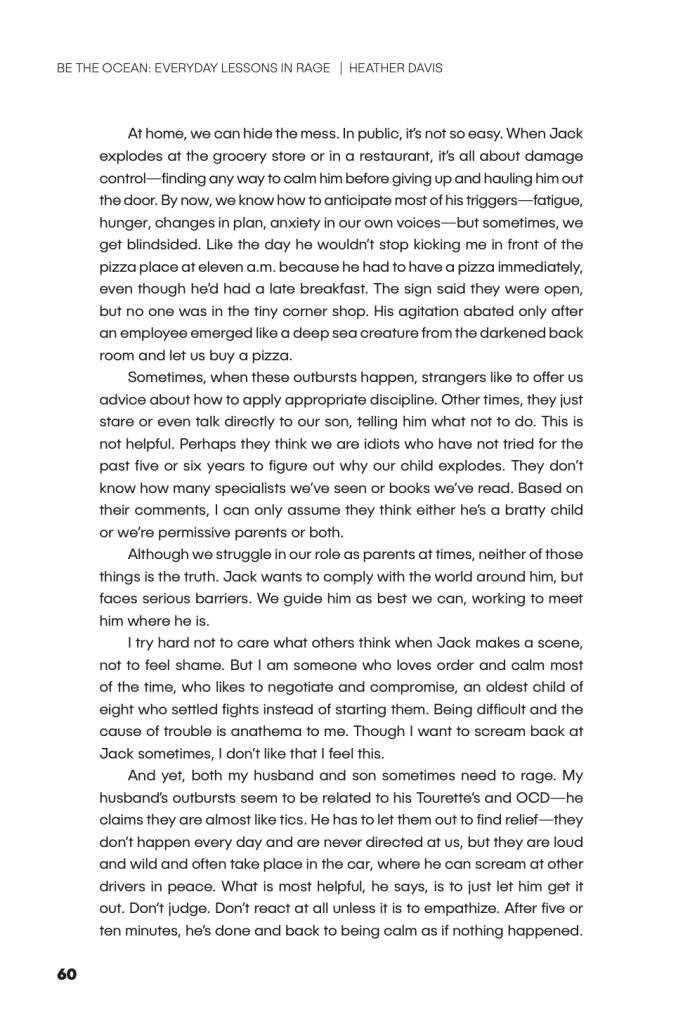
Focusing on the narrator in “Lesson 2: Anger is an Energy,” we learn that she usually doesn’t exhibit rage, but her husband and child do. She gives us a scenario of what happens in public, not able to hide when Jack can’t control his emotions. I liked how she framed feelings as necessary and not something to be feared but something to be channeled as well as the idea that anger is an energy that can be turned into something creative and useful.
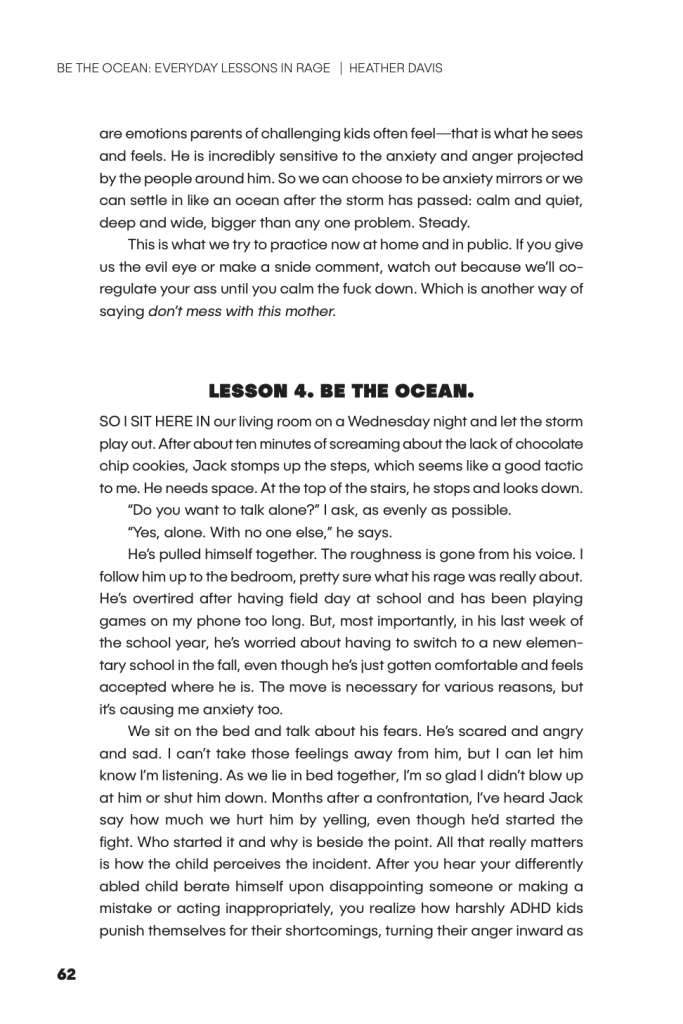
Davis is a natural storyteller; she gives valuable information easily without the mundanity of definitions and overcomplicated concepts. Every lesson section has something to learn, whether it be about ADHD, parenthood, or personal growth. “Lesson 3: Don’t Mess With This Mother” highlights a term that the narrator has recently discovered, co-regulation. “Co-regulation means controlling our own emotions and reactions as parents to help the child better regulate his or her own feelings. It means we are in this together. It means my ability to cope is or will become your ability to cope. It is the opposite of the old-school authoritarian discipline that is usually a disaster for ADHD kids.” In these four sentences, the reader learns a parenting technique, some historical context about children with ADHD and their education, and the reasoning behind her reaction to Jack’s meltdown earlier.
Davis does a brilliant job of not only consistently weaving the theme of emotion throughout the piece but making the reader feel it as well. “…anger occupies an important place in the full spectrum of human emotions.” She gives us a spectrum of emotions in this piece, from the frustrating meltdown to the heartwarming conversation at the end and Jack’s love of giggles and the humorous obscenities that Jack says.
In these four lessons, Davis takes us through an evening with her son, who is having a particularly rough night, across time to the other side of the meltdown. We are set in the story just as the wave is crashing down. We swim through different scenarios, learning about emotions, Jack, and ADHD. Then, when we come up for air, the water is calm. More waves are on the horizon, as they always are, but have we learned how to float- how to be the ocean.
The following is a selection from Furious Gravity, pages 57-63.



An Interview with Heather Davis
By Baylee Teaster
BT:I am very curious about your reasoning behind the structure of the piece. Why did you decide to structure this piece in lessons and why four? Did you have more at any point in time?
HD: The structure emerged naturally as I worked on the draft. Maybe because the piece is so much about the learning we had to do as parents, a set of “lessons” seemed like a good way to funnel what I wanted to say. Parents never stop learning how to parent and the challenges are even more pronounced if your child is neurodiverse. Four lessons in rage seemed like plenty for one essay, though I could write about many many more. No one can prepare you for this kind of journey with your child and every child is unique, but writers can hold up experience as a doorway for others to walk through, which helps them empathize with situations they may never encounter themselves. Walking through that door also helps readers who have had similar experiences–they feel seen and heard because of what the writer has documented. I have plenty more to say about raising neurodiverse kids and being married to a neurodiverse husband. Maybe I need to write a book!
BT: How did you decide to put the Lessons in the order they’re in? I struggle with finding the most powerful order for my paragraphs. Yours flow very well and I’d love to know if you have a specific process for deciding.
HD: To be honest, it’s trial and error for me. I did not have a particular structure in mind when I started writing but knew pretty soon that I wanted to break it up into sections. Reading other essays is probably the best way to get ideas for different kinds of structures to use. I did know I wanted to end on the idea of being like an ocean and I wanted to open with something compelling, so the description of physical aggression seemed to fit that bill. The second section is about the growing realization of the role anger can play and the third section is a sort of rallying point where I own my kid’s behavior and how we parent. It may be easiest to just get a rough draft of all your thoughts down on paper and then go back to see where the natural breaks may be. At that point, you can also mess around with telling a story backwards or jumping around in time. I think every piece is different and there are lots of creative ways to structure any essay.
BT: Though ADHD has been around for a long time, it seems there is a lot of false information floating around about it. I’m constantly learning new things about the condition I live with every day! Every time I learn something new, it makes me feel a little better. I wondered if there were other definitions or terminology that you thought about adding into this piece? I’d never heard of coregulation, and I really appreciated that this piece taught me something new.
HD: I am always learning new things about ADHD and other forms of neurodivergence (ND) as well. I think it is an evolving field and both doctors and regular people understand so much more about it now than they did 20 or 30 years ago. My husband grew up without any diagnosis and his family just rolled with his symptoms without labeling them. But I think there is a lot of value in naming the challenges and acknowledging that there are groups of people who share them. I think ND people used to be viewed as eccentric at best and as deviant or damaged at worst. So it has got to be better to name these conditions or types of brains scientifically and see the related behaviors and traits more objectively. People behave the way they do for a reason, especially children. Some of the other newer terms I have heard that relate to ND include “rejection sensitive dysphoria,” which is an intense negative feeling a person may experience in response to perceived rejection or criticism, and “assume competence,” which suggests that no one should limit autistic people from doing all they are capable of doing.
BT: Do you have any advice for a neurodivergent writer?
HD: Tap into your wonderful difference as much as possible in your writing. Let your unique mind lead you to new places. Figure out how to make it work for you. Every writer has to do that, but an ND writer may find that neurotypical patterns of living and writing are not optimal for them. Don’t be afraid to embrace what works for you. Need to be up at 3 am writing on your phone because that is your most productive time? Cool! Need to write shorter pieces or in spurts? Do it! Need certain distractions to be productive? Find them. It is all good.
 GRACE AND GRAVITY