
4/29/2022

Morowa Yejidé is a native of Washington D.C., where she still resides with her husband and her three children. Her debut novel–Time of the Locust—was nominated for the 2012 PEN/Bellwether Prize, was longlisted for the 2015 PEN/Bingham Prize, and was nominated for the 2015 NAACP Image Award for Outstanding Literary Work.
Last year, she completed her second novel–Creatures of Passage–which has been shortlisted for the Ernest J. Gaines Award for Literary Excellence, and was critically acclaimed by both NPR and the Washington Post upon its release. To learn more about Morowa Yejidé’s work, visit her website.
Introduction to “Heathens”
By Andrew Weimer
By the time “Heathens” was released in Abundant Grace in2016, Morowa Yejidé had already published and received award nominations for her debut novel, Time of the Locust. In the five years before her next novel’s release, “Heathens” is an example of Yejidé finding her voice as not only a D.C. native, but also a Black, female author. To publish in a localized D.C. journal that provides inclusion for woman-identifying voices who continue to fight for equality in a stalled American society that unjustly denies women equal healthcare and economic opportunities, G&G proved an appropriate space for her voice to be heard in an America who closes its ears to impartiality.
Time of the Locust has many similarities to “Heathens.” The novel explores themes like political issues and domestic tragedy, themes where women’s equality and turmoil work in tandem with the short story analyzed in this review. But there is another theme in her novels that is not in “Heathens”: myth. This mythical element also prevails in her sophomore novel, Creatures of Passage, which “explores a forgotten quadrant of Washington, DC, and the ghosts that haunt it.” I include this mythical element as her novels explore them, while at the same time staying grounded in themes of the real world that she implements into her short stories.
In what is mostly an internal monologue of the story’s central character, Mia Taylor, Yejidé provides us with the anxious mind of a housewife struggling to avoid foreclosure while searching for autonomy in both a marriage with a toxically masculine husband and an unforgiving world. In an elegantly tragic use of prose, Mia is left paranoid that “Sherman, Horowitz, Brennan, and Rubin”—the debt collectors—will destroy the lives of her family. Throughout the story, we get the internalization that comes from Mia’s struggle and the worry that everything around her is falling apart. The only hope she feels from “the bright little face” of her youngest child, Sean.
I find it fascinating how Yejidé was able to tie in the title of the piece with her prose; doing so to such an extent that without it, the story is not the same. She only incorporates the word once, but it was more than enough to establish what the word represents in the larger context of the story:
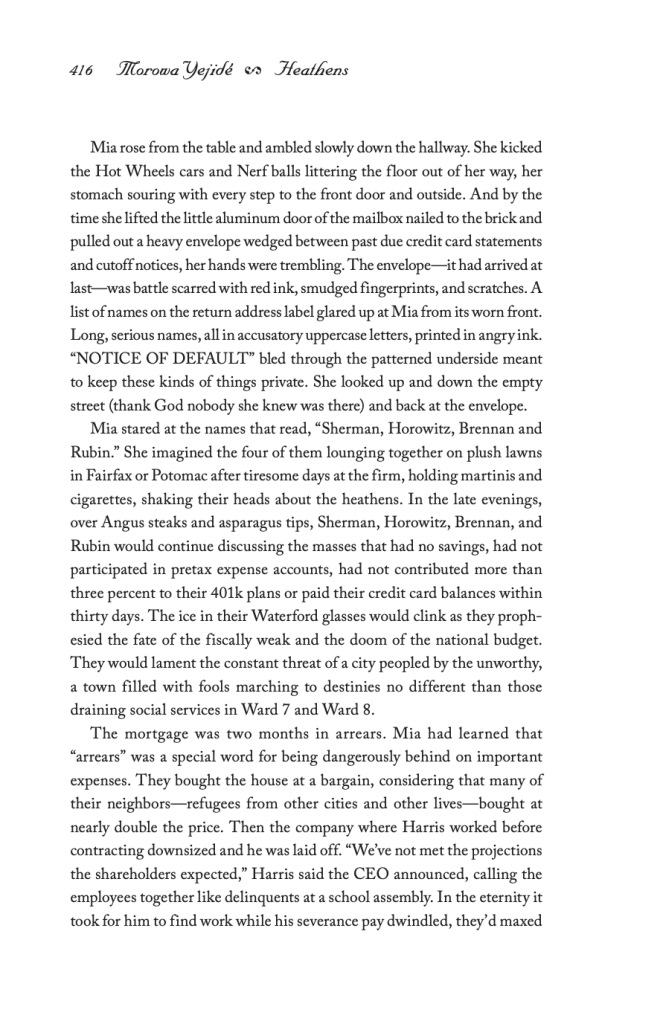
“She imagined the four of them [Sherman, Horowitz, Brennan, and Rubin] lounging together on plush lawns in Fairfax or Potomac after tiresome days at the firm, holding martinis and cigarettes, shaking their heads about the heathens.”
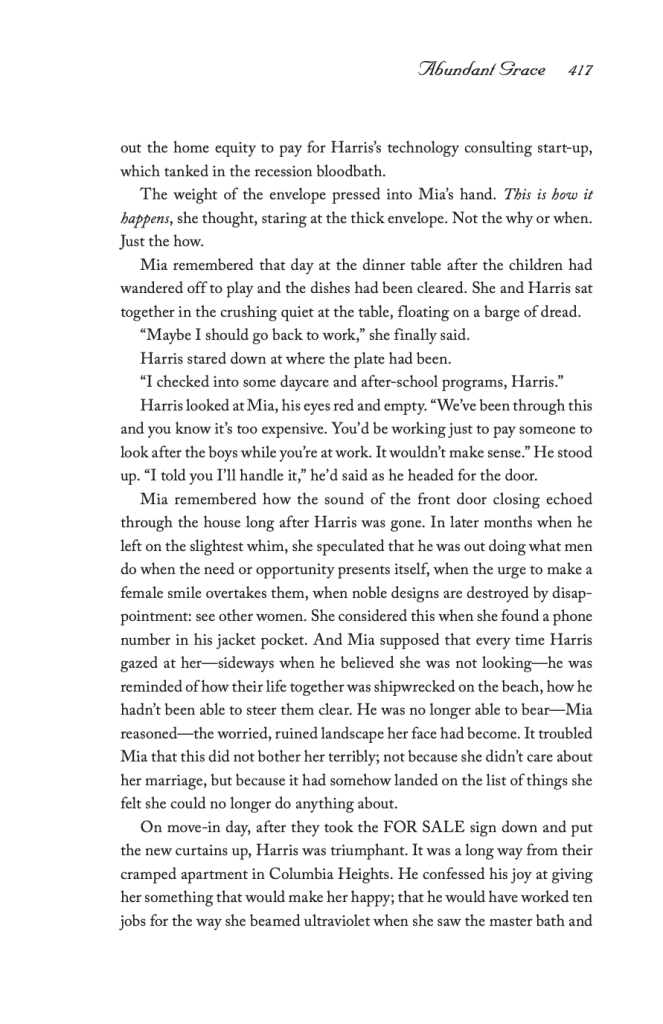
Just in that one line of the prose, we get one side of the class divide that takes place in this story. She imagines the names of these four individuals on “plush lawns” in affluent portions of Virginia as they enjoy pleasantries that the upper class can afford to partake in after a long day’s work. In contrast, later on in the story, Yejidé describes Mia and her family leaving their cramped apartment in Columbia Heights for a roomier one that, given the progression of the story, they seemingly cannot afford. If one were to look simply at statistics, as of 2015, Columbia Heights was not regarded as a neighborhood with a high poverty rate (7%). However, I work in Columbia Heights, and there are a few things I know about it: it is heavily gentrified, and it has a high crime rate because of this. Knowing this information, Yejidé’s inclusion of Columbia Heights is intricate and layered, and shows the even bigger class divide between the debt collectors and the “heathens.”
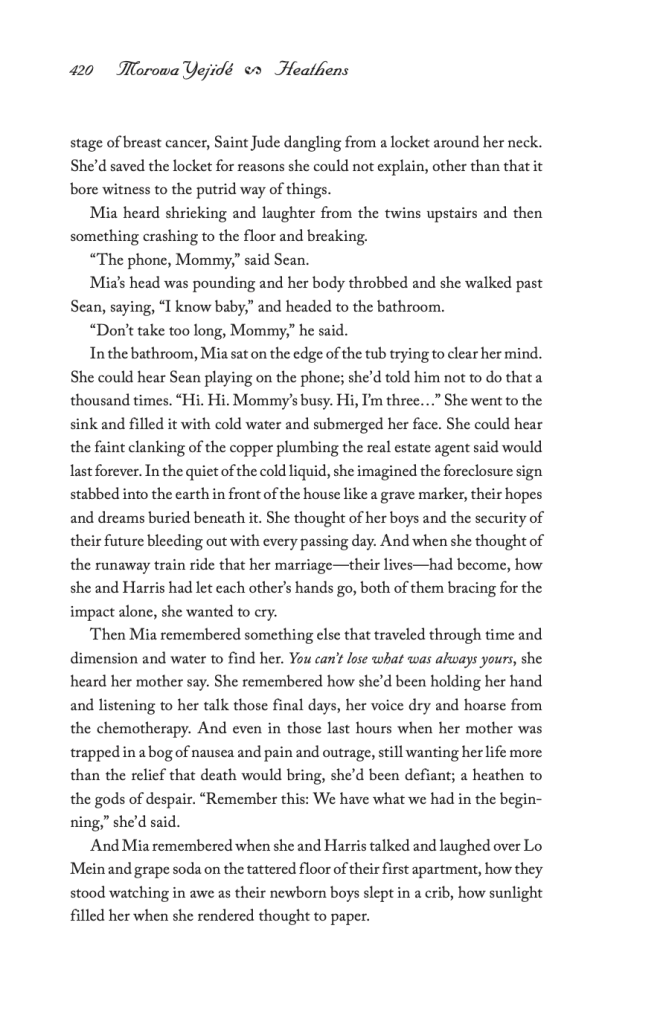
Directly tied in with her formal choices, there are three themes that stuck out to me when reading this: avoidance, coping, and turmoil. In the first line of the story, we are immediately introduced to Mia’s coping: “It took three cups of coffee at the kitchen table for Mia Taylor to get the strength to go out to the mailbox.” This sentence is then strategically followed with avoidance: “Even before the government shutdown, she and Harris had stopped checking the mail until the box was nearly bursting…the possibility of having to stop and speak to her neighbors as she checked the mail sickened her.” Right from the start, we are introduced to how she avoids and why, but it is not until later in the story that we see the turmoil behind it all: “And by the time she lifted the little aluminum door of the mailbox nailed to the brick and pulled out a heavy envelope wedged between past due credit card statements and cutoff notices, her hands were trembling.” Yejidé then mentions an ominous envelope, one with the names of the quartet of rich guys in Virginia, along with the statement “NOTICE OF DEFAULT”; and when she gets the courage to open it, she discovers that “the mortgage was two months in arrears.” However, these are not the only instances of these themes; rather just the ones in the first few paragraphs. Throughout the rest of the story, Yejidé incorporates avoidance through Mia enclosing herself in the bathroom away from everyone else, coping through Mia picturing the past when times were tough but good, and turmoil through numerous occasions in the text. In a story that was only about six pages in length, the fact that she crafted such expansive thematic elements is undoubtedly impressive.
The story’s overall relevance ties into both the literary world and the general one through its contemporary realistic feel. Mia is in a marriage that once meant something to her, and now that she has had three kids, her children have replaced that space in her heart. She loves her kids, and she worries that they may have to learn what becoming homeless in the nation’s capital looks like. On top of everything else going on in her life, the affluent debt collectors are after everything she has that they can take, not having one care in the world about who they take from and what they may be going through. Every choice Yejide decided upon in this piece shows just how tough it is to live in an overall affluent, heartless environment—showcasing the class divide between rich and middle class, and even more so between rich and poor. “Heathens” truly is a contemporary work of art, showing how hard it is not only to live comfortably in Washington D.C., but simply, to live.




 GRACE AND GRAVITY