
4/27/2022
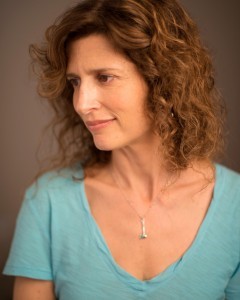
Paula Whyman’s new book, Mad Land: Rediscovering the Wild, One Field at a Time, is forthcoming from Timber Press/Hachette Book Group. It’s a combination memoir, natural history, and chronicle of her attempts to restore retired farmland to natural habitat.
Her first book, the linked short story collection You May See a Stranger, won praise from The New Yorker and a starred review in Publishers Weekly, and won the Towson Prize for Literature. Her stories have appeared in journals including McSweeney’s Quarterly, Virginia Quarterly Review, Ploughshares, The Hudson Review, and The Southampton Review. Her fiction was selected for the anthology Writes of Passage: Coming-of-Age Stories and Memoirs from The Hudson Review. Her nonfiction has been featured on NPR, in the Washington Post, and in The Rumpus. She is co-founder and editor in chief of the literary journal Scoundrel Time. Whyman has taught in writers-in-schools programs through the Pen/Faulkner Foundation in Washington, DC, and the Hudson Review in Harlem and the Bronx, New York. Her fiction is part of the curriculum at The Young Women’s Leadership School in Harlem. Whyman’s work has been supported by fellowships from MacDowell, Yaddo, The Studios of Key West, and VCCA. She was a Tennessee Williams Scholar in Fiction at the Sewanee Writers Conference. She is serving a second term as Vice President of the MacDowell Fellows Executive Committee. Whyman is the recipient of grants from the Maryland State Arts Council (MSAC) and the Arts and Humanities Council of Montgomery County. She was recently awarded a 2022 MSAC Creativity Grant to support her work on Mad Land.
Manxin Luo (Alice) is a dedicated dance company and school manager specializing in marketing and communications. She is a candidate for the MA in Arts Management at American University. Through creating a healthy, trusting and efficient work environment for dancers, Alice is also committed to contributing to the vitality of communities through dance. Her thesis to be published is titled “Building Strategic Marketing Plans for U.S. Ballet Companies.” Outside of her career, Alice likes to work on ballet techniques and ballet pedagogy. She is devoted to Christ.
Introduction to “Title”
By Manxin Luo (Alice)
Paula Whyman is a natural writer, and “Sand People” identifies the home base that we cannot escape. The Saturday afternoon I was talking to her virtually, Whyman, in her overalls, sitting in a pastoral background, told me about her meandering writing path since her childhood. “I grew up in the suburbs in Maryland,” said Whyman. “When I was really little, I would make up stories and tell them to my stuffed animals…. I made a community newspaper that I basically just read to my parents…like one piece of paper!” Whyman published her first story collection in the sixth grade for a class assignment. She worked on newspapers and literary magazines in school and wrote for her community newsletter. Writing was natural to her, but she was led to believe that it wasn’t possible to make it her career.
Instead, Whyman started off as a political science major in college. She hated the classes, however, and switched to literature. Upon graduation, Whyman worked different temporary jobs while freelancing, doing nature writing, book reviews, travel writing, and more. “Eventually I got a job as an editor, and I didn’t have to work as a temp anymore. That was when I really started doing work that I enjoyed. It didn’t pay very well at all, but I enjoyed it,” said Whyman with a smile, thinking back. “I worked at a publisher of real estate magazines and apartment shoppers guides.” It was the 650-page doorstop manual for DC Apartment Shoppers Guide, as she revealed to Bloom in an interview. Whyman then went to work for the American Psychological Association and eventually edited books for them. “That was really fun because I got to work with authors when their books came in from the beginning… That was a great experience and I got to read a lot of interesting psychology.” That included everything from PTSD among refugees to longitudinal studies of personality, as reported by Bloom.
In an interview with Whyman by Melissa Scholes Young, editor of Grace in Darkness and Furious Gravity, I also learned that Whyman worked eight years as an editor before she entered the Creative Writing MFA Program of American University, class of 2000. Whyman’s decision to go back to school in an MFA program was a strategic one, as she was looking to give herself time and resources to do her own writing. Whyman revealed to Young that developing critical judgment of literary works and finding a literary community were the two key components for her writing career that she gained through the program.
During her time in the MFA program, Whyman did an independent study with the late Dr. Charles Larson, called “The Literature of Place,” in which she wrote about particular places and settings. She also did an independent study with Dr. Cathy Schaeff in the Biology Department, in which she studied conservation biology, with a focus on whales. Whyman always says that had she not been a writer, she would like to be a conservation biologist. But she is already accomplishing this dream from a different route – “conservation science ties in with the new book that I’m working on now… I’m gonna do it anyway!”
In an interview with Rachel Léon in Chicago Review of Books, I learned that since the MFA program, Whyman has been writing for various platforms, including humor essays for the Washington Post and Barnes & Noble Review and commentary that has been featured on NPR’s All Things Considered. Her book You May See a Stranger, a linked story collection, won praise from The New Yorker and a starred review in Publishers Weekly.
As she revealed in an interview with bestselling novelist Caroline Leavitt, Whyman became especially interested in learning and writing about change over a lifespan – sources of anxiety and personality changes that develop over time and with age. Whyman likes to start writing by creating a backstory for people that she sees in public places and develop writing prompts and characters from there.
“How did you start writing this piece “Sand People?” I asked Whyman.
“Oh, that’s a really good question. Luckily, even though I wrote that 14 years ago, I think I do remember what it was about, because my husband grew up going to a particular beach on the New Jersey seashore….” That seashore got built up over the decades. People kept building new private upscale homes, adding layers and layers amongst the old homes. “There was one that was being built near the place where he went to the beach, so I started wondering what kind of person builds that house.” This homeowner was the kind of character that Whyman “didn’t necessarily sympathize with,” but she tried to write the character from his own perspective and to understand his way of thinking.
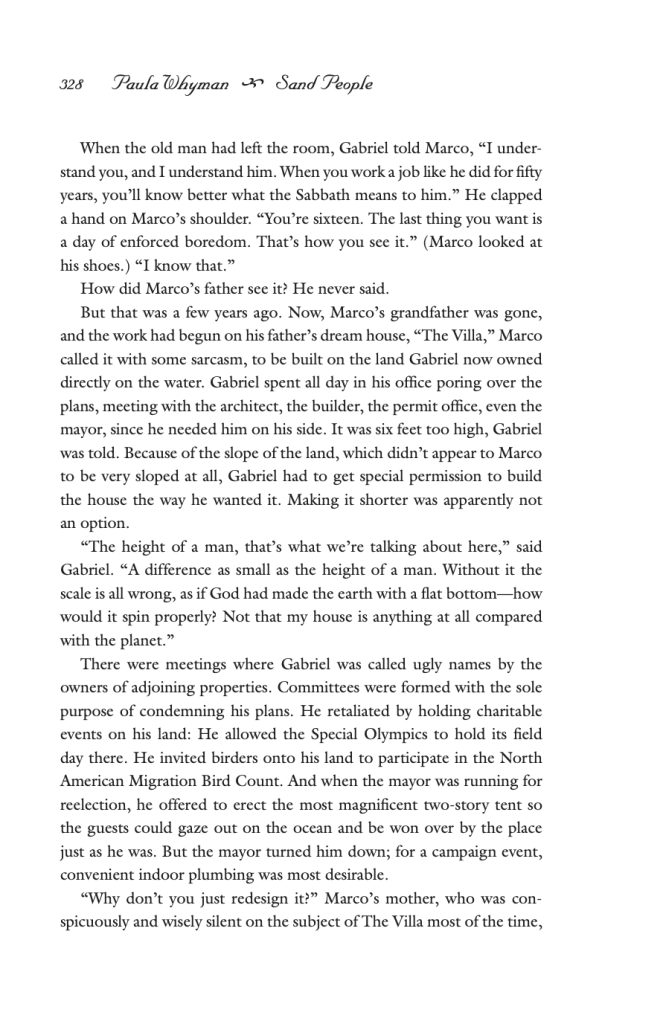
In “Sand People,” one of the main characters, Marco, always tries to run away from the family heritage and historical legacy, but he cannot escape his destiny. Like Moses who led his people out from the desert, the “sand,” five generations of Marco’ family has been living by the “sand” – the seashore. Marco’s dad Gabriel is fascinated with building his gigantic ocean-view villa; his grandpa is a devout Jewish man, scolding Marco for surfing during the Sabbath.
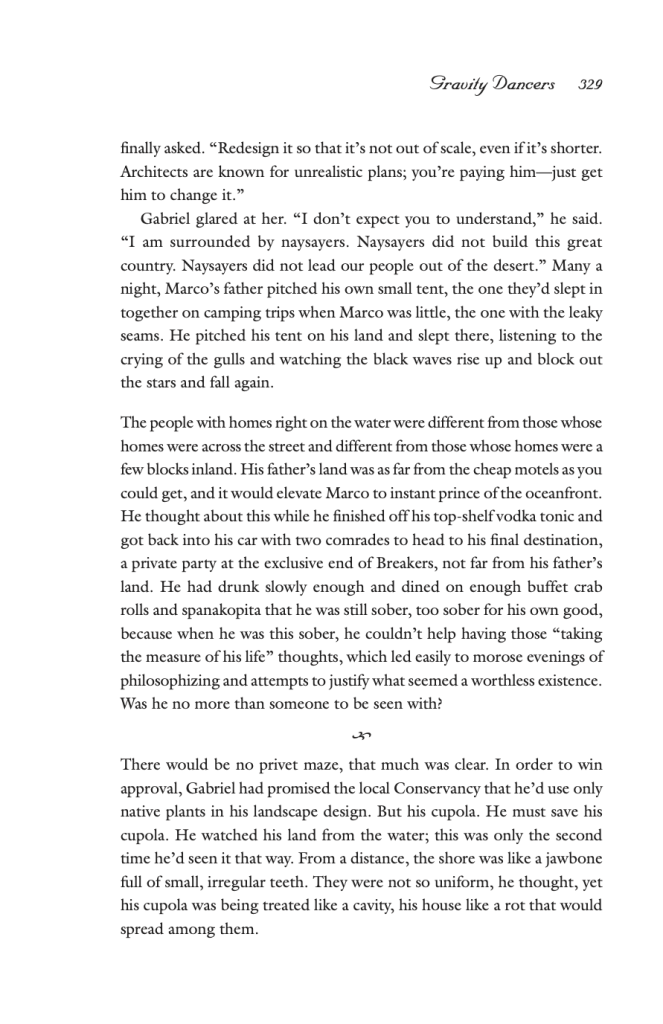
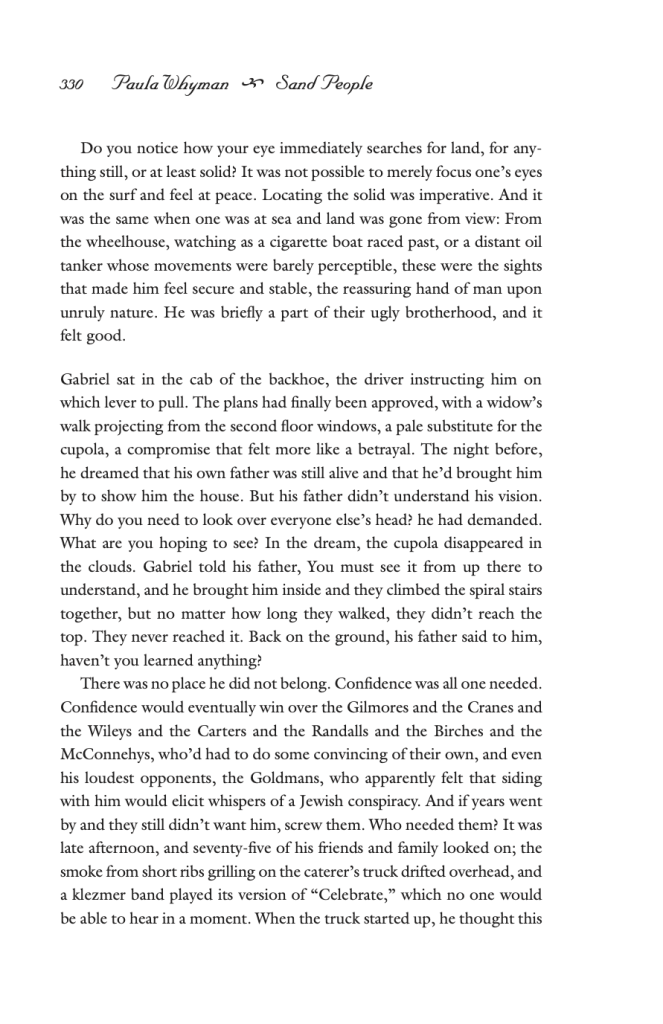
The house and the land are symbolic of Marco’s family legacy. Marco’s dad Gabriel, the landowner and the house-designer, is in the middle of disputes with land use committees and the local conservancy—“the architect, the builder, the permit office, even the mayor”—on his large-scale villa plan, which is marked by a tall cupola. Even Marco speaks of Gabriel’s idea with sarcasm. Though the plans were finally approved, with a widow’s walk replacing the cupola, to Gabriel it was “a compromise that felt more like a betrayal.”
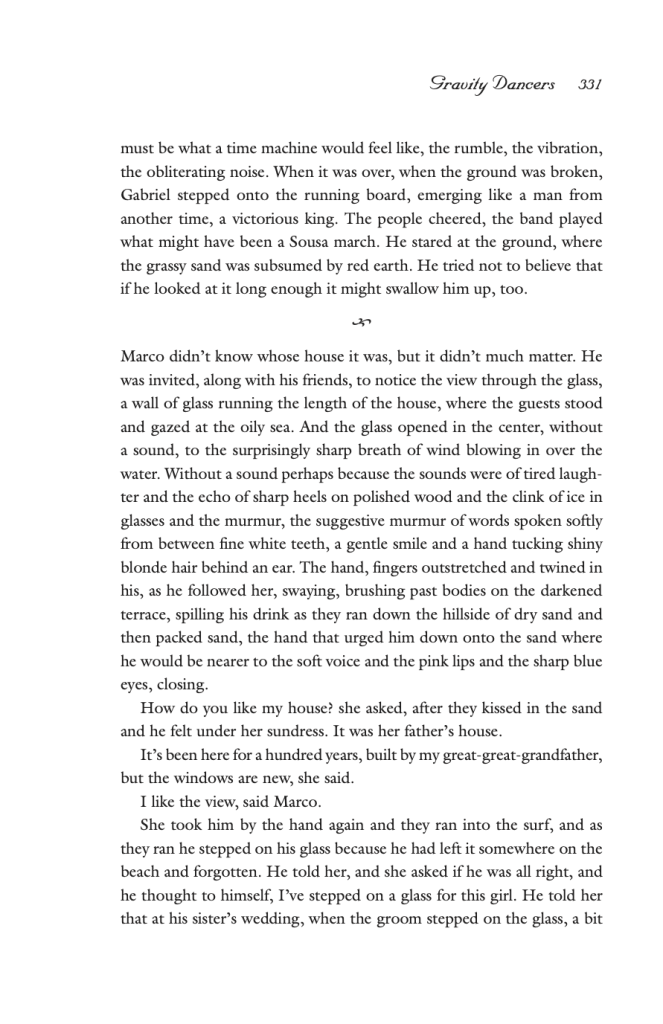
Marco is only sixteen, but he already seems trapped. Marco is “always in a hurry” and “always late.” To his grandfather, Marco is “a stubborn boy.” He is rebellious and always falls into frustration, his life seeming “a worthless existence.” He flirts with a girl for sex, an equally “trapped” girl with a different kind of family legacy, only to find himself being spat out onto the sand like Jonah, sinking back into the sand of his homeland.
Marco’s grandfather is the one holding down the fort for the family, so calm, yet stern. Living the same life for more than fifty years, the grandfather always keeps the Sabbath and reveres the ancestors’ legacy. Though he passed away before Gabriel built up the villa, Gabriel had a dream in which he took grandfather to the widow’s walk to see the whole vision, but they never reached the top of the stairs, which the grandfather expected. “The grandfather was the one who was chastising Marco for breaking the rules…and talking about how material things (the house) were not what mattered,” explained Whyman.
The grandfather accepts the legacy as the norm, while Gabriel and Marco rebel against it. But despite their fight, despite their search for reassurance and self-confidence, their lives are already apocalyptic. How could they fall out from their ancestors’ legacy? “My people came from the desert.” The story’s ending circles back to its start.
“Sand People” is a story that can connect to everybody’s life experiences, as we all live our family legacies as part of our identity. If we are not “sand people,” we may be “American people,” or “Asian people,” or “technology people,” or “nomad people.” These lineages and legacies become our home bases and define who we are. Whyman admits that she might want to change the story if she were writing it today, because she has changed through the years, and so should the characters. But Whyman is still writing. Writing is her home base.
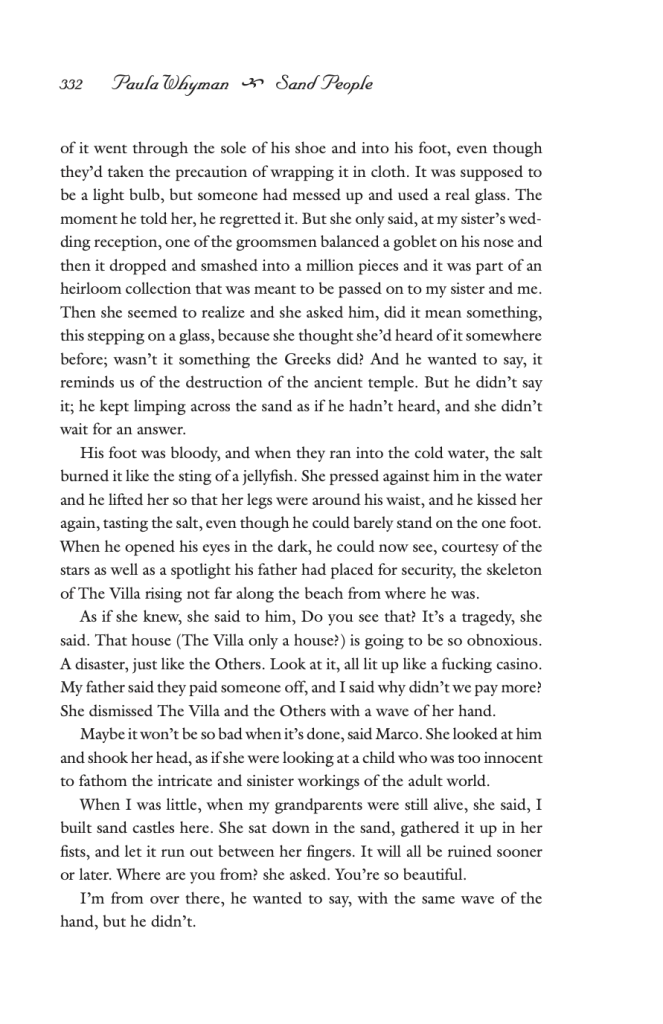
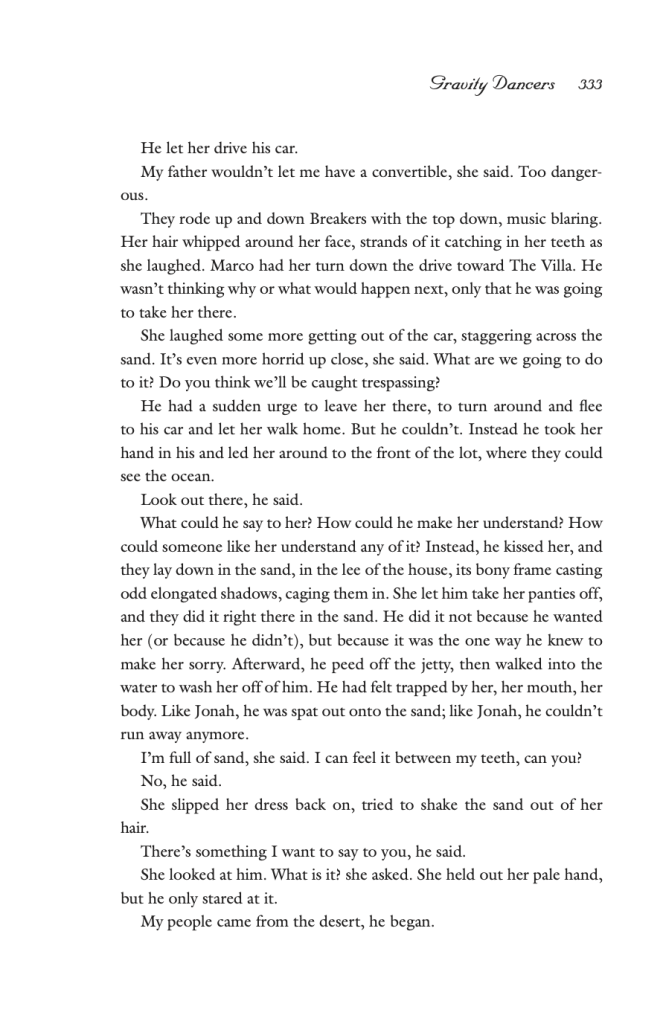
The following is a selection from Gravity Dancers, pages 325-333.
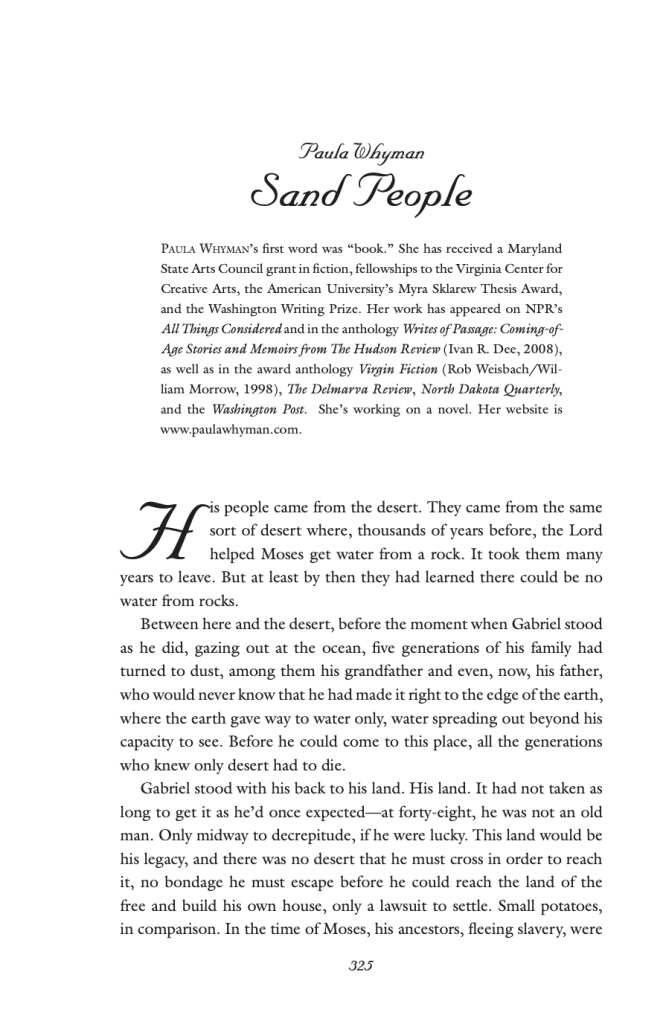
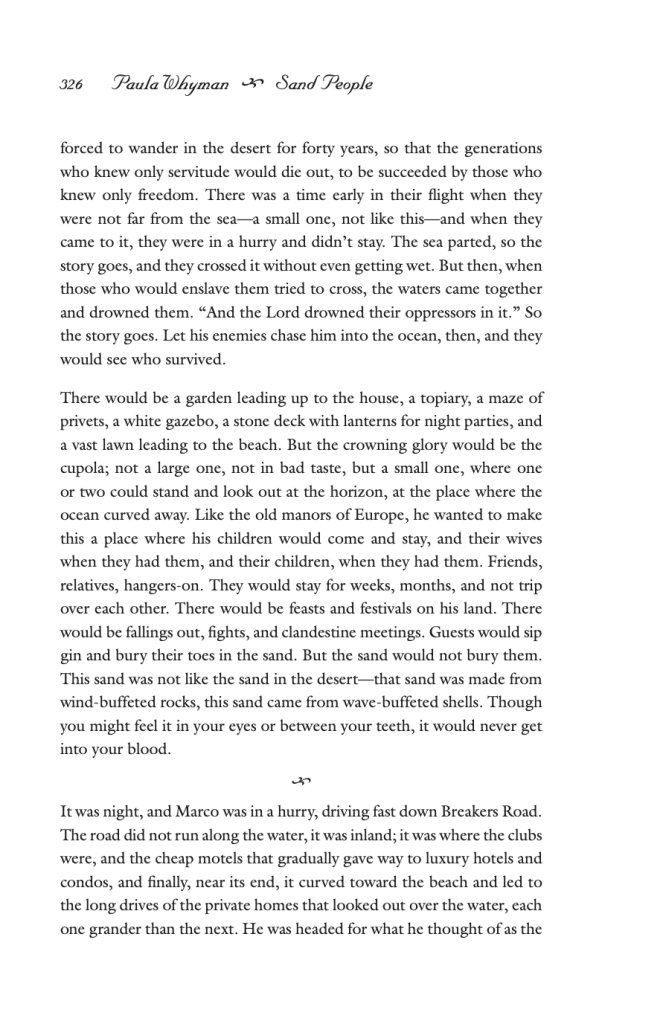
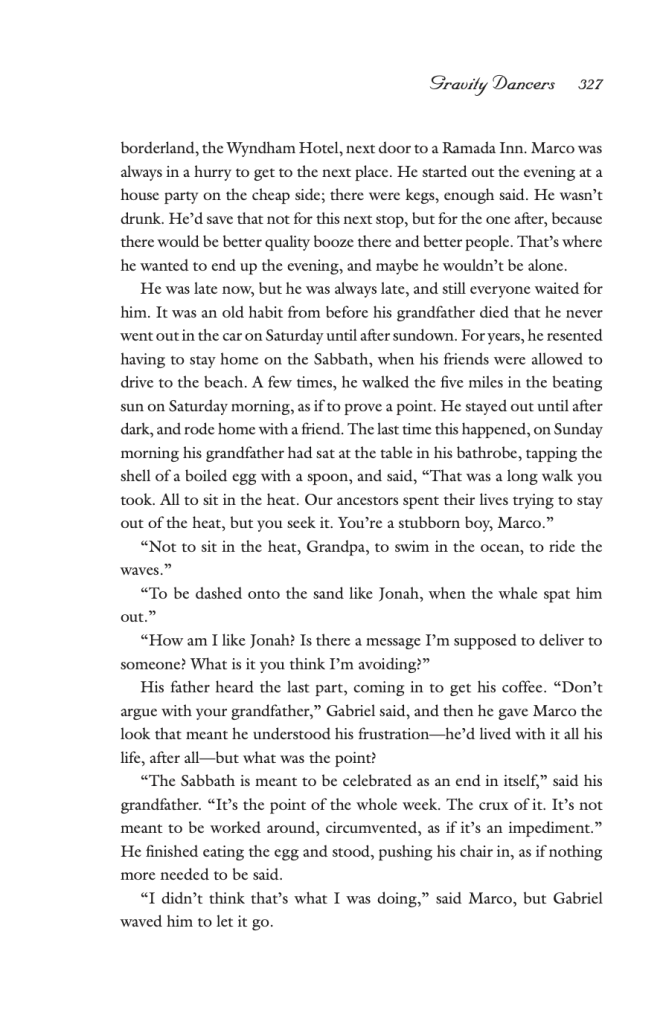
To learn more about Paula Whyman’s work, including her book You May See a Stranger, visit her website.

 GRACE AND GRAVITY