
4/21/2022

Amber Sparks is the author of four collections of short fiction, including And I Do Not Forgive You: Revenges and other Stories and The Unfinished World, and her fiction and essays have appeared in American Short Fiction, the Paris Review, Tin House, Granta, The Cut and elsewhere. She lives in Washington, DC, with her husband, daughter, and two cats.
Gloria Rose Potts is a writer from Cape Cod, Massachusetts. She studied at Clark University in Worcester, MA and is currently pursuing her MFA at American University in Washington D.C. She is fascinated by the human connection to nature and the supernatural, believing the lines between these concepts are not just blurred but non-existent. Once, while traveling in Scotland, she was accused of witchcraft but managed to make it home safely. Ask her about it, she’ll tell you the story sometime.
Introduction to “As They Always Are”
By Gloria Rose Potts
Reading an Amber Sparks story is like reading the night sky. Millions of lights scattered across an expansive darkness reminding us of the simultaneous notions of possibility, and finality. We are here and we are nowhere. We are enchanted and we are lost. Her work carries echoes of ancient folk tales, which gives the reader a strange sense of nostalgia – have we heard this story before? Did our mothers not insist on telling us these words? No, certainly not. Because it carries her contemporary touch which pushes the reader to question tropes and assumptions. She does not shy away from the darkness of the human experience, but rather finds strange and unique ways to celebrate it. As her Instagram bio boils it down for us: ghosts and death and fairytales and feminism.
Since “As They Always Are” was first published in Amazing Graces, Amber Sparks has continued to bloom in the literary world. Other stories forged at her hearth carry the same weighted ideas expertly crafted to cut through the fog of routine. They push the reader into the darkness, but always provide a lantern. We sit comfortably with concepts of loss, anger, love, and death. Sparks convinces us that they are not deep, scary wells of humanity, but rather old friends to converse with.
Sparks’ stories have been published in Gargoyle, PANK, Barrelhouse, The Washingtonian, Split Lip Magazine – just to name a few. Her essays have been featured in Literary Hub, The Cut, Real Pants, Gay Magazine – just to name a few more. She co-authored with Robert Kloss The Desert Places (2013) and has authored three books May We Shed These Human Bodies (2012), The Unfinished World (2016), and most recently And I Do Not Forgive You (2020). And I Do Not Forgive You was named Best Book of 2020 by The Washington Post, NPR, Bustle, Good Housekeeping, and Tor.com. I made the wonderful discovery today that my copy is available for pick-up at the Tenley-Friendship Library.
Her story “As They Always Are” falls somewhere between a Grimm and a ghost story. Relatively short at first glance, but every line is overflowing with imagery and new clues for the reader. We eagerly gobble up each passage. Beginning on a haunting tone: “The mother was a mother in a time before drugs could save you from the small things,” Sparks simultaneously grounds and eludes the reader. This is the story that engages the two types of mothers we encounter in fairytales. The mother who dies and is placed up on a pedestal and the stepmother whose inability to love the child is so deep that the child cannot even accept nourishment from her. “As They Always Are” cracks the bedrock of the classic fairytale by presenting a heady question: what if the perfect, dead mother returns?
Sparks creates a veil with her imagery reminiscent of Shirley Jackson but reaches back further into the ether of lore with allusions to Baba-Yaga and her three horsemen. Just as the three horsemen in their distinct colors brought signs of the passage of time; a black, white, and tabby cat signal the passage between worlds. And still, Sparks’ expertise stretches to the oldest parts of humanity, as cats in ancient Egypt were considered guardians of the underworld and often are the harbingers in fairy tales. So of course, they would be the ones to bring the ghost of the mother home. Sparks tells us, “They’re truly chaotic neutral; they’re not on anybody’s side and it’s great”. Cats are just the messengers. I’m reminded of my own cat when his dilated eyes seem to be staring at nothing in the corner of my bedroom, I’ll lean and close and ask: “what do you know, witch?”. Alas, he keeps his secrets.
Much has changed for Amber Sparks since she wrote “As They Always Are”. She has become a mother and lost her own, and was very open about how the story resonates with her in the present. “It’s funny – I wrote it before I was a mother, and before my own mother died, and so it feels unbearably sad now, and poignant in a way that it didn’t before. It’s not that I couldn’t imagine what it was like – at the time I wrote it, I desperately wanted to be a mother and was dealing with infertility”. It is hard to envision a greater loss than losing one’s mother, and a greater gain than becoming one. I have not begun my own journey to becoming a mother, but it is one I consider in my future. I can only try to imagine what it is like to want to love like a mother, only to be met with resistance at the threshold. Infertility affects approximately 10% of women in the United States. That’s about 6.1 million women. If the “self” is the body and the soul, what can the soul do when the body struggles? We continue, we hope, we return. The soul of the mother returns without her body in “As They Always Are” to try and love a little more. Perhaps there is some answer tucked away in there.
But what of the father? Sparks controls the eye of the reader as we watch the two types of mothers in the story, and she allows us to see just enough of the father to question. Writing an absent character seems counter-intuitive, and yet Sparks’ proficiency is resolute that we do not even notice her guiding hand. The father in “As They Always Are” appears sporadically to alert the reader to his presence and his minimal involvement in his new baby’s life. He only steps in after the mother departs, and steps back out as the stepmother enters. I was oddly reminded of Beyoncé (indulge me, this will only take a moment I promise). When Beyoncé and Jay-Z welcomed their first child, there were multiple news stories criticizing Beyoncé for returning to work so soon and not caring for her baby. And yet, not a word about Jay-Z and his work habits. This was not a shocking reaction from the public, and ten years later still would not be. The pressures of parenthood are often most acutely pressed upon the mother. How unfair that we put so much pressure on mothers that she cannot even rest in peace and must return even after death to care for her child. Going forward with her writing, Sparks hopes to subvert the trope of mothers dying. She says, “I don’t want the mother to die anymore! I want more living mothers!”. Most fairytales are responding to the fear of death during childbirth, and childbirth can be scary. But it is also a wonder. It is the power of being itself. So, we will let the mother live and wonder.
Sparks’ non-fiction essays delight in similar ways. In more than one casual conversation this week I have recommended to peers and strangers her article Escaping into Books About the Middle Ages is My Self-Therapy published in Literary Hub. Sparks ponders the lives of medieval peasants refusing to romanticize the harsh realities of the era, including the Black Plague. She writes “I couldn’t say for sure, but I think it’s something to do with the small strange miracle of ordinary people just… living, in a mostly chill way through all this chaos”. We have all now developed a strange kinship with our ancestors in the Middle Ages who had to live through disease and chaos. The most poignant part of this essay? It was published February 12, 2020 before the world had even begun to lock down due to our modern plague. Sparks may not only be a prudent author, but she may be a seer as well.
What remains throughout all of Amber Sparks’ pieces is the complexity of life, and the reality that we constantly must be holding multiple truths at the same time. “As They Always Are” presents the deep well of love a mother holds for her child. An undeniably beautiful feature of the human soul. However, simultaneously we explore the sad expectations placed on mothers and that love. And once the baby in question is gone, the mother and stepmother can both be forgotten. The world moves on, maids will come clean up and the unsightly smudge on the ground can be covered. As a horseman signals the passage of time and cats shepherd us between worlds – we all must move on. Our stardust fades to dust, and we can only hope that –for a moment – we had been as beautiful as the night sky.
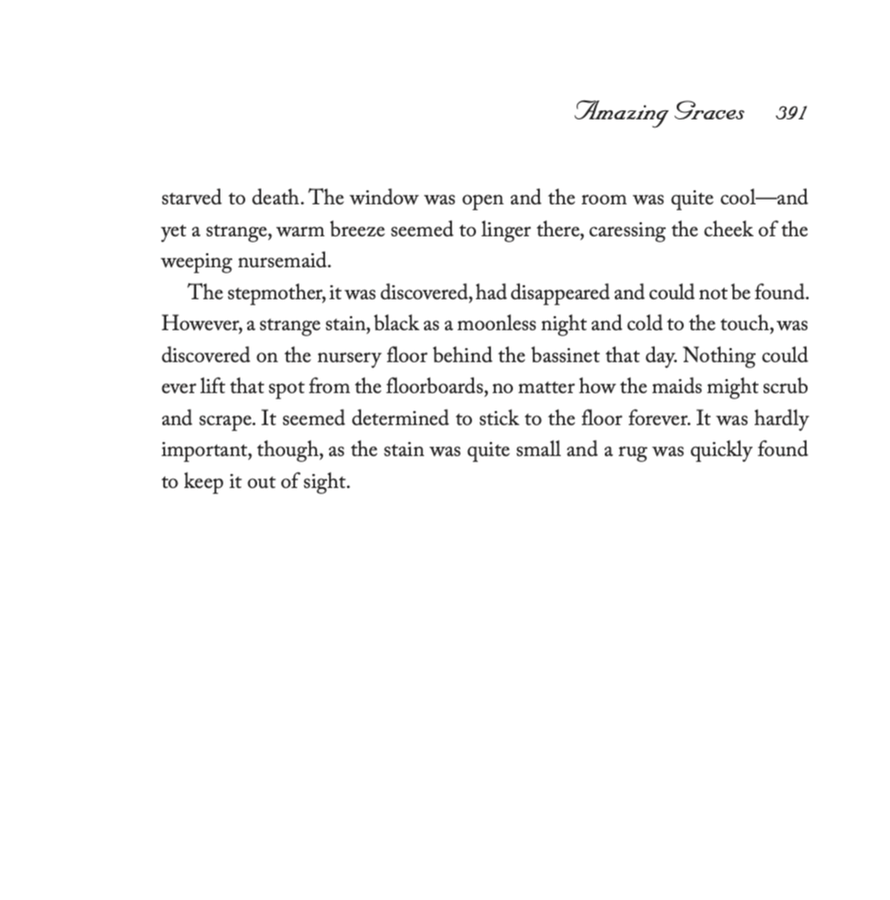
The following is a selection from Amazing Graces, pages 388-391.


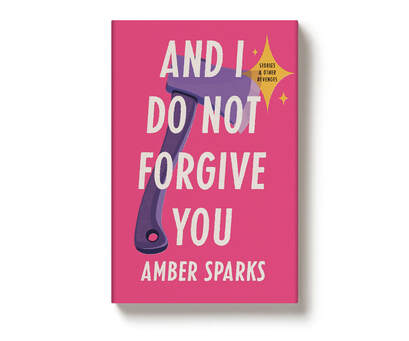
To learn more about Amber Sparks’s work, including her book And I Do Not Forgive You, visit her website.
 GRACE AND GRAVITY