
4/16/2022

Caron Garcia Martinez is a writer, activist, and teacher who was a runner-up at the 2010 SouthWest Writers Conference for “Emerging Multicultural Voices,” and was selected for a writing residency at Ragdale in 2017. Her short stories have appeared in two “Grace and Gravity” anthologies, Abundant Grace and Grace in Darkness, and her short story, “Good People,” appeared in This is What America Looks Like, an anthology of fiction and poetry published in 2021 by the Washington Writers’ Publishing House. Caron’s non-fiction has appeared in Catholic Digest and Mothers at Home. She currently teaches at American University’s Kogod School of Business and serves as its Director of the Center for Professionalism and Communications. A former Foreign Service Officer with tours in Mexico City, in London, and in Quito, Ecuador, Caron’s two current projects are a collection of linked short stories about women traveling north to the U.S. from Central America in search of a better future and a novel set in Mexico in 1910 based on stories told by her abuela, Celia. Caron is a native Californian and a graduate of Williams College, George Mason University, and the London School of Economics and Political Science. For further information, please see Caron’s LinkedIn profile, here.
Sydney Hamilton is a Creative Writing MFA candidate at American University, where she also received her bachelor’s in Literature. Born and raised in Balitmore, Maryland, she has always had a penchant for stories about growing up and the absurd difficulty of just trying to be a person. She enjoys writing middle grade, young adult, and romance stories.
Introduction to “Corazón”
By Sydney Hamilton
I wish I could pinpoint the moment when I knew how to use words. Not in the rudimentary sense (and speaking of which, when did I learn words like rudimentary?), but knowing that there is a right word for everything. That moment when you are in the middle of a conversation and you know, you know there is a perfect word for what you are trying to say; a word that captures it all. Not until reading Caron Garcia Martinez’s “Corazón,” did I realize that this experience – of searching for words and using them to illustrate life – is the first sign of being in love with a language.
Growing up in Southern California, Martinez fell in love with literature by reading the works of Isabel Allende and Helena María Viramontes. This passion for language and literature continued to follow Martinez through school and into her career, eventually leading her to American University where she now works as the Director of the Center of Professionalism and Communications at AU’s Kogod School of Business. Motivated by her love of writing and her culture, Martinez penned “Corazón,” a short story featured in Grace and Gravity’s Spring 2018 issue, Grace in Darkness.
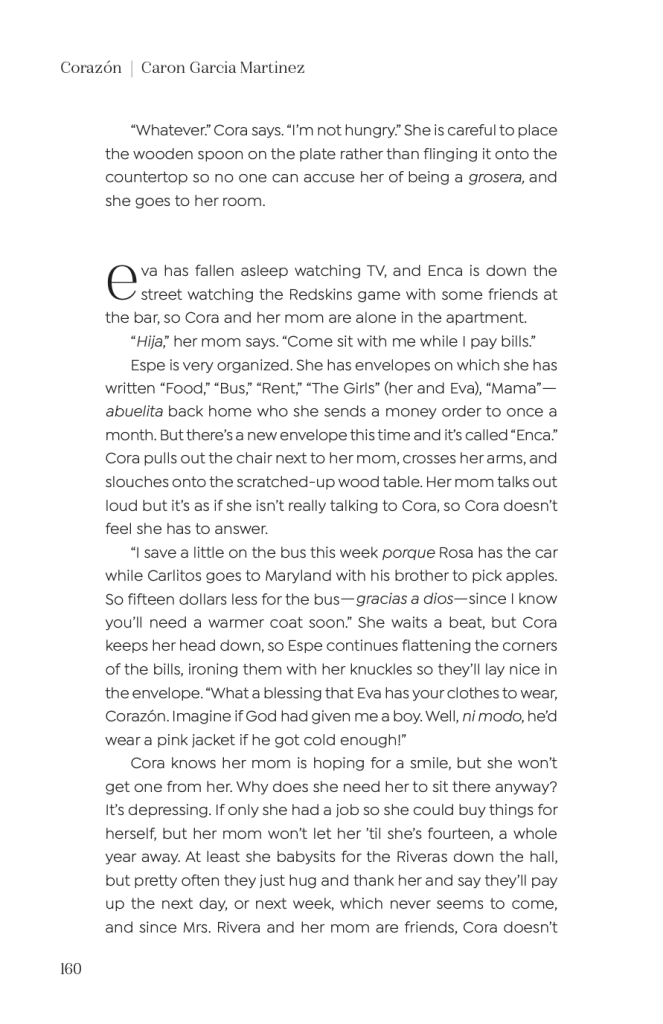
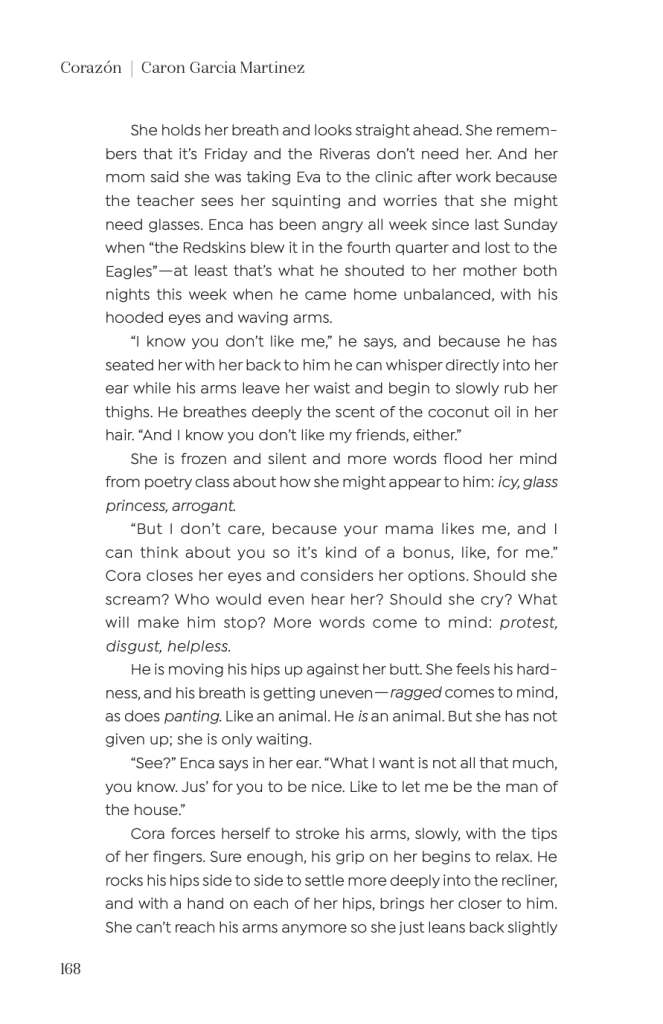
The story follows thirteen-year-old Cora, who recently immigrated to the United States from Mexico with her mother, Espe, and her younger sister, Eva. In DC, they live with Espe’s boyfriend, Enca, and with him around, the apartment is anything but a home to Cora. Harassed by his unsavory friends, his violating gaze, and his inappropriate touches, she struggles to find any escape and dreams of being back in Veracruz with her abuelita.
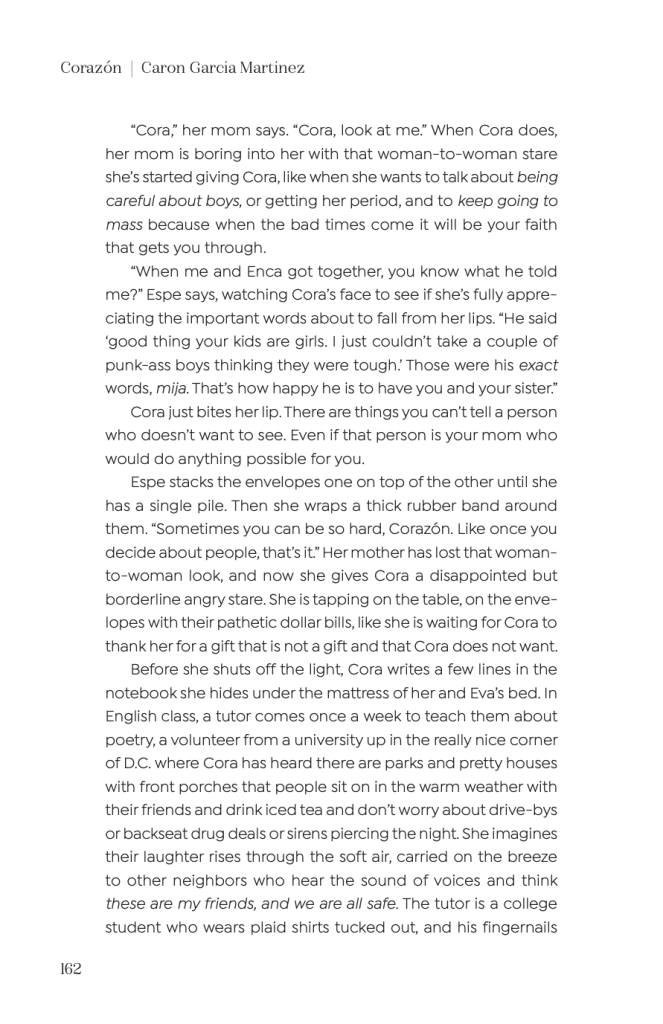
However, Cora does find relief in something: words. Once frustrated trying to learn English, now “Cora has started to think poetically.” Inspired by a tutor who introduces her to poetry, she graduates from just recognizing words to curating them and using them to create the images in her mind. Through Cora’s embrace of this newfound skill, the story speaks to the relationship between language and emotion. While her desire to know and further comprehend English is evident, what is even more transparent is the way that Cora has learned to internalize the words she learns, tethering them to her emotions. She does not think about words just for the sake of thinking about them, she feels them.
Cora finds herself looking into the faces of those around her, taking in their expressions and their actions, and all the while searches for the word that captures them best. Enca and his friends are not just bad, they’re “manipulative.” She does not just feel sad, she’s “devastated.” Yet, this bond between language and emotion is also true when Cora turns to Spanish at times to express herself. It is no coincidence that when she thinks of her family and is around them, she favors her Spanish vocabulary. Talking to Martinez about which language Cora prefers to write in, she also felt that Cora’s mood might come into play. She compared Cora to a gymnast, feeling close to her native language but wanting to stretch and show off her skills in English. There is a sense of her familiarity with Spanish, whereas when she uses English, it is like changing the lens on a camera; Cora can view old subjects in a whole new light.
When I asked Martinez about why she wrote Cora as an aspiring poet, she said that she wanted to showcase the accessibility of poetry and demystify it. When Cora’s tutor, Miguel, asks her class about poets, they can only conjure up images of old men with beards and bored, rich women. However, as Cora learns about the likes of Langston Hughes and Judith Ortiz Cofer, she begins to see a place for herself among them. Not only does she admire the new words she’s learned in English, but she develops a fondness for metaphors and similes. Poetry allows her to illustrate with her emotions and her words, in either English or Spanish. There is a consistent openness to poetry, inviting everyone and anyone to use the poetic structure as an outlet. Though I consider myself strictly a fiction writer nowadays, I can vividly recall being in middle school – heartbroken by my own unrequited feelings – and for some reason, turning to poetry to express my tween anguish. Martinez thinks of her own son, Daniel, who is a musician, and how his raps and songs are poetry. Emotiveness being a hallmark of poetry, it makes sense that Cora finds a home in writing poems.
Cora’s growing bilingualism functions as a motif in this story, as not only does her vocabulary grow, but so too does her cultural identity. With each poem that she writes, Cora envisions herself living in D.C., surrounded by friends and pursuing her dreams – and above all, feeling safe. The more she recognizes that her dream can be a reality, the more dissatisfied she feels with her surroundings, with Enca, and with her mother. Yet, Cora’s increasing bilingualism drives a wedge between her and her mother. While Cora enjoys the sound of words like “scintillating,” Espe finds the words extra and complicated. Martinez sees Cora’s use of English as her breaking through some of the boundaries in her life. Having immigrated to the US at such a young age, many of her fond childhood memories are tied to her life in Veracruz. Now, she’s experiencing her adolescent years in a completely new environment, and she’s finding English is the language that allows her to best voice her restlessness and her questions.
While she still feels connected to Spanish and to that part of her, there is something about learning this new language – especially from a poetic stance – that emboldens her. With language and speech being at the heart of this story, it is interesting to recognize that the reason men like Enca bully Cora is because she refuses to give them her words. She refuses to waste these words that she has learned on them. It gives her so much power as a young woman – a power that scares her at times but one that she values, nonetheless. In this way, “Corazón,” is not just a story about the power of words, but the power that comes from being able to choose our words and what it means for words to illustrate different choices and actions.
Martinez told me that originally she had a much darker ending in mind, with Cora unable to escape Enca’s abuse in time. However, after her son read the piece – and here she emphasizes the importance of having someone else to read your work – he felt the ending did not do Cora justice. The Corazón she had written up until this point had proven herself to be stronger than that. Martinez realized that her son was right. In the end, Cora, cannot submit to Enca even though she is still trapped in the same home as him. Her rebuffing him creates tension she will have to live with, but she trusts more in her own strength. Eventually, Espe reveals that she has read Cora’s poems, and she looks at her daughter with new eyes; glimpsing the woman she might become. Somehow, it feels more relevant than ever that the meaning of her mother’s name – Esperanza – means hope.







 GRACE AND GRAVITY