
4/22/2022

E.J. Levy is the author of the 2021 novel, The Cape Doctor, and a professor in the MFA program at Colorado State University. Levy received a B.A. in History from Yale and an MFA from Ohio State University. Her work has received a Pushcart Prize, the Flannery O’Connor Award, and the Lambda Literary Award, and has been featured in The New York Times, The Paris Review, and The Washington Post. More information about Levy and her work can be found at ejlevy.com
Isabella Goodman is an award-winning essayist who writes about the intersection of art, culture, and the media she loves. She often finds a way to talk about her hometown of Houston, Texas and her time as an undergraduate at American University in Washington, D.C. Her work has been featured in New York Magazine, Houstonia Magazine and The Eagle. You can find her writing at isabellagoodman.com and via email at isabellamgoodman@gmail.com
Introduction to “My Life in Theory”
By Isabella Goodman
Her own desires, skepticism regarding fidelity and monogamy, questions about what we owe those we love and ourselves, and annoyance at the Anglo-American penchant for delimiting identities and desire in ways that often seem falsifying: these were the matters at the forefront of E.J. Levy’s mind while writing her short story, “My Life in Theory.” Levy’s writing is bold and unafraid to explore complex themes in relationships and sexuality, as seen in her personal essays, short stories, and novel. Whether it’s an article in Salon about being a lesbian and marrying a man, a collection of stories called Love, in Theory that’s rooted in its characters trying to understand and rationalize their attraction, or basing her first novel, The Cape Doctor, on a 19th-century surgeon who was born female but spent his adult life identifying as a man; Levy has spent her career seeking to understand how and why we love. In an interview with Superstition Review, Levy said, “Now, I’d say that love is more like a collaborative art project, or a great meal, or like a garden that you cultivate with your beloved—it’s a built thing, like fate, requiring attention, cultivation, but when it’s done well, it feeds you, sustains, nourishes, is a thing of beauty.”
Originally from St. Louis Park, Minnesota, Levy holds a Bachelor of Arts in History from Yale and an MFA from Ohio State University. She currently teaches in the MFA Program at Colorado State University and in 2021 released her first novel, The Cape Doctor, published by Little, Brown and Company, was a New York Times Book Review Editor’s Choice and on Barnes & Noble’s list of 100 Best Books of Summer 2021 and will be translated in French, Spanish and Italian in 2023. Her award-winning work has appeared in many outlets, including Paris Review, The New York Times, Washington Post, and The Best American Essays; more of her essays can be found on her website. Levy is also the editor of Tasting Life Twice: Literary Lesbian Fiction by New American Writers (Harper Perennial, 1995), and the author of Amazons: A Love Story (University of Missouri Press, 2012). Her debut short story collection, Love, In Theory (University of Georgia Press, 2012), was the recipient of the Flannery O’Connor Award, the Great Lakes Colleges Association’s New Writers Award. Levy is also currently working on a novel set in Park Slope in the 1990s.
Love, In Theory contains ten stories that explore love of all kinds through different theories and was called “a smart, insightful collection of stories about life and love, in a starred review by Kirkus. Among the ten stories is “My Life in Theory,” which was published in the 2006 edition of Grace and Gravity, Enhanced Gravity during her time as a creative writing professor at American University from 2004 to 2008. According to Levy, editor Richard Peabody selected this piece because, “the story is representative of my debut collection as a whole and of my preoccupations at that time – i.e., love, fidelity, how theories can both illuminate and mislead us, the relation between ideas and bodied experience,” Levy said.
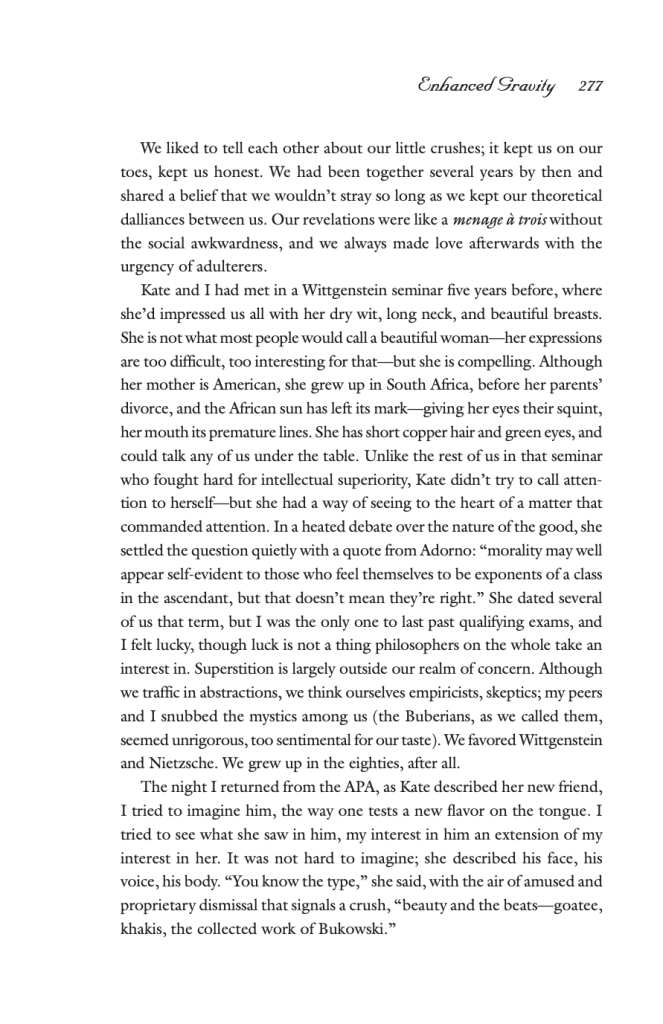
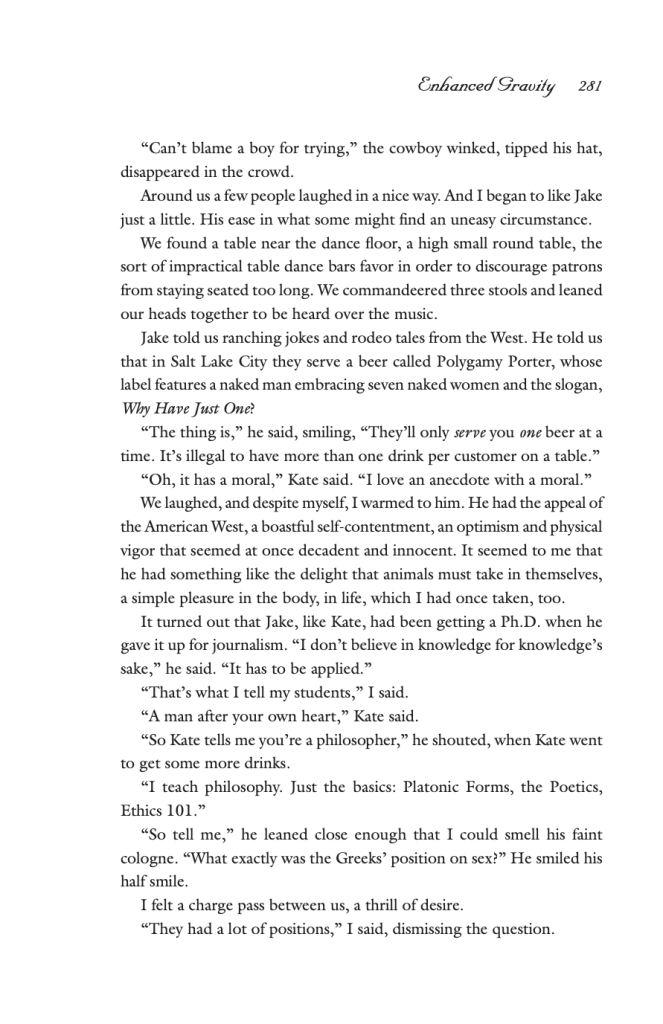
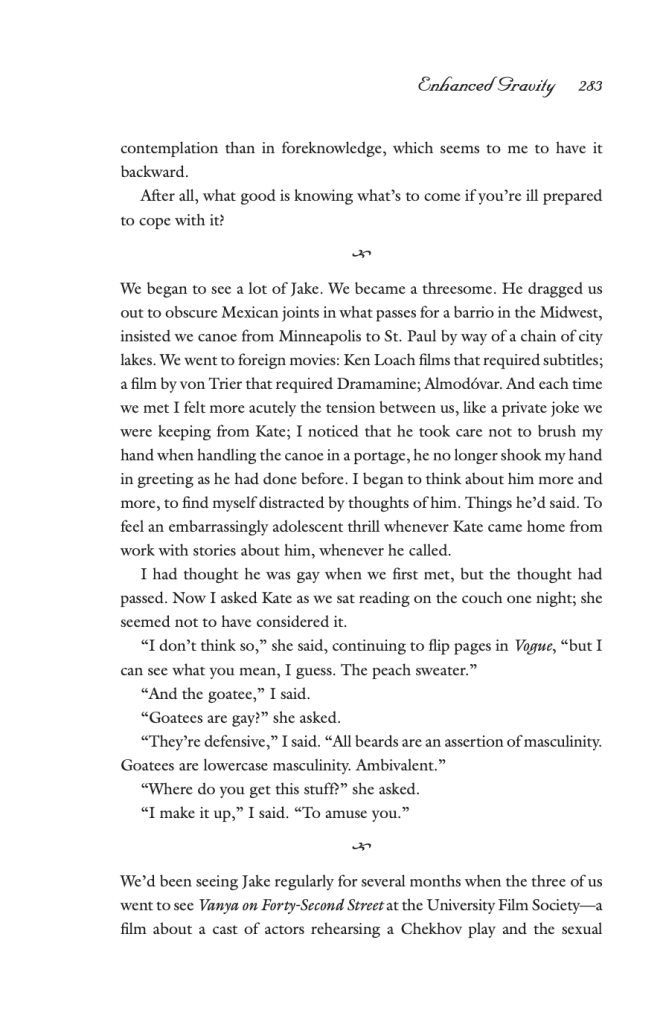
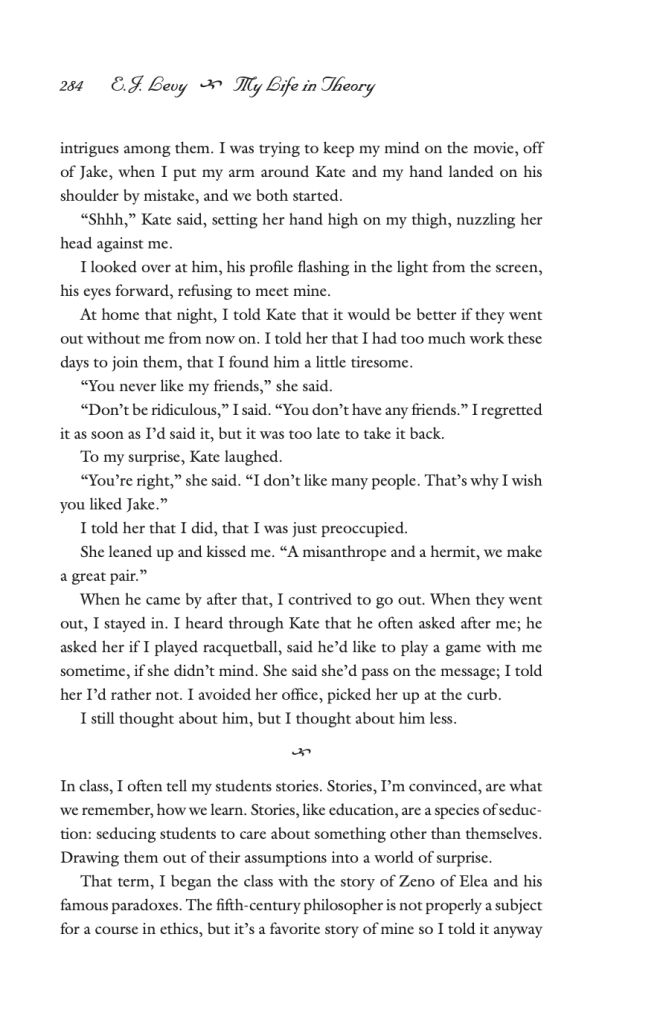
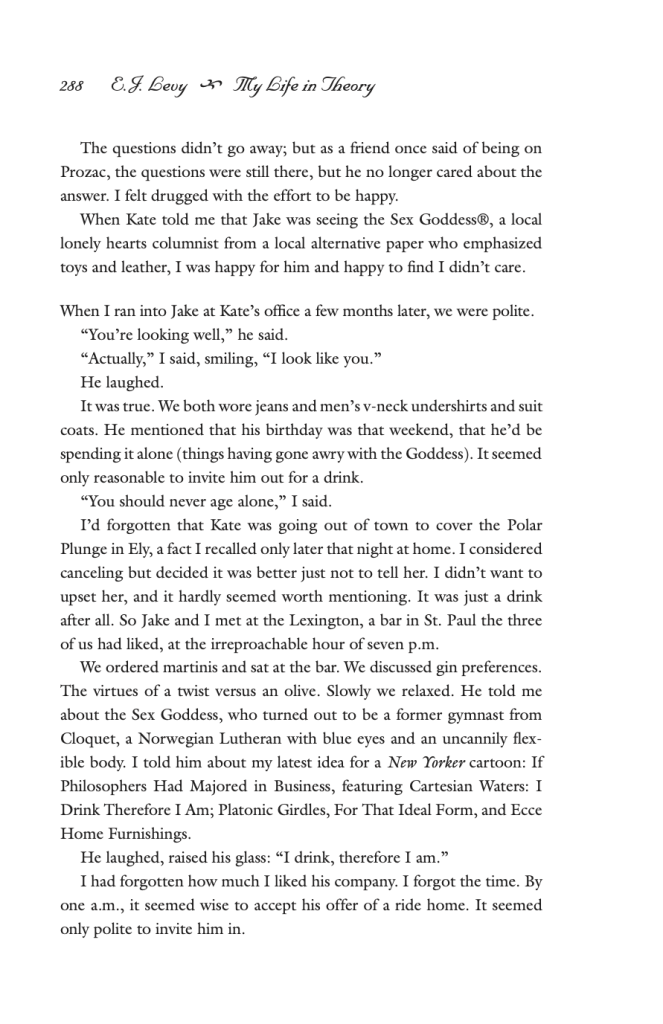
“My Life in Theory,” is the story of a philosophy professor whose long-term relationship is challenged when the narrator finds herself drawn to her partner’s new friend. Using philosophy as a framework for understanding, Levy’s excavation into the narrator’s relationships goes deep into love and loss, examining desire:
“I wanted the feeling that comes when you release yourself toward things—reading can do this and looking at a painting and listening to music or walking through half-empty streets almost anywhere alone at night will do this. I wanted to stand in the radiant presence of desire” (292).
The question of desire is paramount in “My Life in Theory,” as well as in much of Levy’s work. What is it, how do we feel and express it, how does it blind us from ourselves and the people we love; these are all questions that Levy poses in a rigorous form, through the eyes of an academic. In speaking with Superstition Review, Levy said that, in her own life, desire has become her subject: “Desire in its many forms–salvific desire, destructive desire, refracted through ambition, sex, children, art, food. For me, it’s really the pulse of life,” Levy said.
The desire in “My Life in Theory,” beyond being adulterous, is fraught with the complexities of sexual orientation as well. For much of the piece, Levy keeps the gender of the narrator ambiguous; it’s not until fourteen pages in that there’s an explicit mention of the narrator’s sexual identity. Levy writes:
“Lesbians are often accused of narcissism—our love of women blamed on a hatred of men or a hatred of our mothers or a thwarted maturation that has locked one in pursuit of an adolescent mirror image of oneself—as if a woman simply loving another woman were inexplicable without reference to aversion or impediment. But this, in my experience, could not be more wrong. I have loved women because they are beautiful, because they are tender or brilliant, because I am moved by them. When I fall for a man, as I fell for Jake, it’s because he reminds me of myself.” (289)
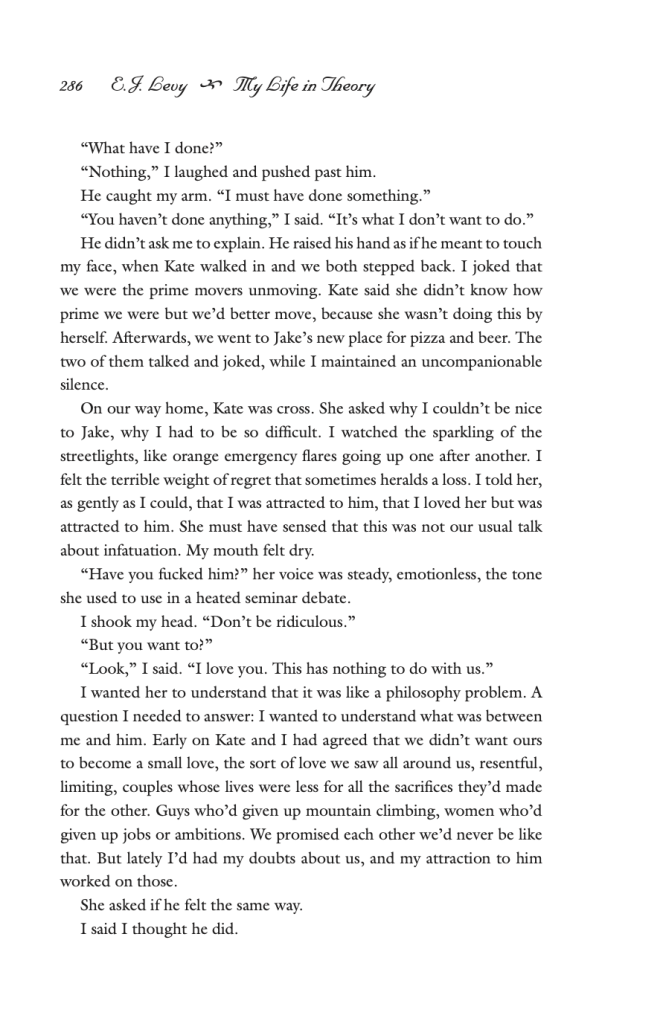
Thus, the desire is further complicated. Early in the story, the narrator describes her long-term relationship with Kate as refreshingly open, with the two joking about their fleeting crushes. When the narrator confesses her infatuation for Kate’s friend Jake, however, Kate is upset. And while – at this point in the story – the narrator’s gender and sexual orientation are unclear, the lesbian who falls for a man is a dynamic that is familiar in Levy’s writing, as is the particular kind of resentment that comes from her partner.
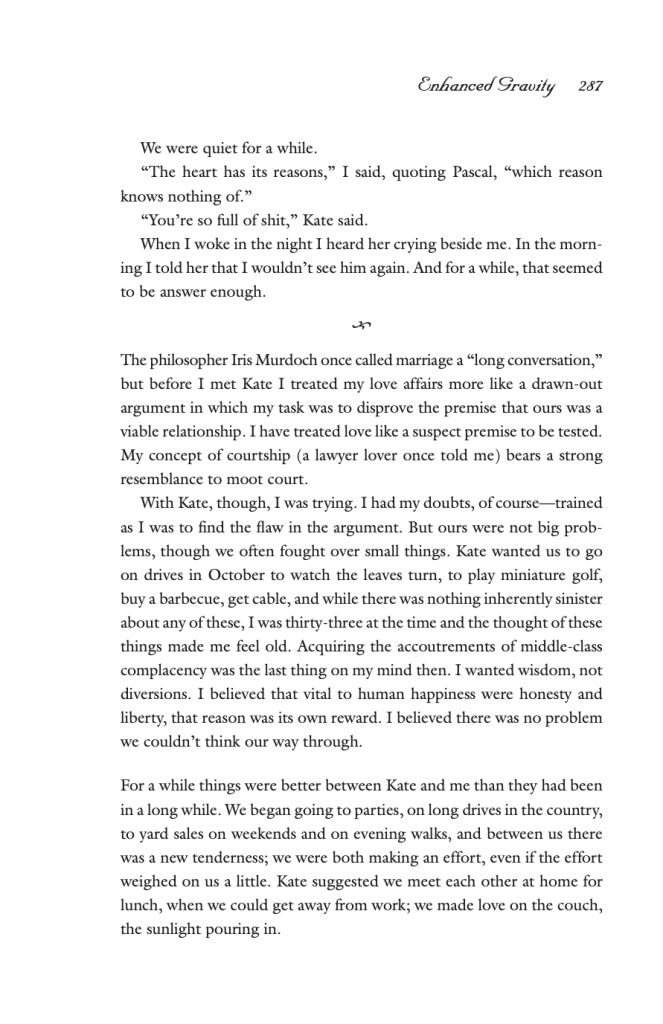
Levy handles the conflict with grace, and her erudite approach to the philosophies of love simultaneously creates distance between the narrator and her feelings and then closes it through the apparent comfort that academia can bring. Levy writes:
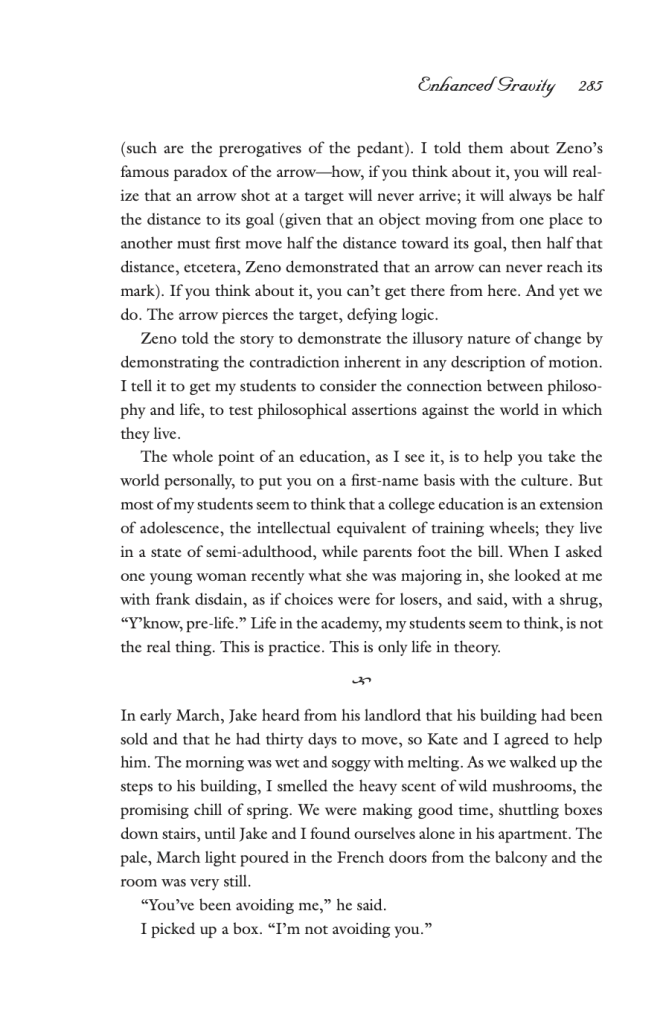
“The whole point of an education, as I see it, is to help you take the world personally, to put you on a first-name basis with the culture.” (285).
Though this story was published while Levy was a professor, she says it was written while she was a graduate student. “I was dating scholars and was interested in how the pleasures of the intellect and scholarship might relate to life, to love, to our bodied experience of our humanness,” Levy said, adding that she had a particular interest in how “lived experience measured up to our ideas about [school], and to consider how theories might guide and maybe mislead us.” Her work stands out among other stories of academia because of the through line: desire. Levy grounds the theories and philosophies with a feeling that unites us and does so in an exciting and unexpected way. There’s catharsis in the desire that the narrator experiences, even if it’s misguided.
By writing “My Life in Theory” and Love, In Theory, Levy was able to reckon with the matters that plagued her. “By the time I’d finished the book, I’d worked out an answer to these matters that I could live with,” Levy said. “Namely, that devotion is a meaningful discipline and worth the effort; it humanizes us.”






 GRACE AND GRAVITY