
4/15/2022

Chelsea Leigh Horne teaches writing and literature at American University. She is also a faculty fellow at the Internet Governance Lab. Her areas of research encompass writing, digital rhetoric, communication, information literacy, privacy, big data, and Internet governance. Recent scholarly work has appeared in Telecommunications Policy, Writing Spaces, and Routledge Studies in Shakespeare.
To learn more about Chelsea Leigh Horne’s work, visit her website.
Marriya Schwarz has always been drawn to quirky stories that add humor to everyday life. She’s a writer, comedian, and nationally ranked graphic designer (NSPA). She has words in Slate Magazine, Women’s eNews, and Slackjaw Humor. Marriya has previously worked for showrunner Chitra Sampath and comedian Sammy Obeid, and developed television shows with Amazon, FX, and Netflix. Currently, she works as a pop culture writer and reviewer at Zimbio. And she also runs her own late-night show THE CATCH-UP, hosts the Remake Hot Take podcast, and works as the Editor-in-Chief and designer of Everything But… magazine. Marriya also judges creative writing competitions in satire and flash fiction for NYC Midnight, and she is the current non-fiction editor of Folio Literary Magazine. In her free time, Marriya balances attending classes as a Creative Writing MFA candidate at American University, tap dancing, and transcribing 18th century almanacs.
Introduction to “The Heartbreaking Misfortunes of a Nearly Genuine Almost Casanova”
By Marriya Schwarz
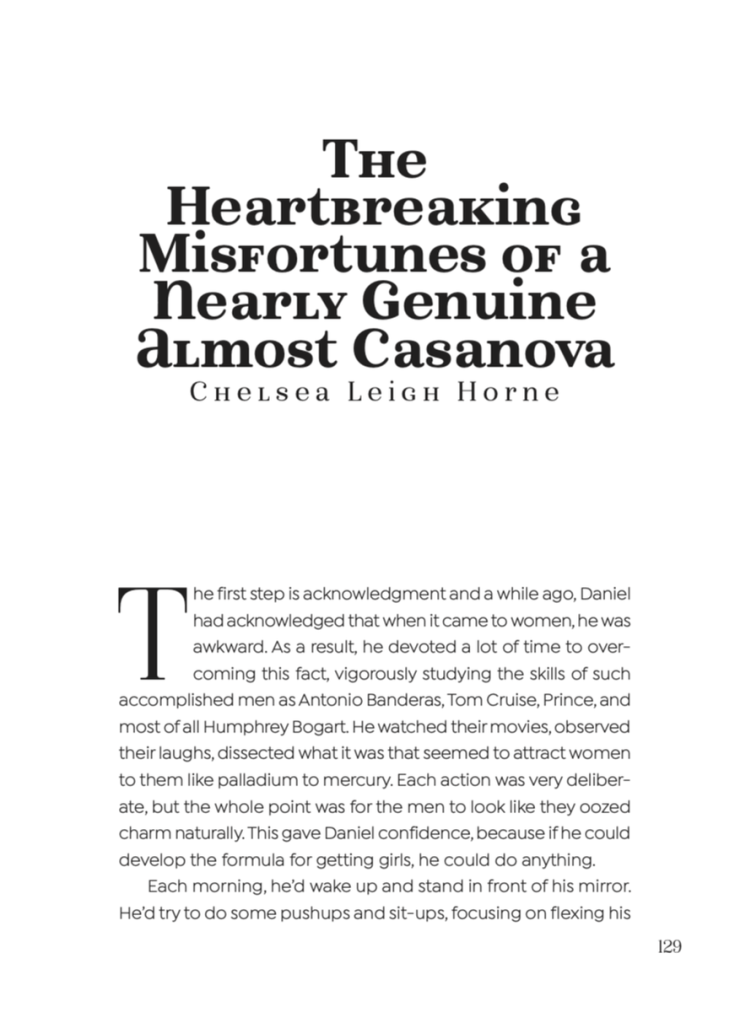
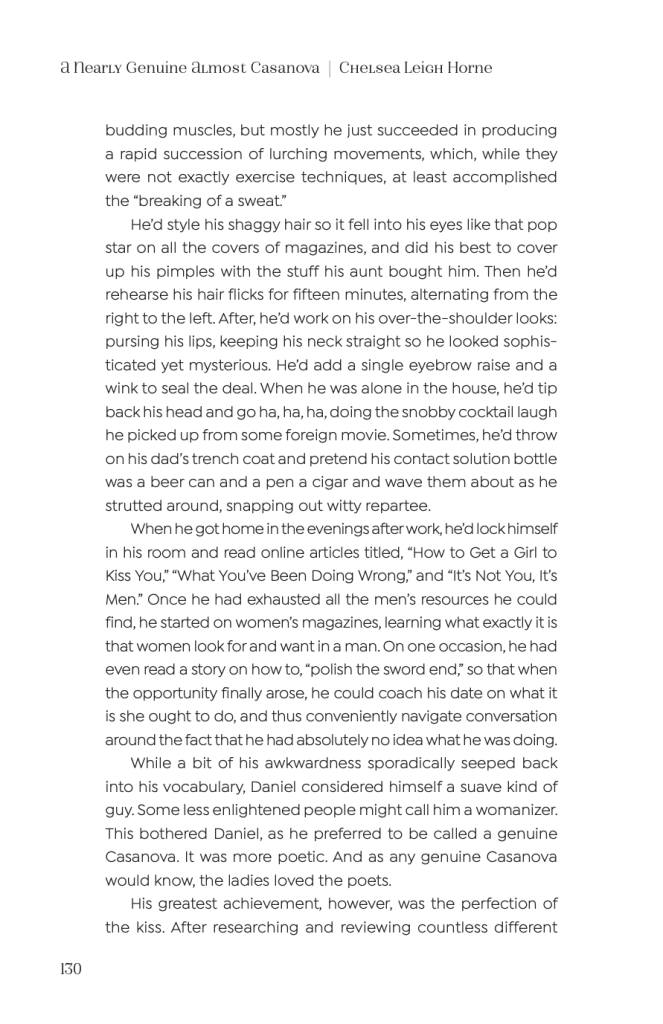
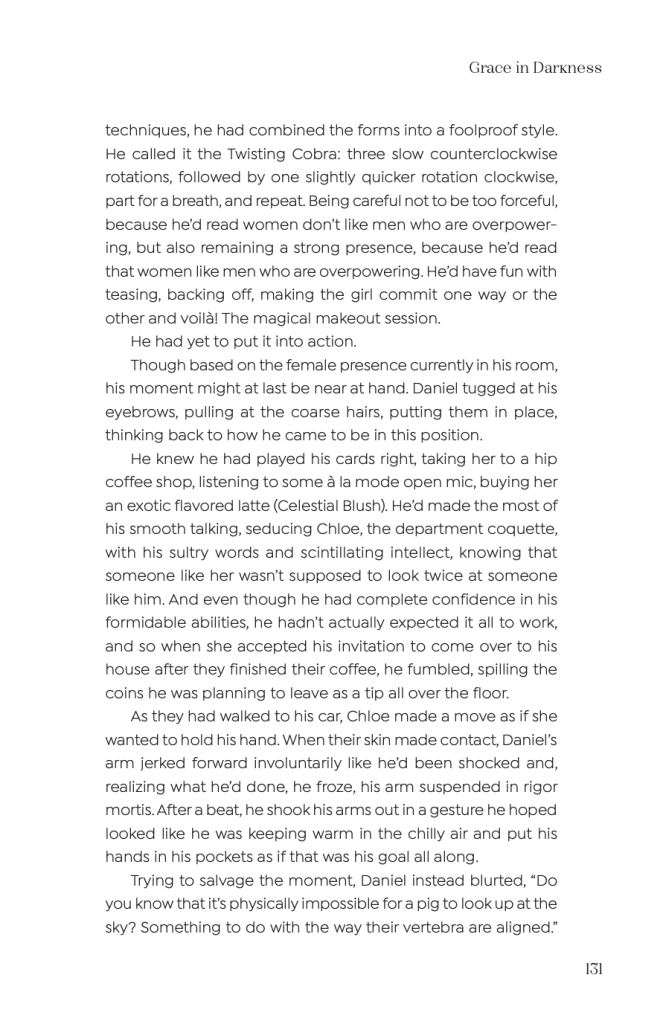
The main character in Chelsea Leigh Horne’s “The Heartbreaking Misfortunes of a Nearly Genuine Almost Casanova” has a complexity that makes me simultaneously want to smack him and also feed him Ben & Jerry’s ice cream by the pint. In this short story, Daniel has all the makings of a budding Casanova. He’s watched movies starring Humphrey Bogart, rehearsed hair flicks, and invented his own kissing technique, “The Twisting Cobra.” His one issue lies in the small detail that he has never put these practices in effect. But when he finally has a chance with long-time crush and all-around hottie Chloe, it quickly goes awry.
I’m sure we’ve all been a Daniel in some way or another. Growing up in the digital age, I experienced the perks of having all information readily accessible. I could easily plug questions into Google with a tap of my fingers. There were no more wonderings about “Is this a swollen mosquito bite or am I just dying?” or “What are the tell-tale signs of botulism and do they apply to this can of SpaghettiOs?” But ironically, the issue of growing up in the digital age was having all information readily accessible. Like Daniel, I had an ‘information is power’ type of mentality even as a child. Therefore, my attempts at a love connection would start like any school project: with research. I was convinced this ‘boyfriend-girlfriend’ thing would be a breeze with the entire internet at my disposal. To be fair, that was how I achieved such a good grade on my class presentation on the state of Wisconsin. Yet, no matter how many times I “accidentally” touched a guy’s hand, made sure my feet were always pointed at him so he knew where my priorities were, and talked about sports I had no interest in, a love connection was not meant to be.
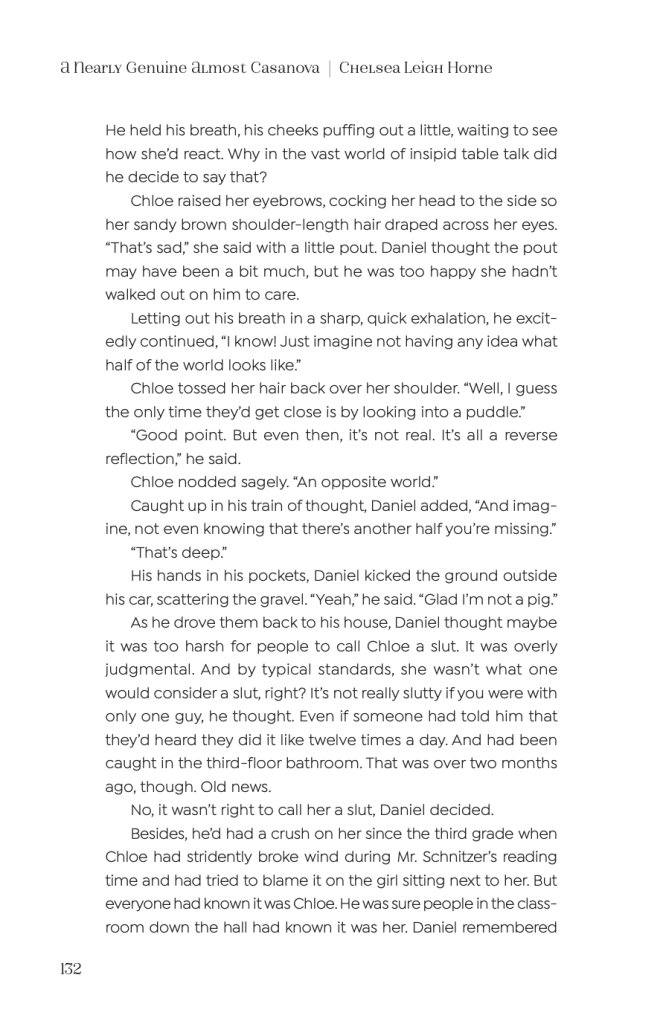
In “The Heartbreaking Misfortunes of a Nearly Genuine Almost Casanova,” something similar befalls Daniel as he begins to realize that all the information of the world is not a replacement for actual living. While Daniel has spent his time pouring over poetry books and turning himself into a gentleman women should swoon over, his preparation fails him when the first real line he says to a girl is “Do you know that it’s physically impossible for a pig to look up at the sky?” It’s a lot less suave than he hopes. There’s a reason the famous romantic line from Jerry Maguire is “You had me at ‘hello,’” and not “You had me at ‘pig anatomy.’”
Horne herself is a proponent of experiential learning. An avid traveler, Horne has led short-term study abroad programs in Ireland and England, both with a focus on literature, drama, landscapes, and culture. Clearly, she takes inspiration from the world around her and her experiences, unlike Daniel’s reliance on research. This is a lesson I think we can all benefit from: sometimes, it’s better to learn in the moment, rather than asking, as Daniel does, “What would Bogart do?”
I had the pleasure of speaking to Horne over Zoom in a much different world than when this story was originally published in 2018 (though, one can only imagine how Daniel would function now in the time of COVID-19 and FaceTime dating). As Horne explains, when visiting new places, she takes the time to “absorb an actual space, the landscape, the feel of things, and also the feel of the people.” The ability to draw on real-world experiences and feelings is what makes this story feel that much more real, and thus more relatable.
Aiding the relatability element is the ability to be in Daniel’s head. We get to witness as our main character rationalizes his failures to maintain his highly romanticized view of reality with lines like “it was theoretically improbable for her to have anything but a strong attraction to him at this point” in a moment that can only be described as him utterly striking out. Horne’s ability to create such a fun and compelling voice in this piece is something well within her wheelhouse, as a writer of many researched articles with a deeply personal spin, as seen in “Women’s Softball Needs the Olympics” in The Atlantic and “Argentines Under Siege” in Ragazine. The shared characteristic in these two texts is a narrative tied together with Horne’s own strong voice. Therefore, it’s no surprise that Daniel’s voice is similarly compelling in “The Heartbreaking Misfortunes of a Nearly Genuine Almost Casanova.” While he may not be the most reliable narrator, he’s the most entertaining.
Daniel’s voice has a way of staying with you long after finishing the piece, which can also be said of the fun facts featured in this story. A researcher herself on privacy, platform, and internet governance, Horne is full of trivia. In particular, as a professor at American University, where she also received her MFA, her research bleeds into her fiction writing because she believes “it’s important to… always impart some sort of knowledge.” In this piece, we get to hear fun facts about pigs, cream soda, physics, and more. On my first reading, one of the fun facts that jumped out the most to me was the idea that “it’s actually impossible to touch something.” This is something equally fascinating for Horne, who cited this fun fact back to a physics camp and stated she remembers being haunted by this concept and the idea that touch is just the force of atoms repelling. Commenting on it now, she stated, “So it’s kind of lonely, if you really think about it at the very atomic level.” The ideas expressed in these details add a complexity often lacking in other comedic texts, making Horne’s story fresh and unique.
But Horne makes it clear that she does not see this piece necessarily as a comedy, but rather as a story “having comedic elements.” Therefore, I think the hidden gem of this piece is the way Horne manages to break away for great moments of vivid description. Daniel happens to live in a poet’s dream setting, aka within view of the parkside cemetery. Looking at the scenery before him, we see his thoughts as he wonders “if today the old granite tombstones thirstily soaked in each drop, sucking up the water as it hit the stone.” In this moment, Daniel is not just a fan of poetry as any Casanova should be; he is a poet. Horne herself is a writer of prose poetry with three poems in the Paterson Literary Review Volumes 44 and 45. As she described, her poet side comes forward in her fiction writing mainly through intentional word choice, especially in her figurative language. These sections of description in the story allow us to break away from the humor and slip into the reality of the world.
Truly great comedic writing is more than something that provides a laugh. It allows you to think deeply about how it applies to your own life. Throughout this story, I couldn’t help but see Daniel as a manifestation of my own romantic side that I usually chalk up to watching too many rom-coms. As Horne explained to me, Daniel’s character came together because of the ongoing joke in the literary community about how male writers struggle to write realistic female characters. Therefore, as she told Grace & Gravity in 2018, she “approached the story applying [the] reverse, really emphasizing some of Daniel’s traits.” The beauty here is the balance Horne manages between the humorous and the sympathetic. Sure, it’s funny and a little cringey when Daniel tries to apply some of his research by reciting poetry in a British accent, since all research points to the fact that “women like confident men and poetry and accents.” But at the same time, his overall motivation is about as relatable as it gets. As Horne stated, “if we can find that formula that Daniel is trying to capture, wouldn’t that be lovely?” Maybe we don’t all quote Tennyson’s poetry to potential partners, but we all want that romance Tennyson would write poetry about. Reading this piece taught me to hug my inner Daniel who wants nothing more than to be loved and accepted by the world around him. Just like all of us, he may fumble occasionally, but he’s out here trying his best.
 GRACE AND GRAVITY