
4/14/2022
Eugenia SunHee Kim is an author of novels and short fiction based in the Washington, D.C. area. Raised in the DC suburb of Takoma Park, Maryland by Korean parents who immigrated to America shortly after the Pacific War, Kim went on to study Studio Art at the University of Maryland, pursuing a career in graphic design before earning an MFA in Writing and Literature at Bennington College. Currently, she teaches in the MFA Creative Writing program at Fairfield University.
Gwyneth Morgan is a writer currently based in Washington, D.C. She grew up in a tiny coastal California town where she developed an interest in quaint and quirky places that continues to inspire her writing. Starting with poems and comic strips about her childhood cat, Morgan now writes across multiple genres. Her work has been featured in multiple publications, including the BIPOC empowerment magazine LUMXN. In her free time she enjoys knitting, learning about fashion history, and creating playlists for every occasion.
Introduction to “Year of the Boar”
By Gwyneth Morgan
What drew me into Eugenia Kim’s “Year of the Boar” was its honest portrayal of mothers and daughters. Growing up, I often felt overwhelmed by the rosy images of mothers and daughters that permeated the media I consumed. Mothers were always the epicenter of emotional support for their daughters. Daughters were always dedicated to achieving their mother’s likeness, coveting fractions of her identity above anyone else’s.
Though not entirely fraught, my own experience always felt more complicated than the relationships I saw in books and on screen. My mother, having been born and raised in the Philippines, differs from me in many ways. She often struggles to understand my interests and desires which, completely shaped by my American upbringing, strays from the things she knows best, the things that shaped her own identity. These differences, however, do not divide us completely. Rather, our efforts to understand each other are the basis of our bond. In “Year of the Boar,” Kim artfully captures this disjunction of generational and cultural difference without resentment. Instead, her complicated portrayal is one full of love, even amidst the struggles that often surround it.
Kim’s first novel The Calligrapher’s Daughter was published in 2009 and won the Borders Original Voices Award. The novel was named a Best Historical Novel and Critic’s Pick by The Washington Post. A work of historical fiction, the novel follows a young woman named Najin Han as she navigates the struggle between tradition and new opportunities amidst the violence of Japanese occupation. The Calligrapher’s Daughter established Kim as a prominent authorial voice in the Korean American community, as she effortlessly blended a contemporary struggle with a historical story inspired by her mother’s own experiences. The success of the novel exemplifies the importance of diverse storytelling across genre and era.
After the success of The Calligrapher’s Daughter, Kim began another historical novel based on a true story. The Kinship of Secrets, published in 2018, follows the lives of two sisters, one in South Korea and the other in the United States as they grapple with the impact of the Korean War. The novel emphasizes the power and importance of sisterhood amidst the violence of war. The Kinship of Secrets captured, once again, Kim’s ability to illuminate the intersectional links between current experiences and history, especially as it relates to understandings of family, tradition, and the importance of forming a personal relationship with one’s culture.
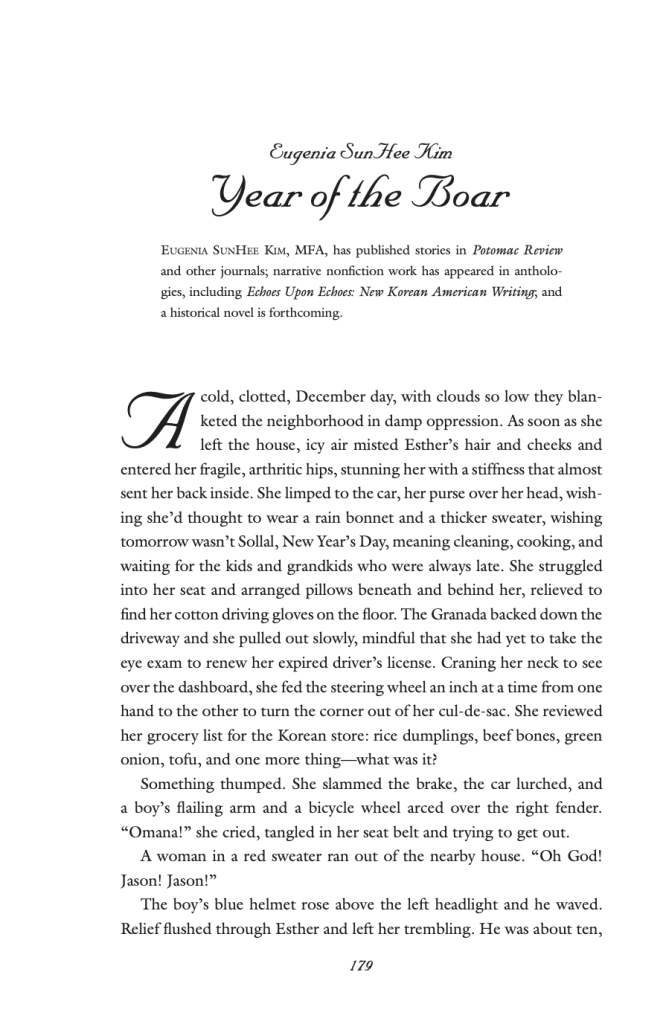
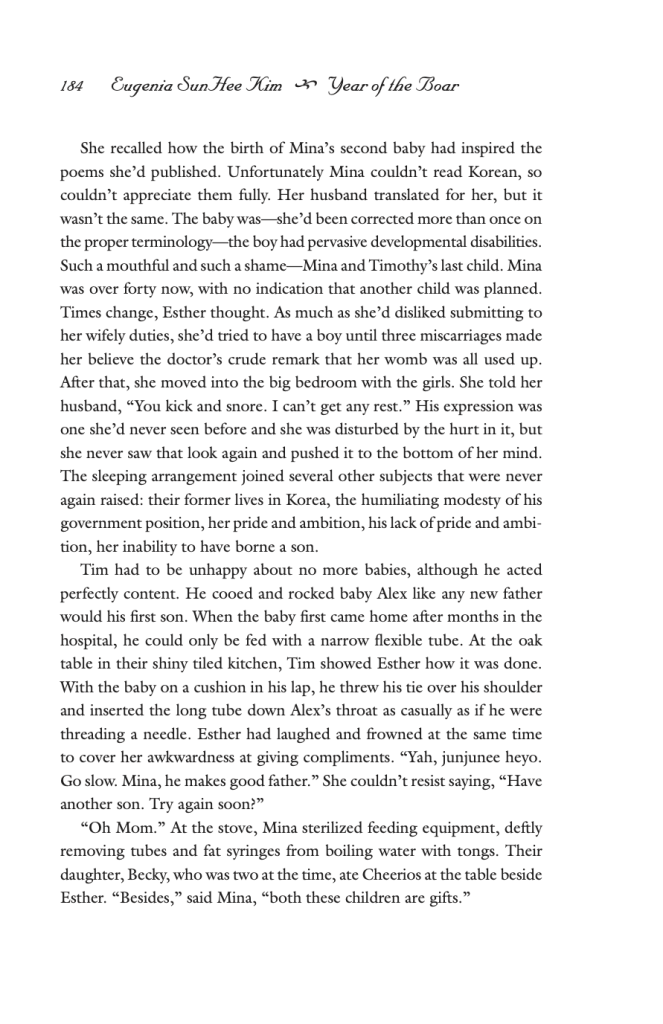
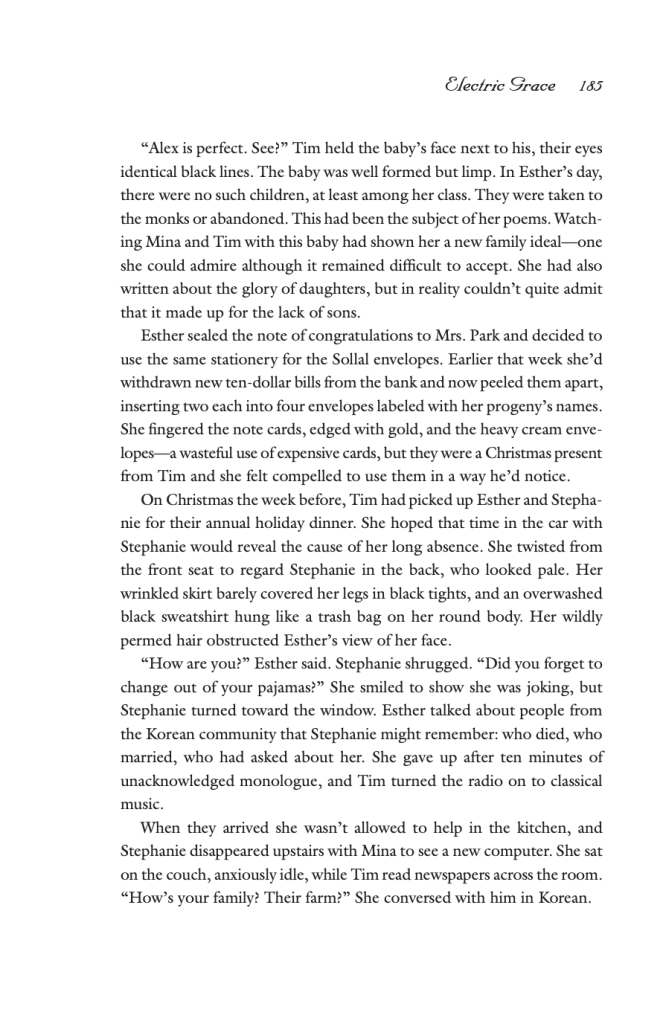
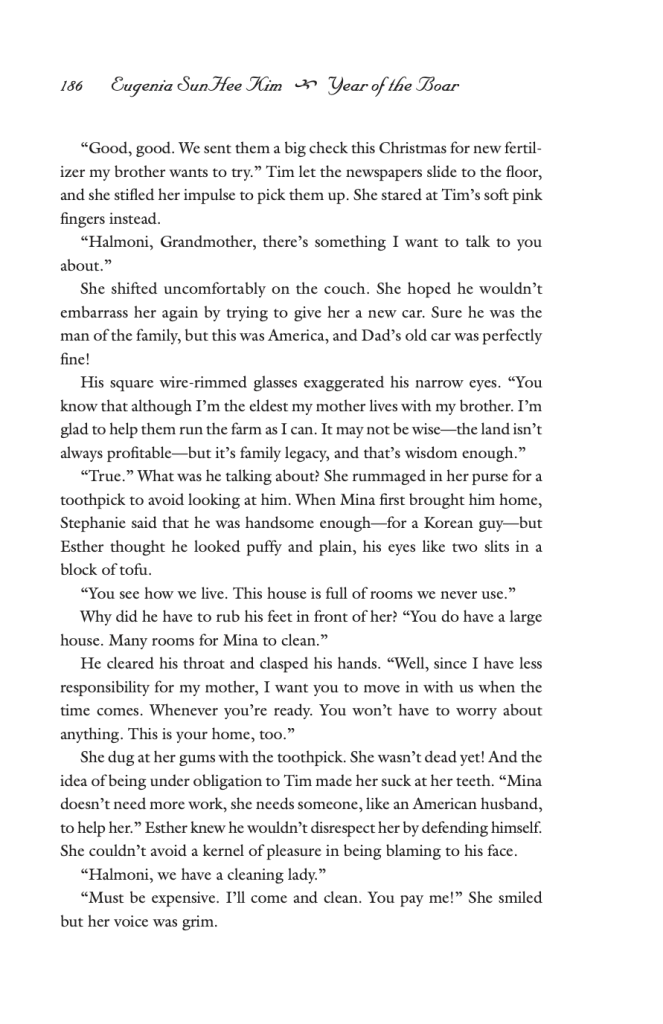
Similar themes permeate Kim’s short story “Year of the Boar” which was published in the Electric Grace volume of Grace and Gravity. The story follows Esther, an older Korean woman, as she prepares for Sollal, New Year’s Day. Poignant and compelling, Kim writes through Esther’s thoughts as she anxiously awaits the arrival of her two daughters. Widowed, only a toy poodle named Kongju keeps Esther company. Much of the story unpacks the complicated relationship between Esther and her two daughters which is troubled by a cultural divide. Esther, born and raised in Korea, expresses her love and concern for family in ways that her two daughters, who were raised in America, don’t completely understand. Their struggle to communicate their love for each other encapsulates the heart of Kim’s style, which gracefully understands the clashes between different generations as full of importance. When one unpacks these conflicts, it’s impossible to see them as meaningless or petty fighting. Instead, Kim draws our attention to these moments in a way that emphasizes the love each character has for each other, no matter how complicated.
“Year of the Boar” is imbued with complex portrayals of love and devotion. Esther fondly recalls a sweet relationship with her husband, but not without also remembering the brutality of his death. Having fallen after a heart attack, Esther remembers the failed attempt to repair a gash in her husband’s forehead in stunning detail, the flaw strikingly apparent despite all efforts to prepare him for an open-casket funeral. Kim writes, “When he was laid out for viewing, the cut was hidden beneath a line of flesh-hued putty, an unfortunate permanent ridge. Sometimes she thought about him lying in his casket…She visualized him serene – his Haband shoes, black church suit, rectangular fingernails, half-bald, round head ringed with grey, his full lips sealed in a half-smile. But this vision was disturbed by the thin rope of putty on his forehead, and she would leave thinking about him with her brow creased”.
The detail paid to this grim depiction of someone Esther loves highlights the way Kim’s work does not aim to soothe in a traditional way. Rather, the authenticity of her characters and the way they navigate their struggles internally, the memories they hold and the thoughts they have day to day, encapsulate the power of honesty. Esther remembers sweet details about her late husband as much as she remembers the morbid.
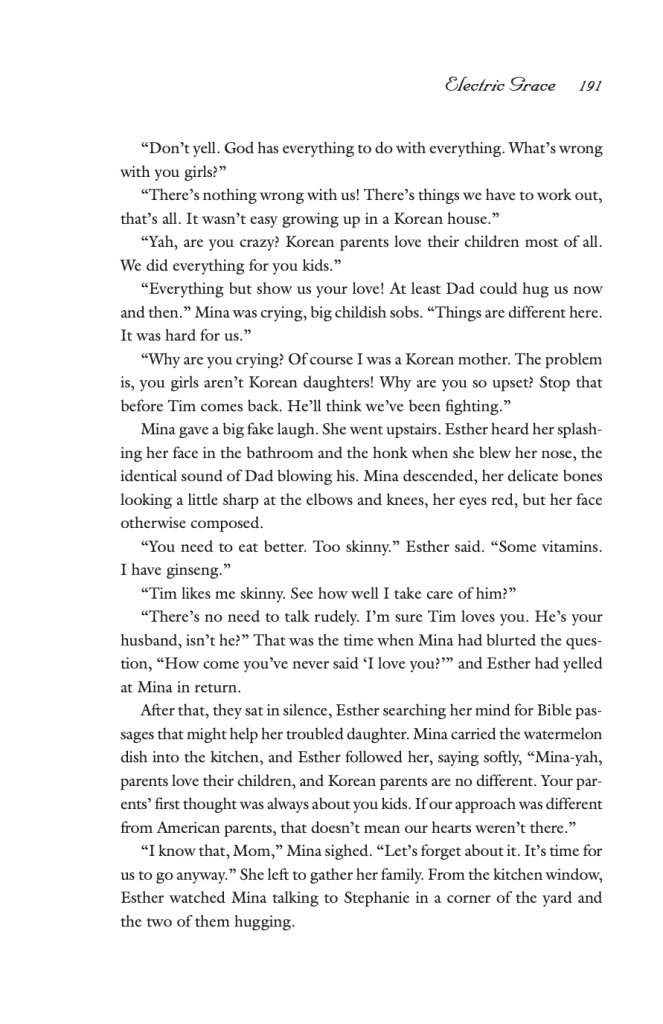
A similar vein of honesty can be followed through Kim’s depictions of Esther and her daughters’ relationship. Divided by barriers of language, culture, and generation, the women of the story struggle deeply to understand each other. At times, Esther passes judgment on her daughters. She dislikes her daughter Mina’s husband but is more concerned that her other daughter Stephanie is still single. She doesn’t understand their struggles with depression or their need for verbalized affection. However, as much as these feelings are ingrained in Esther, Kim highlights the ways effort is made to bridge the gap in understanding in ways that Esther sees fit. In conflict with her daughter Mina, Esther searches for “Bible passages that might help her troubled daughter.” Mina, on the other hand, chooses to “forget about it” instead of pushing the conflict further. No absolute resolution is reached, like most families grappling with similar struggles. But, effort is honestly shown. This honesty is a driving thematic force in the piece, and more widely, Kim’s work which, despite its confrontation of difficult pasts, presents, and futures, still uplifts the experiences of those who can relate. In a recent chat with Kim, she noted the healing power of the story in her own life. “When I wrote that, I had a really different understanding of my mother as a result, really saw her children from her point of view,” she said. “I could see her point of view in a way that I hadn’t regarded before, so it was a really helpful story for me psychologically as well.”
Though I am a Filipino American woman, Kim’s work resonates with me because of how this honesty reflects the bond I have with my mother despite our differences. When reaching the end of “Year of the Boar,” I came to realize how this dynamic unites many in a shared Asian American experience. And in this, I couldn’t help but feel surrounded by love.






 GRACE AND GRAVITY