
4/12/2022
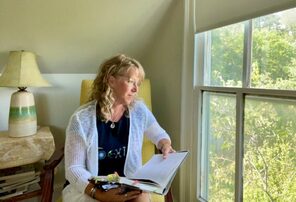
Julia Tagliere is a writer and editor and the recipient of a 2022 Maryland State Arts Council Independent Artist Award. Her work has appeared or is forthcoming in The Writer, Potomac Review, Gargoyle Magazine, Washington Independent Review of Books, SmokeLong Quarterly, WritersResist, Birdcoat Quarterly, various anthologies, and the juried photography and prose collection, Love + Lust. Winner of the 2015 William Faulkner Literary Competition for Best Short Story, the 2017 Writer’s Center Undiscovered Voices Fellowship, and the 2021 Nancy Zafris Short Story Fellowship, Julia resides in Maryland with her family, where she completed her M.A. in Writing at Johns Hopkins University. In 2019, she founded the community literary reading series MoCo Underground, to showcase the work of local writers. She serves as an editor with The Baltimore Review and is currently working on her next novel. Contact her at julia@justscribbling.com.
Abby Grifno’s work can be found tucked into different drawers around the internet, most notably in American Literature. She is an undergraduate student at American University majoring in International Studies, but with aspirations to become an English Teacher. In the fourth grade she won an essay writing contest about taking care of gerbils and has considered herself a writer ever since. Abby can be contacted via email at abigailgrifno@gmail.com and found on Instagram as @ab__solutely.
Introduction to “Control”
By Abby Grifno
When I first read “Control”, I was swept away by the imaginative ties Julia Tagliere created between technology and people. In a story of only seven pages, Tagliere creates incredibly complex characters that attempt to grapple with both the good and bad of a world embedded with technology. The world Tagliere creates is strikingly similar to our own, but with one major difference–the main protagonist doesn’t just use the technology, but becomes it. As I read the story, I knew I wanted to know more about Tagliere and how she came up with her fantastical idea, so I began my research.
Tagliere is a writer who hails from the Midwest, but now calls Montgomery County, Maryland her home. Tagliere described herself in an interview with It’s A Woman’s World as a life-long writer who initially took to writing for relaxation and as a form of catharsis. Despite her love for writing, she became a teacher of French and Spanish at the high school level after graduating college. She excelled as a mentor and coach, but always felt drawn to the art of writing. Several years later, after taking some time off teaching to care for her children, she was able to dive back into her passion. With support from her husband and family, she decided to hone in on her craft and successfully completed her Masters of Arts in Fiction from Johns Hopkins University.
Now, Tagliere is a well-regarded writer and editor. She frequently contributes to magazines and literary journals with her fiction, non-fiction, and craft pieces. She also published her debut novel, Widow Woman, in 2013. Outside of her own writing, Tagliere is a freelance multilingual writer and editor whose skills have allowed her to write on a variety of topics for business and creative purposes. Those of us in the DC area may also recognize her as the founder of the MoCo Underground Writers Showcase, which invites writers aged 16 and up to share their work with an engaged audience in Maryland. MoCo Underground invites new and veteran writers to their Zoom stage, creating a welcoming space for anyone who, like me, wants to participate more in the writing community. MoCo Underground also hosts in-person and hybrid meeting at the Sandy Spring Museum in Maryland. Aside from her work with MoCo Underground, she also serves as an editor with The Baltimore Review which showcases diverse writing from new and seasoned writers in the Baltimore area. Tagliere stays busy, but she still takes the time to develop her craft in new ways.
Tagliere’s pieces frequently discuss familial relationships, such as her piece “Color Blind” which examines the relationship between a young woman about to leave for college and her family, whom she believes fail to understand her true emotions. Another of Tagliere’s pieces, “How to Save Your Marriage Before the Elevator Reaches the Hotel Lobby,” written as a hermit crab, focuses on a woman as she contemplates cheating on her husband. In all of her pieces, Tagliere captures human emotions and real-life struggles in inventive ways by utilizing unique formats and symbolic items. While her stories feature characters who feel disconnected from their family or significant other, they often hold notes of hopefulness and the possibility of redemption. “Control” is no different in this way, but it does differentiate itself by bending genres and incorporating science fiction elements into the plot line. All of her stories explore an element of the human condition, but for those who enjoy exploring the effects of technology on relationships, “Control” will be an especially compelling read. When I connected with Tagliere, she explained how you can be “in a room crammed full of people and still feel unseen, disconnected, and terribly, terribly lonely.” She argues that technology has been a main contributor to feelings of disconnection, and her story is hoping to challenge the shallow interactions we all frequently engage in.
“Control” is a powerful story that will leave readers questioning how technology has impacted them, individually, for better and for worse. Reading the story brought me back to my own interactions with technology. Like many, I scroll through social media regularly and play Candy Crush whenever I have some time on my hands. Technology is easily intertwined with parts of our everyday lives; meetings are held online, texts are easier than phone calls, and many bond over videogames or through apps. Technology, it seems, has the ability to both connect and disconnect us. For all its greatness, reading “Control” made me wonder if I had let the technology I use get in the way of my relationships.
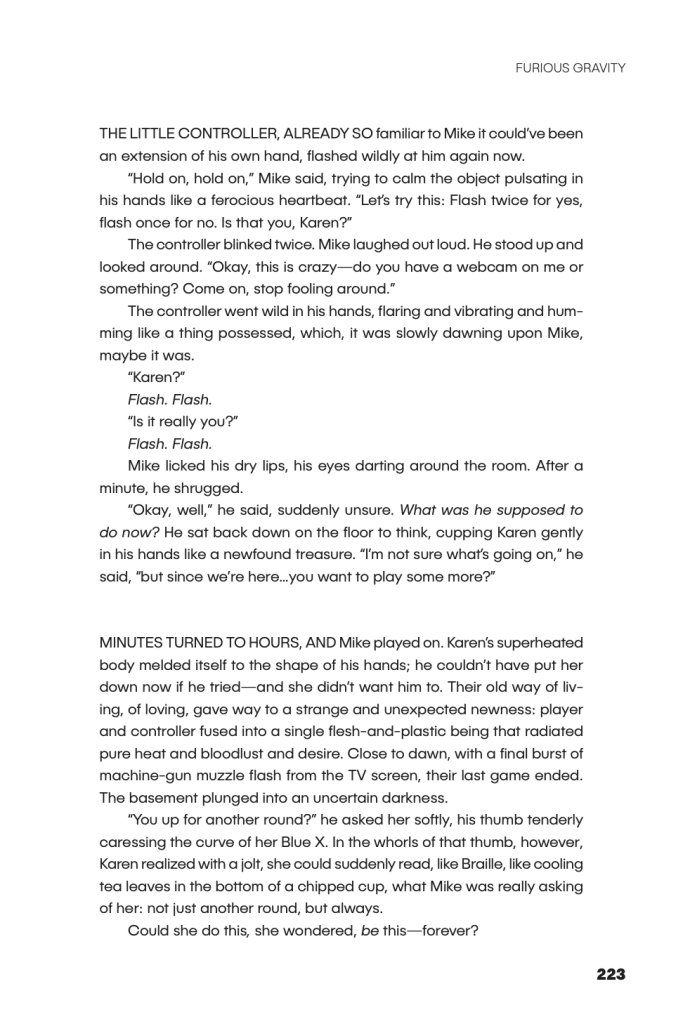
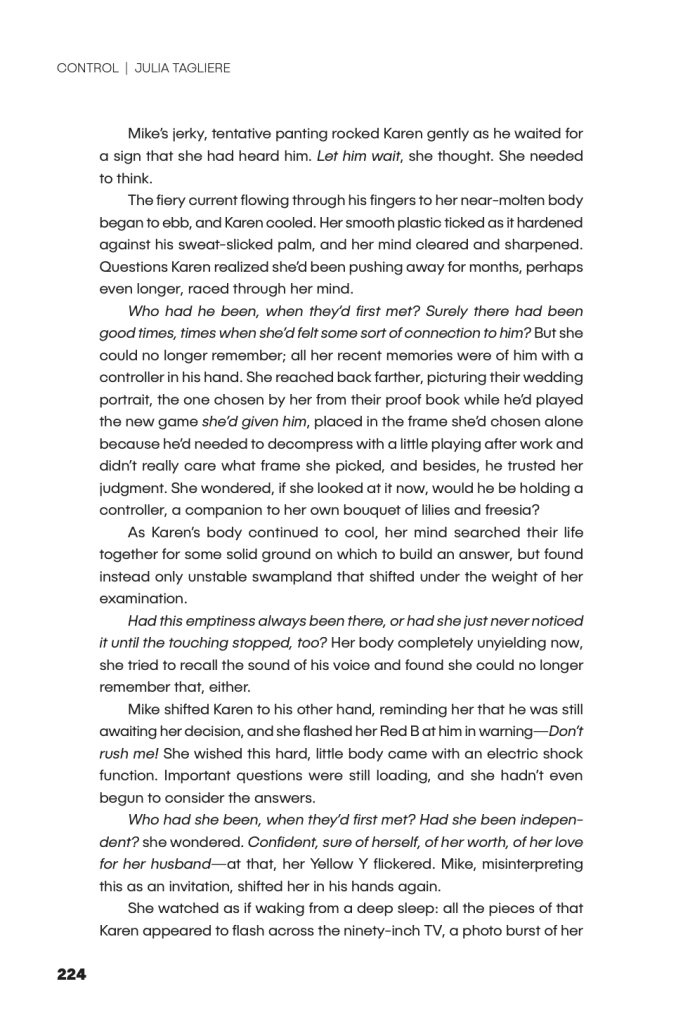
According to Tagliere, this story is fundamentally about “loneliness, about a desperate longing to connect with someone, fully and intimately.” The story follows Karen, a woman in a struggling marriage, who suddenly finds herself trapped in a video game controller. The controller is both the device that has gotten in the way of her relationship with her husband and something with the possibility of bringing them back together. Like her husband, Karen finds herself swept up into technology as well, but has to decide if the benefits outweigh the costs.
The story switches between both Karen’s perspective and that of Mike as they individually grapple with the future of their relationship. I asked Tagliere why she chose to include Mike’s perspective and Tagliere explained to me, “It was tempting to only show Karen’s perspective, but I felt that would have villainized Mike, and I just couldn’t make myself see him as a villain.” She explained, “It’s ridiculously easy for any one of us to take someone for granted, to stop seeing them, connecting with who they really are.” She hopes that by showing Mike’s perspective “people in the audience also see he’s not a villain–he’s just a human, doing human things, as we all do, and maybe that, ironically, will make it easier for them to connect to him.” This point resonated with me a lot: haven’t we all gotten distracted from what matters at one time or another? Tagliere shows us that while this may be true, it doesn’t make us any less accountable; it’s still our responsibility to make sure those we hold relationships with feel valued.
Taking place over a few short days, Tagliere uses memories and flashbacks to help Karen recount how their relationship used to be and the way it evolved over time. Karen, once turned into a video game controller, no longer has the ability to speak. Tagliere creatively takes this opportunity to use embedded dialogue, allowing the reader to understand Karen’s thought process and the rudimentary communication that is developed between Karen and Mike.
Tagliere deftly blurs the lines between fantasy and reality, leaving the reader wondering how much of the story is meant to be taken literally or metaphorically. Throughout the story, Tagliere’s diction reveals the way technology is both dangerous and seductive and that it is easy for anyone to get carried away in what it has to offer. By placing the reader into an impossible scenario, she allows us to question whether or not we too have become complicit in our use of technology and have let it get in the way of our human relationships.
I asked Tagliere what drew her to writing a science fiction piece. Tagliere describes herself as a “child of the 80s” and explained to me how she “learned early on, through movies like WarGames and The Terminator, the perils of technology running amok, and yet in [our] lifetime, millions of us have surrendered so much of our daily lives, our social interactions, our very agency, to technology.” I could easily agree with this, but I was shocked when Tagliere noted to me that there are inpatient residential treatment facilities for teen video game addiction. The idea that technology has been so helpful for some and so damaging for others makes her story all the more relevant to the current human condition. Tagliere explained that she wanted to explore these ideas in “a less terrifying way than via a computer starting a global thermonuclear war or a murderous, time-traveling cyborg trying to exterminate humankind.” Unlike the science fiction stories Tagliere just described, her piece takes on a far more subtle approach. When the protagonist enters into the controller, the reader is of course in awe, but the larger conflict of Karen’s relationship isn’t overshadowed. Human connection, or the lack of it, is ultimately at the heart of this story.
Tagliere admitted that despite her reservations toward technology she, like many of us, still has a cellphone, laptop and a few other gadgets. She did say she draws “a hard line at inviting Alexa in–she’s far too crafty.” I agree, but I’m glad I can keep up with more of Tagliere’s work on her website. Here, you can check out all of her work, but as “Control” reminds us, don’t let yourself get too swept away on the internet. You never know what might happen.



 GRACE AND GRAVITY